
To choose engineering plastic, define what your part must withstand and how it could fail. Then shortlist exact grades, review manufacturing constraints and test representative parts. Material price and room-temperature strength alone cannot establish suitability for your application.
What Information Do You Need Before Choosing A Plastic?
Start with a written application specification, rather than a favorite polymer or a generic datasheet comparison.
Describe the part’s function and its mating components. A rotating bushing needs different evidence from an electrical spacer or transparent cover.
Define failure in observable terms. Examples include leakage, binding, excessive deflection, increased backlash, cracking or loss of electrical isolation.
Record both normal operation and exceptional conditions. Cleaning, startup, storage and transport can expose the part to different environments.
| Requirement | What You Should Specify | Why It Changes Selection |
|---|---|---|
| Mechanical duty | Load, support, impact, speed and duty cycle | Stiffness, creep and wear requirements differ |
| Temperature | Continuous, peak, cycling and local hot spots | Dimensions and mechanical behavior change |
| Chemical exposure | Exact chemicals, concentration and contact time | Compatibility depends on the actual exposure |
| Moisture | Humidity, water contact and conditioning state | Dimensions and electrical behavior can shift |
| Fit and accuracy | Datums, clearances and installed condition | Thermal and moisture movement affect assembly |
| Electrical duty | Voltage, insulation, ESD or shielding requirements | These need different material properties |
| Surface requirements | Appearance, optical quality and cleanliness | Material and finishing routes must suit the surface |
| Documentation | Exact approvals, declarations and traceability | Evidence must match the grade and supply scope |
Ensinger’s material selection questionnaire provides a useful reference for preparing application requirements.
Which Requirements Should Eliminate A Material First?
Use mandatory requirements to remove unsuitable candidates before comparing cost or machining convenience.
An incompatible chemical exposure can eliminate a material despite its attractive strength. Missing grade-specific evidence can also prevent approval.
Separate essential requirements from preferences. A black color preference should not outweigh an electrical insulation requirement or a critical fit.
Next, identify the dominant engineering problem. Is your part limited by deflection, wear, temperature, chemical exposure or dimensional movement?
Shortlist several candidates when uncertainty remains. A single early choice can hide a useful tradeoff or an unavailable stock size.
Ensinger’s material selection guidance can support screening. Your final decision still needs application-specific evidence.
How Do Load And Time Affect Plastic Selection?
Choose for the load’s duration and temperature, not only the material’s short-term tensile strength.
A plastic spacer can deform gradually under sustained compression. This time-dependent behavior is called creep.
A material can survive an initial assembly test yet lose clamp load during service. Review contact area, support and retained load.
For a bracket, stiffness may control alignment before strength becomes limiting. Increasing section thickness may help, but can change space and manufacturing requirements.
For impact-loaded parts, review notches, corner radii and operating temperature. A stiffer filled grade may not solve the actual failure mode.
Use relevant long-term data where available. The engineering polymers design guide explains why stress, environment and time matter together.
How Should You Compare Temperature Ratings?
Compare thermal data against the part’s actual load, exposure time and dimensional requirements.
Melting point, glass-transition temperature, heat-deflection temperature and recommended service temperature describe different things. They are not interchangeable operating limits.
A heat-deflection result uses specified test conditions. It does not establish acceptable deflection for your particular bracket or housing.
Record local temperature as well as ambient temperature. Sliding contact, nearby electronics and process fluids can create hot spots.
Include thermal cycling and mating materials. A plastic-to-metal fit can change as the components expand differently.
For demanding duties, review PEEK, PPS or PEI grades against the complete requirement. Do not select them solely by a headline temperature.
How Do Chemicals And Moisture Change The Choice?
Evaluate the exact chemical mixture and moisture condition under the expected temperature, stress and exposure duration.
A compatibility chart is a screening tool. Your fluid may contain additives, cleaning agents or concentrations absent from the chart.
Chemical exposure and mechanical stress can interact. Testing an unloaded material coupon may not represent a stressed component.
Nylon can absorb moisture, changing dimensions and other properties. Define the conditioning state for machining, inspection and service.
For chemical-contact applications, you might evaluate PTFE, PVDF, PP, PVC or PEEK. Selection depends on the medium and mechanical duty.
Read PVDF machining and PTFE machining guidance for relevant drawing considerations.
Avoid treating chemical resistance as a pressure rating. Sealing geometry, creep, connected fittings and temperature still require review.
Which Engineering Plastics Should You Shortlist?
Shortlist materials by function, then compare exact grades within the candidate families.
The table includes engineering polymers and other plastics commonly considered for custom industrial parts. It is a screening guide, not an approval list.
| Material Family | A Useful Reason To Evaluate It | Question To Resolve |
|---|---|---|
| POM / Delrin | Precision mechanical parts and motion interfaces | Does the exact grade suit the environment and fit? |
| Nylon / PA | Tough wear parts, bushings and rollers | How will moisture conditioning affect dimensions? |
| PET | Mechanical parts needing dimensional consistency | Are the exact grade and service conditions suitable? |
| UHMW | Wear strips, guides and impact-contact parts | Can the design tolerate deflection and thermal movement? |
| PTFE | Chemical-contact, sealing and sliding interfaces | How will sustained load affect deformation? |
| PEEK | Demanding thermal, chemical and mechanical duties | Does its benefit justify cost for this application? |
| PEI / Ultem | Electrical supports and elevated-temperature duties | What grade-specific electrical and flame evidence is required? |
| PPS | Thermal and chemical technical components | How do fillers and geometry affect the application? |
| PVDF | Selected fluid-handling and chemical-contact parts | Is the exact fluid exposure compatible? |
| PC / Polycarbonate | Tough transparent covers and selected housings | Are impact, chemical and cosmetic requirements compatible? |
| PMMA / Acrylic | Clear display and appearance-critical parts | Is the design suitable for impact and stress exposure? |
| HDPE / PP / PVC | Selected fabricated and fluid-contact parts | Are stiffness, temperature and joint design adequate? |
| ABS | Selected housings, covers and development parts | Does the grade meet thermal, impact and appearance needs? |
| PAI / Torlon | Demanding loaded and wear applications | What grade, processing and conditioning requirements apply? |
For a closer mechanical comparison, see POM, Nylon, PTFE And PEEK For CNC Machining.
How Do You Choose A Plastic For Sliding Or Wear?
Select wear materials around the complete contact system, including load, speed, counterface and lubrication.
Low friction does not automatically mean long service life. A soft material may slide easily but deform under sustained contact pressure.
Record shaft material, surface roughness, alignment and operating clearance. Include dust, fluids and other contamination at the interface.
Ask whether the motion is continuous, oscillating or intermittent. Reversals and startup can change the wear pattern and heating.
POM, Nylon, UHMW, PTFE and selected high-performance grades can all deserve evaluation. Their suitability depends on the specific mechanism.
For plastic bushings, define acceptable clearance growth and inspection conditions. Test representative mating surfaces rather than unrelated samples.
What Should You Check For Electrical Or Transparent Parts?
Treat electrical, optical and appearance requirements as separate specifications, even when they occur in the same part.
An insulating polymer is not automatically ESD-safe. A conductive or static-dissipative filler can change the electrical behavior you originally needed.
Specify working voltage, insulation geometry and required evidence. Creepage, clearance and surface condition also depend on the component design.
For plastic insulators, identify the exact grade and any required flame-rating conditions. A family name does not establish approval.
For transparent parts, distinguish visibility from specified optical performance. Define scratches, haze, polished edges and viewing conditions where they matter.
Evaluate Polycarbonate and Acrylic / PMMA against impact, stress and chemical exposure.
Why Does The Exact Grade Matter More Than The Family Name?
The exact grade determines properties, processing requirements and available evidence more precisely than a polymer family name.
Unfilled, glass-filled, carbon-filled and wear-modified grades can behave differently. Fillers can alter stiffness, wear, thermal expansion and electrical properties.
Reinforced materials can also have direction-dependent behavior. Check whether your datasheet describes the stock form or process you will actually use.
Victrex’s grade portfolio distinguishes unfilled, reinforced and wear-oriented products. Those distinctions matter before ordering stock or approving an alternative.
Specify supplier designation, filler, color and stock form when they affect acceptance. Require approval before substituting another grade.
Food-contact, medical, electrical and other regulated requirements need separate evidence. Confirm the applicable conditions and finished-part responsibilities with your qualification team.
How Does Manufacturing Affect Material Selection?
Choose the grade and manufacturing route together, then review geometry, availability and dimensional stability.
For CNC machining, confirm that suitable rod, plate or block stock exists. Stock thickness and machining allowance can affect material use.
Thin walls, deep pockets and heavy stock removal may require different supports or machining sequences. Internal stress can affect the released part.
Agree the inspection state for critical dimensions. Temperature, moisture, clamping and measurement force can influence the result.
For molding, confirm a suitable resin grade and process design. A successful machined prototype does not validate every molded-part characteristic.
See CNC Machining Plastics Vs Injection Molding when comparing production routes.
Use Quality & Inspection to prepare datums, conditioning requirements and requested reports.
How Do You Validate A Material Before Production?
Validate the candidate grade using tests that represent the part’s function and its most important service risks.
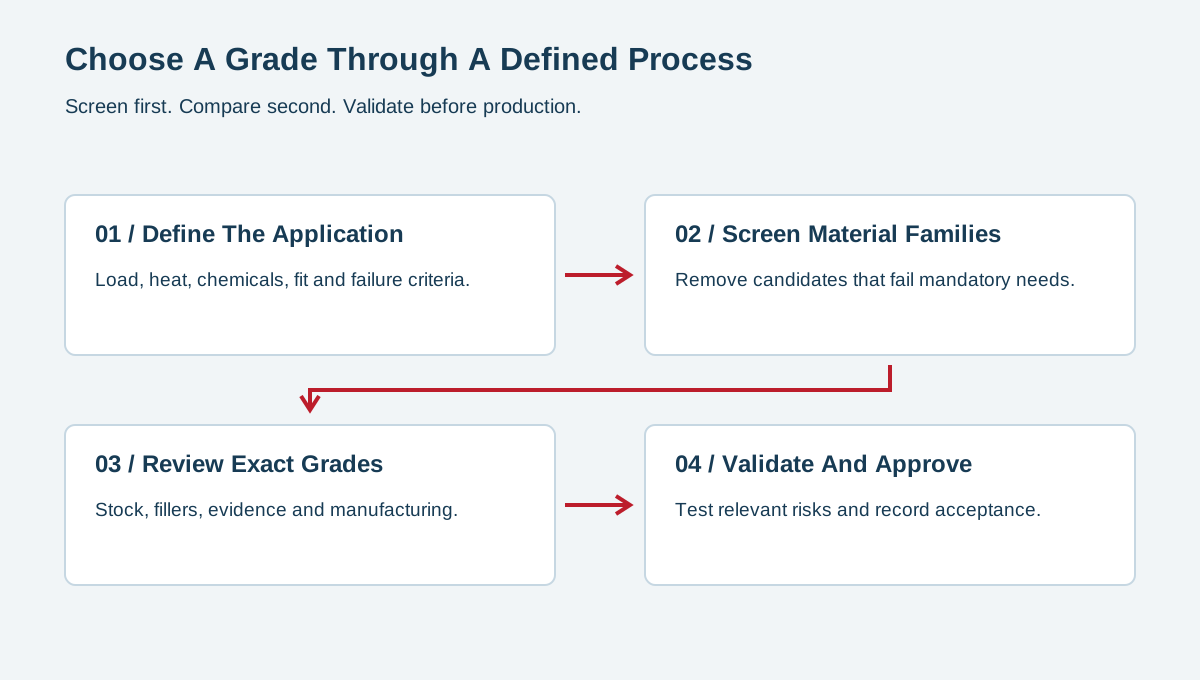
Use a staged review:
- Confirm mandatory requirements and measurable failure criteria.
- Compare grade-specific data and available stock or resin.
- Review geometry, manufacturing and inspection conditions.
- Test representative samples under relevant load and exposure.
- Record acceptance, limitations and the approved material designation.
For a loaded bushing, test the actual contact system and clearance change. For a manifold, define chemical and sealing acceptance.
Include realistic thermal or moisture conditioning when relevant. Record test duration and operating conditions so results can be interpreted correctly.
Dimensional conformity alone does not establish service life. Likewise, a supplier datasheet does not replace validation of your finished component.
These are planning examples, not TOPS customer case studies or universal test requirements.
How Can You Compare Cost Without Choosing The Wrong Material?
Compare the total cost of an acceptable part, rather than selecting the cheapest kilogram of plastic.
Include stock availability, waste, machining, finishing, inspection and required documentation. Factor in replacement effort and the consequences of failure.
A higher-performance material can be unnecessary if a simpler grade meets every requirement. Conversely, cheaper stock can increase manufacturing or service costs.
Ask suppliers to explain alternatives against the same application specification. Do not accept substitutions based only on a similar polymer name.
TOPS Plastics can review drawings for custom CNC plastic machining and agreed inspection requirements.
Confirm the exact grade, geometry and documentation before ordering. Final application qualification should follow the responsibilities agreed for your project.
Frequently Asked Questions
Engineering plastic selection works best when you match an exact grade to a defined function and validate the important risks.
What Is The Best Engineering Plastic?
There is no universally best material. Your load, temperature, chemicals, accuracy, electrical duty and manufacturing route determine the useful shortlist.
Is PEEK Always Better Than POM Or Nylon?
No. PEEK may suit demanding duties, but its added cost can be unnecessary. Compare exact grades against your actual requirements.
Should You Choose Plastic By Tensile Strength?
Tensile strength is only one screening property. Stiffness, creep, wear, temperature, moisture and geometry may control failure first.
Can You Replace Metal With The Same Plastic Geometry?
Sometimes, but direct substitution can create stiffness, creep or thermal-fit problems. Review section thickness, support, fastening and service conditions.
Does A Material Datasheet Guarantee Finished-Part Performance?
No. Datasheets describe specified test conditions. Your grade, stock form, manufacturing route and application still require appropriate review and validation.
What Should You Send For A Material Recommendation?
Send the drawing, function, load, temperature, chemicals, moisture, mating parts and failure criteria. Include quantity, documentation and manufacturing constraints.
Request A Drawing-Based Material Review
Send your drawing and operating requirements before committing to a material. Include critical fits, exact grade preferences and required evidence. Contact us for a machining feasibility review and project-specific quotation.