Nylon vs Delrin often comes down to moisture, fit and mechanical duty. Delrin can be attractive when lower moisture sensitivity supports precision interfaces. Nylon deserves evaluation for suitable tough wear components. Compare exact grades, conditioning states and operating conditions before approving either material.
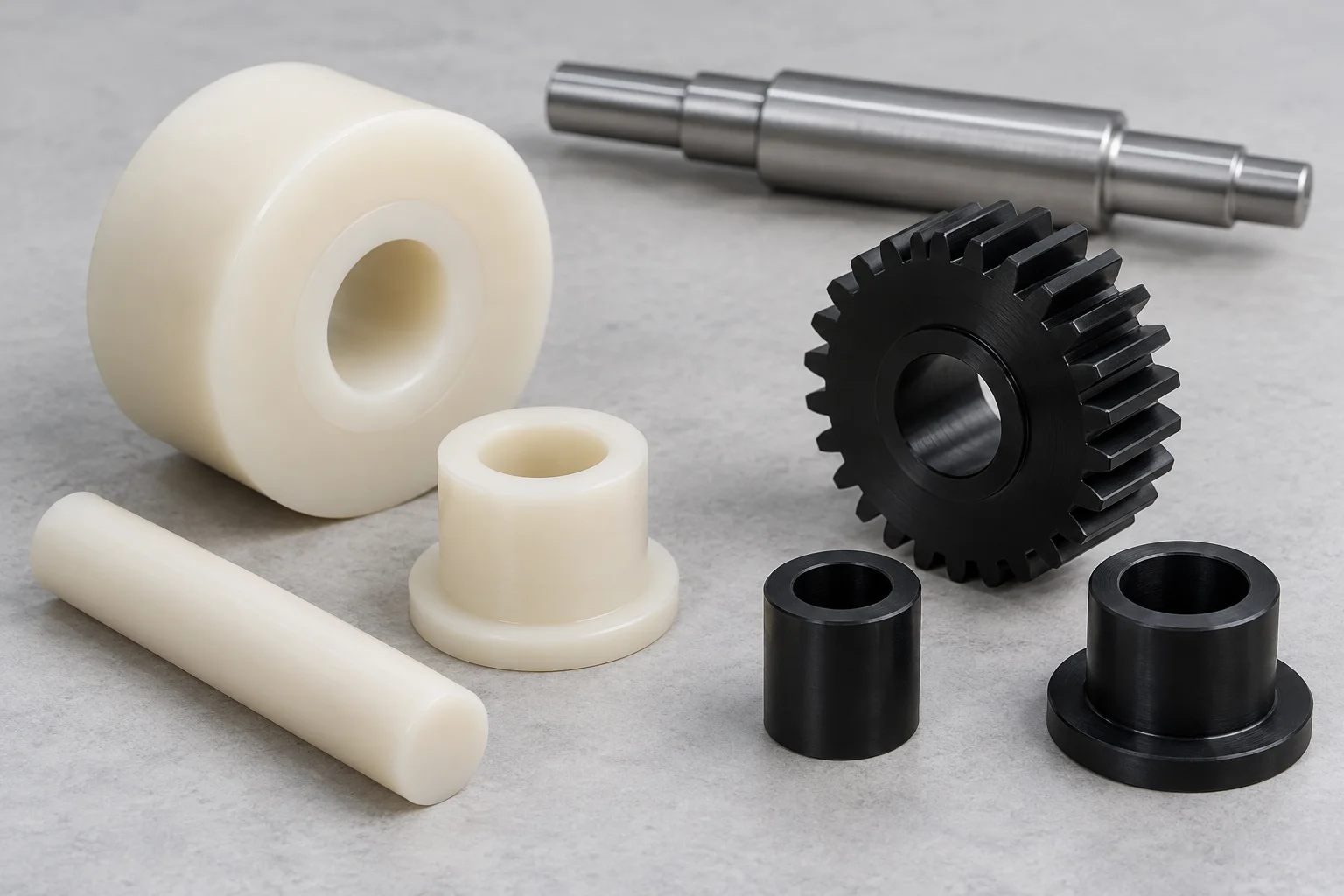
What Is The Difference Between Nylon And Delrin?
Nylon is a polyamide family; Delrin is a brand of acetal homopolymer, also called POM-H.
Nylon can mean PA6, PA66, cast PA6 or a modified grade. Those descriptions are not interchangeable specifications.
POM also includes acetal copolymers. A drawing specifying Delrin should not automatically receive an unspecified POM-C substitute.
Both families include unfilled, reinforced and wear-modified products. Specify the exact supplier grade and stock form when they affect acceptance.
| Selection Factor | Nylon | Delrin / POM-H | What You Should Check |
|---|---|---|---|
| Moisture response | Absorption can change dimensions and properties | Generally less moisture-sensitive than common PA6 / PA66 grades | Relevant grade data and conditioning state |
| Precision interfaces | Fit must account for moisture and temperature | Often worth evaluating for stable mechanical interfaces | Installed clearance and service environment |
| Wear components | Suitable grades can serve rollers, guides and bushings | Suitable grades can serve gears, rollers and bushings | Complete contact system and acceptable wear |
| Impact and loading | Toughness can be useful, depending on grade and condition | Mechanical performance remains grade-dependent | Impact, stiffness, fatigue and creep requirements |
| Manufacturing | Cast and extruded stock can differ | Exact stock grade and stress still matter | Available size, machining sequence and inspection |
| Cost | Compare delivered parts and required conditioning | Compare delivered parts against the same specification | Stock, machining, waste, inspection and service risk |
This is a screening guide, not a universal ranking or material approval.
How Does Moisture Change The Comparison?
Moisture can change Nylon’s dimensions and mechanical behavior, so compare dry and service-conditioned conditions separately.
A part that fits immediately after machining may behave differently after exposure to humid air or water.
Absorption depends on grade, environment and exposure time. Wall thickness and geometry also affect how quickly the part approaches equilibrium.
Ensinger’s dimensional stability guidance explains why moisture conditions belong in material selection.
Delrin generally offers lower moisture sensitivity than common PA6 and PA66 grades. That does not make it dimensionally unaffected by moisture or temperature.
Avoid comparing dry Nylon data with differently conditioned Delrin data. Check the test method and conditioning notes before interpreting property differences.
How Should You Specify A Close-Tolerance Nylon Part?
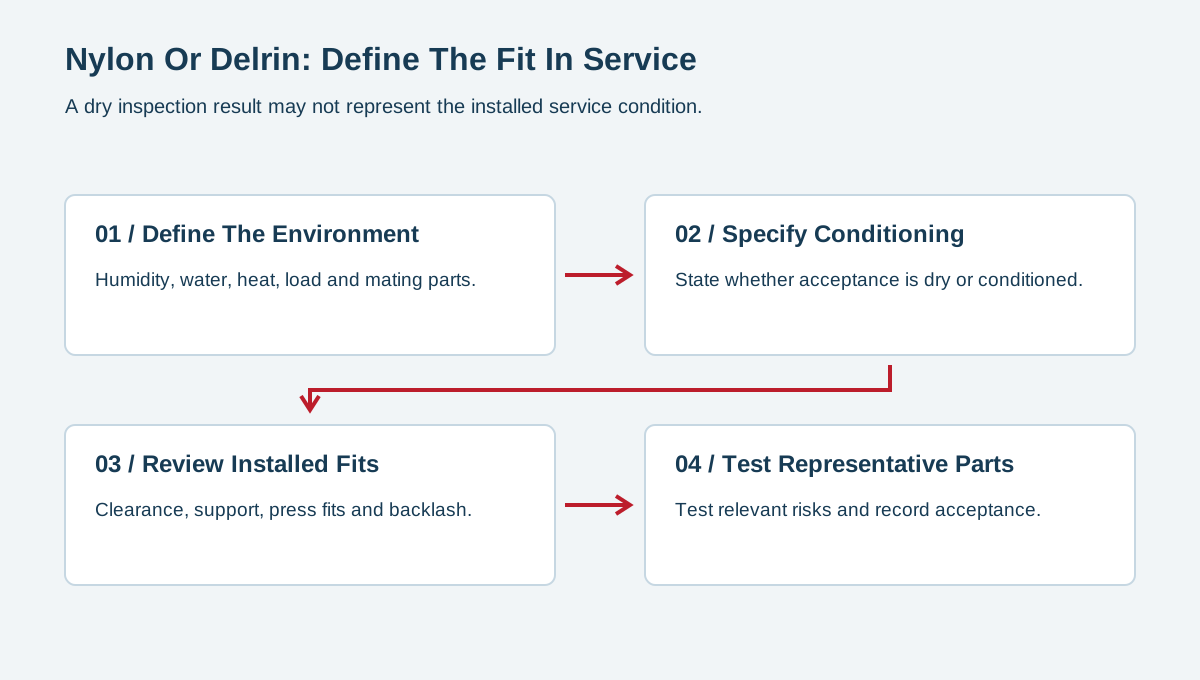
Define the material’s conditioning state and the inspection condition wherever moisture-sensitive movement could change acceptance.
Specify whether dimensions apply dry, conditioned or in the relevant service state. Agree any conditioning procedure instead of assuming one.
For a bushing, identify the released part and installed assembly requirements. Press fitting and housing constraint can change the final bore.
Do not assume every dimension changes in a predictable direction after installation. Geometry, support and moisture gradients can affect the result.
Provide shaft dimensions, housing material, temperature and allowable operating clearance. Confirm how those conditions relate to the inspection drawing.
Use Nylon machining and Quality & Inspection guidance when preparing these requirements.
When Is Delrin A Useful Starting Point?
Evaluate Delrin when lower moisture sensitivity and suitable mechanical behavior help maintain precision interfaces at an acceptable cost.
Potential candidates include gears, spacers, rollers, bushings and selected housings. The exact operating conditions decide suitability.
A precision spacer may need consistent stack height across humidity changes. Delrin can deserve early consideration for that requirement.
A small mechanism may also benefit from suitable sliding behavior and machinability. It still needs grade-specific review and validation.
Ensinger identifies low moisture absorption and machinability among POM’s useful characteristics.
For a drawing requiring Delrin, confirm POM-H rather than treating every POM grade as equivalent. See Delrin / POM machining.
When Should You Evaluate Nylon First?
Evaluate Nylon when the selected grade’s toughness, wear behavior or available stock form suits the component and environment.
Possible candidates include supported rollers, wear guides, bushings and other loaded mechanical components.
Stock form matters. A cast Nylon product and an extruded Nylon product can differ in formulation, processing and available sizes.
Assess moisture-related movement alongside the mechanical benefit. A grade that performs well in contact may still create an unacceptable fit change.
Do not describe all Nylon as stronger, tougher or more wear-resistant than all Delrin. Compare the exact grades under relevant conditions.
For plastic rollers, include bearing arrangement, runout and contact loading. Confirm the expected environment throughout service.
Which Material Is Stronger Under Load?
The useful comparison is performance under your load, time and environment, rather than one room-temperature tensile-strength value.
Distinguish strength from stiffness. A component can deflect beyond its functional limit without breaking.
Then separate static load, repeated load and impact. These require different evidence and can favor different grades.
Sustained compression can produce creep or relaxation in either material. Moisture and temperature may change the relevant behavior.
Delrin’s creep and stress-relaxation guidance identifies composition, temperature, stress and moisture as relevant variables.
For Nylon, use comparable long-term data at the relevant conditioning state. Dry-state results alone may not represent humid service.
Define acceptable deflection, retained load or alignment before choosing a material. These limits make a test result useful.
Which Is Better For Gears, Bushings And Sliding Parts?
Choose the material around the contact system, not a general claim that Nylon or Delrin always has lower wear.
| Component | Important Inputs | What To Validate |
|---|---|---|
| Gear | Torque, speed, tooth form, center distance and lubrication | Backlash, wear, noise and dimensional changes |
| Bushing | Shaft finish, load, motion and installed clearance | Wear, temperature rise and clearance growth |
| Roller | Contact load, bearing support and operating environment | Runout, deformation and contact condition |
| Wear guide | Sliding speed, support, debris and mating surface | Wear allowance and alignment over time |
| Spacer | Clamp load, contact area and temperature | Stack height and retained geometry |
Moisture-related movement can change gear engagement or bearing clearance. Frictional heating can also shift the operating condition.
Fillers and lubricating additives can alter behavior. Confirm counterface compatibility and any effects on electrical or chemical requirements.
For plastic gears and plastic bushings, test representative mating components.
Neither family guarantees dry running, zero wear or maintenance-free service.
How Do Heat, Chemicals And Water Affect Selection?
Review the exact exposure, because Nylon and Delrin do not share identical temperature or chemical limitations.
Record continuous temperature, local peaks, thermal cycling and load duration. Melting point is not an allowable service temperature.
Identify chemicals by name and concentration. Include lubricants, cleaners and maintenance exposure as well as the main process fluid.
Chemical screening data should match temperature and exposure time. Mechanical stress can also affect the application’s response.
Water exposure requires more than a corrosion question. Consider moisture uptake, dimensions, electrical behavior and the selected grade’s temperature limits.
Use the manufacturer’s Delrin design resources and the selected Nylon supplier’s grade data.
For demanding duties outside either material’s confirmed range, broaden the shortlist instead of forcing a choice between them.
How Do Nylon And Delrin Compare For CNC Machining?
Both can be CNC machined, but the grade, stock condition and component geometry determine the practical process.
Confirm stock form, machining allowance and any material conditioning requirement. Heavy removal can release stress and change dimensions.
Thin walls and slender parts need appropriate workholding. Cutting heat, burr control and support can affect the final result.
For Nylon, connect inspection to the agreed moisture state. Do not machine or measure against an unstated assumption about conditioning.
For Delrin, lower moisture sensitivity does not remove thermal expansion or residual-stress concerns.
Discuss critical tolerances feature by feature. Neither polymer name guarantees a universal machining accuracy.
TOPS Plastics can review drawing-based CNC plastic machining requirements and agreed inspection documentation.
Does Delrin Always Cost More Than Nylon?
There is no reliable universal price relationship for every grade, stock size and finished component.
Compare quotations for the exact material designation and drawing revision. Include stock availability, machining, waste, finishing and inspection.
A lower stock price can be offset by conditioning, remakes or service problems. A premium grade can also be unnecessary.
Compare the total cost of an acceptable part. Include replacement effort and downtime when they matter to your purchasing decision.
Avoid approving a substitute solely because it is cheaper or shares a broad material description.
Can You Replace Nylon With Delrin Without Redesigning?
A material swap needs review even when the replacement can match the original drawing dimensions.
Check stiffness, impact, creep, moisture movement, friction and fastening. Different behavior can change alignment or contact pressure.
Review press fits, bearing clearances, gear center distances and insert retention. The original design may depend on the selected grade’s response.
For controlled products, follow the engineering approval process. A successful dry fit does not establish equivalent service performance.
The broader engineering plastic selection guide explains how to define requirements before considering alternatives.
How Should You Validate The Final Material?
Validate exact grades using conditions that represent the part’s important service risks.
- Define load, temperature, humidity, water exposure and mating components.
- Identify measurable failure limits, including clearance, wear and deflection.
- Confirm grade designation, stock form and conditioning requirements.
- Agree machining, inspection state and representative sample testing.
- Record the approved material and drawing revision after evaluation.
For a bushing, evaluate installed clearance through relevant exposure. For a gear, include backlash and performance after conditioning.
These are planning examples, not TOPS customer case studies. Your product determines the required tests and acceptance criteria.
Dimensional conformity does not establish service life. Agree functional validation and reporting responsibilities separately before ordering.
Frequently Asked Questions
Nylon and Delrin should be compared by exact grade, conditioning state and application requirements.
Is Delrin The Same As Nylon?
No. Nylon is a polyamide family; Delrin is an acetal homopolymer brand. They have different chemistry and service behavior.
Which Absorbs More Moisture, Nylon Or Delrin?
Common PA6 and PA66 grades generally absorb more moisture than Delrin. Confirm exact grades, exposure conditions and test methods.
Is Delrin Better For Tight-Tolerance Parts?
Its lower moisture sensitivity can help some precision applications. Geometry, temperature, stress, grade and inspection conditions still determine the actual result.
Which Is Better For Gears And Bushings?
Both deserve consideration in suitable duties. Compare load, speed, lubrication, mating surfaces, humidity and acceptable wear or clearance change.
Should Nylon Always Be Inspected Dry?
No. The required inspection state should match the drawing and application. Agree dry, conditioned or relevant service-state requirements explicitly.
What Should You Include In A Nylon Vs Delrin RFQ?
Send drawings, quantities, grade preferences, operating conditions and mating geometry. Specify moisture conditioning, critical fits and required inspection documents.
Request A Drawing-Based Material And Machining Review
Send your drawing, service environment and quantities before choosing Nylon or Delrin. Identify critical fits and the moisture condition that matters. Contact us for a project-specific machining review and quotation.