Material traceability for machined plastic parts means being able to connect a delivered component or shipment to the identified stock material and the records agreed for that order. A polymer name on a quotation is only the starting point. Buyers also need a clear answer to which grade was used, which source supplied it and how the finished quantity relates to the supporting documents.
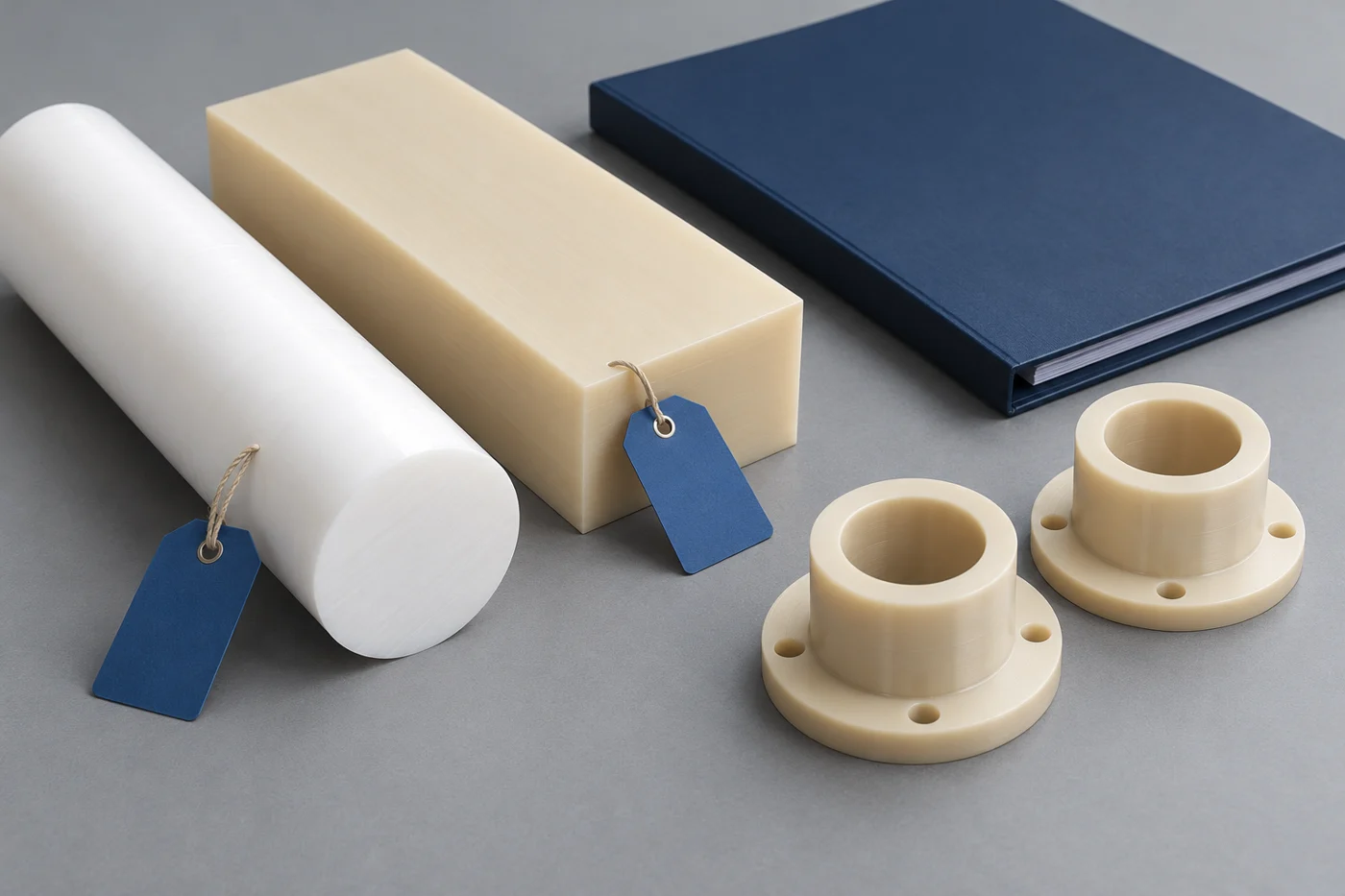
The right documentation package depends on the application and purchasing requirements. Request it before material is ordered, rather than after the finished parts arrive. This guide explains how to define useful records, review substitutions and preserve identification through machining without treating a certificate as proof of every possible performance claim.
Begin With An Exact Material Description
Specify the manufacturer and product designation when the design requires a particular stock product. Include the polymer family, grade, filler or modifier, color and stock form where relevant. If alternatives are acceptable, define the approval process instead of leaving the supplier to interpret a broad phrase such as equivalent engineering plastic.
A drawing that says PEEK does not necessarily distinguish an unfilled grade from a reinforced or modified product. Similarly, a black component is not identified by its appearance. Color, dimensions and surface finish can assist an incoming comparison, but they do not establish the material’s composition or manufacturing history.
Keep the material requirement consistent across the drawing, purchase order and quotation. If the documents disagree, resolve the difference before authorizing production. A clear precedence rule helps, but it should not become an excuse to ignore an obvious conflict between the design intent and the offered stock.
Use the engineering plastic selection guide to establish the functional shortlist first. Traceability then helps control which selected material actually enters the manufacturing route. It does not decide whether that material is suitable for the application.
Understand What Each Document Is Intended To Do
A technical data sheet describes a product through stated properties and test information. Read its notes, units and conditions. Do not assume its typical values are individual measurements from the stock used for your order, or that every listed property is a guaranteed acceptance limit for the finished component.
A supplier statement of conformity is a declaration against its stated scope. Check who issued it, what product or shipment it covers and which requirements it references. A document headed certificate is not automatically a batch test report. The content and connection to the order matter more than the title.
A batch-specific test record should identify the material or lot to which the reported results apply. If testing is required, agree the property, method, sampling and acceptance criteria in advance. Confirm whether the results concern resin, a stock shape, a test specimen or the finished machined part.
A dimensional inspection report addresses another question: whether the specified features of the component were checked against the agreed drawing and inspection plan. It can accompany material records, but it does not replace them. A part can have correct dimensions while the material identification remains unresolved.
| Document or record | Useful question it can address | What to check before accepting it |
|---|---|---|
| Product data sheet | What product properties are described? | Exact grade, revision, test conditions and stated limitations |
| Supplier conformity statement | What does the issuer declare for this supply? | Issuer, scope, order references and applicable requirements |
| Batch test record | What was tested for the identified material? | Lot connection, test method, results and acceptance basis |
| Machining and inspection record | Which work and checks relate to the parts? | Drawing revision, job identity and agreed inspection scope |
| Packing or delivery record | Which identified quantity was shipped? | Part number, quantity and links to the required lot records |
Ask For Order-Connected Evidence Early
Material manufacturers describe documentation arrangements for their own products. Ensinger’s quality assurance FAQ explains that certain material confirmations are issued in connection with an actual order and the supplied material. This is a useful reason to settle document requirements during purchasing rather than assuming any website declaration will cover a later shipment.
Ask the machining supplier to confirm availability before placing the order. Identify whether original upstream documents, a supplier declaration or additional testing is required. Some requested evidence may depend on how the stock was sourced. Clarifying this early allows the buyer to evaluate the proposed supply route before machining consumes the material.
Avoid requests such as all certificates available when a particular document is essential to release. List the deliverables and agree what happens if one cannot be obtained. A supplier’s acceptance of the purchase order should reflect the agreed documentation scope, including any exceptions that need buyer approval.
Set a document review point where appropriate. Reviewing the proposed material identity and available supporting evidence before cutting can prevent an avoidable dispute after value has been added. The timing should match the purchasing risk and schedule rather than become a routine delay with no defined decision.
Follow The Identity Through Stock Conversion
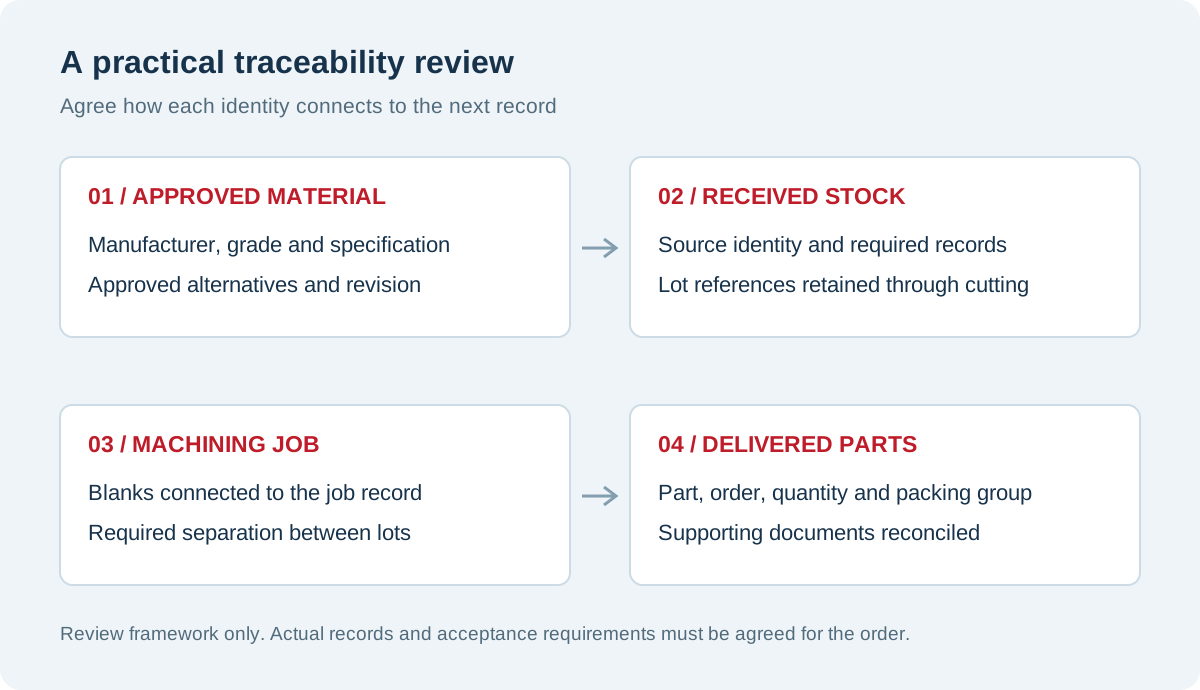
Stock arrives as rods, plates, tubes or other shapes, while the delivered items may be small components with no original manufacturer marking. The traceability question is how the source identity remains connected when material is cut, moved between operations and divided into finished quantities.
Ensinger’s stock-shape traceability example illustrates links between delivery information, semi-finished product identifiers and upstream material records. It describes that manufacturer’s chain. A machined-parts buyer should separately establish how the machining supplier connects its own jobs and shipments to the received stock.
A practical review asks how cut blanks are identified, how similar-looking materials are separated and how remnants remain usable without losing their history. Physical tags, container labels or recorded locations may form part of the method. The selected controls should remain clear when a piece is removed from its original packaging.
Small remnants deserve attention. An unlabeled offcut may look identical to the specified product, but appearance does not recover its missing origin. If retained material is proposed for a repeat order, confirm that its identity and any required records remain available before treating it as approved stock.
Decide Whether Mixed Lots Are Acceptable
A machining job may draw material from more than one stock lot. That is a purchasing decision to clarify, rather than a condition to discover only when documentation is assembled. State whether one lot is required, multiple lots are permitted or approval is necessary before combining sources in a shipment.
If multiple lots are accepted, agree the required level of separation. The buyer may need each packing group connected to its source record, while another order may require a different arrangement. The important point is that the delivered quantity can be reconciled with the agreed traceability scope.
The packaging illustration shows separate trays containing similar plastic bushings, each with its own blank identification card. It illustrates keeping groups distinct. It does not demonstrate an actual traceability system or prescribe the labeling method for a particular order.

Define how shortages, extra parts and replacements will be handled. A replacement made later may come from a new lot even when the part number and revision are unchanged. Its documents should describe that supply accurately instead of borrowing the identity of an earlier shipment.
Review Material Substitutions As A Controlled Change
A proposed substitute can differ in manufacturer, grade, filler, color or stock manufacturing route. Ask the supplier to identify the difference explicitly. A lower price or faster delivery does not establish equivalence, and a matching polymer abbreviation does not settle every functional requirement.
The design authority should review the proposed material against the application. Compare the relevant technical information, the available declarations and the required component behavior. Where evidence is incomplete, identify what evaluation or testing would be needed rather than approving the change through an informal purchasing note.
Record the approval and the affected drawing or order revision. If approval is limited to a prototype or a single shipment, make that limit visible. Otherwise, a one-time concession can unintentionally become the assumed specification for future production.
The POM-C versus POM-H comparison provides an example of why related material names deserve careful review. Family similarities do not remove the need to identify the actual offered product and the conditions relevant to the component.
Separate Material Evidence From Application Approval
A material document may concern a particular product, test specimen, condition or intended use. Read that scope before using it in an engineering release. A statement supplied for stock does not, by itself, answer every question about a finished assembly, subsequent processing or the environment in which the component will operate.
Where an application requires specific compliance evidence, have the responsible technical or quality team define the requirement and review the applicable document. State the intended exposure and processing conditions that are relevant to that review. Avoid treating broad terms such as medical plastic or food-safe plastic as complete purchasing specifications.
Mitsubishi Chemical Group’s quality information describes material traceability as part of its broader quality approach. That manufacturer’s statement is not a certification of TOPS Plastics or of a particular finished component. Keep the issuer and the object of each claim explicit when building a project file.
For dimensional evidence, use a separate quality and inspection review. Define which dimensions, surfaces and conditions need verification. Material identity, dimensional acceptance and application qualification are related tasks with different evidence needs.
Build A Usable Receiving Checklist
At receipt, compare the shipment with the order before releasing parts for assembly. Check the part number, drawing revision, quantity and package identification. Then verify that the supplied records refer to the expected material and the relevant shipment or lot, using the references agreed during purchasing.
Look for inconsistencies rather than relying on document volume. A packet containing many pages can still omit the exact grade or fail to connect a test result to the delivered items. Conversely, a concise package may be sufficient when it clearly addresses every agreed requirement.
If a reference is unclear, keep the affected quantity identifiable while seeking clarification. Do not merge it with previously accepted parts and then attempt to reconstruct the groups afterward. Record the question, the supplier’s response and the disposition so the next reviewer can understand the decision.
Archive the accepted records under a retrievable part and order reference. Agree any retention period that the project requires. File formats, access permissions and responsibility for maintaining the records deserve attention, especially when a buyer changes systems or a component is reordered after a long interval.
A Hypothetical Repeat-Order Problem
Imagine a buyer reordering beige machined bushings from an old drawing that names only the polymer family. The earlier shipment fitted correctly, but the project folder contains no exact stock designation. This is a hypothetical purchasing example, not a TOPS customer case or a claim about a particular supplier.
The useful response is to establish the current material requirement and available historical evidence. The buyer should not infer the original grade from color or assume a new candidate is identical because its nominal dimensions match. Any unresolved difference should be reviewed before the new order is released.
For future orders, the parties can record the approved designation, documentation scope and substitution process. That does not eliminate every supply risk. It gives repeat purchasing a controlled reference instead of relying on memory, an old photograph or an ambiguous description.
Put The Requirements Into Your RFQ
Send the current model and drawing with quantity and delivery needs. Include the exact material designation or the process for proposing alternatives. Identify the required material documents, inspection deliverables and whether the shipment must retain separation between stock lots.
Explain any required approval point before machining. Request written confirmation of exceptions, including unavailable upstream records or a proposed change in stock source. Compare quotations against the same documentation scope so an apparently cheaper offer is not based on omitting a release requirement.
For custom machined plastic parts, the best RFQ makes both the component and its evidence package clear. Agree what must accompany delivery, who reviews it and how an unresolved issue will be handled before production begins.
Frequently Asked Questions
Does A Data Sheet Prove Which Material Was Used?
No. A data sheet describes an identified product. The order needs a separate connection between the supplied stock, the machining job and the delivered parts. Ask how that connection is recorded and which evidence will accompany the shipment.
Is A Material Certificate The Same As A Test Report?
Not necessarily. Read the document’s scope. A declaration and a record of measured results answer different questions. If testing is required, specify the property, method and acceptance basis rather than relying on a document title.
Can Identical-Looking Plastic Parts Come From Different Grades?
Yes. Appearance alone is insufficient to establish grade or origin. Use the approved product designation and the agreed supply records. Keep accepted lots distinguishable when that separation is required by the order.
Should Every Order Require The Same Documents?
No. Match the evidence to the application and purchasing requirements. Confirm availability and scope before ordering. A detailed packet is useful only when its contents answer the questions needed to accept that particular supply.
Discuss Your Component And Documentation Needs
Send TOPS Plastics your drawing and project requirements. Include quantity, material identity, critical features and the documents needed for review. Confirm the available evidence and any proposed exceptions before placing the production order.