PEEK vs Delrin is primarily a question of service conditions and cost. Delrin often deserves consideration for economical precision mechanical parts. PEEK becomes relevant when demanding temperature, chemical or loaded-service requirements justify its premium. Choose an exact grade and validate the finished component before approving either material.
What Is The Difference Between PEEK And Delrin?
PEEK is a high-performance polymer family; Delrin is a brand of acetal homopolymer, also called POM-H.
POM includes homopolymer and copolymer materials. A drawing specifying Delrin should not automatically receive an unspecified POM copolymer substitute.
Both materials are available in multiple grades. Fillers, lubricants, colorants and stock processing can change their behavior.
For CNC parts, confirm the stock supplier’s exact designation. A resin datasheet may not describe the finished stock shape you will machine.
| Selection Factor | Delrin / POM-H | PEEK | What You Should Confirm |
|---|---|---|---|
| Main reason to evaluate | Precision mechanical parts with cost constraints | Demanding thermal, chemical or mechanical duties | Which requirement limits your application? |
| Elevated temperature | Performance depends on load, time and grade | Typically offers a broader high-temperature capability | Relevant long-term data and actual part temperature |
| Sustained loading | Creep and relaxation still need review | Can merit evaluation for demanding loaded service | Deflection and retained fit over time |
| Sliding and wear | Useful candidate for suitable motion interfaces | Selected wear grades can address demanding duty | Counterface, speed, load and lubrication |
| Chemical exposure | Compatibility depends on the chemical and conditions | Broad resistance does not mean universal resistance | Exact medium, concentration, temperature and stress |
| CNC production | Common candidate for machined mechanical parts | Higher-value stock makes waste and rework important | Stock form, geometry and inspection requirements |
| Cost decision | Often a practical starting point when requirements permit | Premium needs an application-specific justification | Total accepted-part and service cost |
This is a screening comparison. It does not replace grade-specific data or a drawing-based review.
When Is Delrin A Sensible Starting Point?
Evaluate Delrin first when your mechanical requirements can be met without a high-performance polymer premium.
Typical candidates include gears, spacers, rollers, bushings and selected housings. Suitability depends on the mechanism and operating environment.
You may value dimensional consistency, useful stiffness and sliding behavior. Those benefits still require the correct grade and design.
For a room-temperature positioning spacer, PEEK may add cost without solving an actual problem. Define the unacceptable deflection before upgrading.
Review Delrin / POM machining when preparing material specifications and critical fits.
When Should You Evaluate PEEK Instead?
Evaluate PEEK when a documented service requirement challenges Delrin’s suitability or makes its remaining risk unacceptable.
Possible triggers include demanding heat, combined chemical and mechanical exposure, or difficult loaded-service conditions.
A part near a heat source needs its actual temperature profile. Ambient room temperature may not represent the local interface.
Repeated cleaning or steam exposure can also require a different material review. Confirm the grade and complete exposure cycle separately.
PEEK is not automatic approval for every demanding application. Its grade, geometry, manufacturing history and operating conditions still matter.
See PEEK machining for drawing preparation. Confirm application requirements before accepting a material recommendation.
How Should You Compare Temperature Performance?
Compare temperature performance under the required load, exposure duration and dimensional limit, rather than comparing melting points alone.
Melting point, glass transition, heat-deflection temperature and recommended service temperature describe different properties or test conditions.
A high melting point does not establish acceptable stiffness for your loaded bracket. A short excursion also differs from continuous exposure.
Record normal temperature, local peaks, cycling and shutdown conditions. Include frictional heating where the part slides or rotates.
Compare grade-specific data under equivalent conditions. Victrex’s 450G information is an example of a specific PEEK grade, not every PEEK product.
For Delrin, consult the manufacturer’s technical resource center for the exact selected grade.
Is PEEK Stronger And More Dimensionally Stable Than Delrin?
Neither a strength value nor a stability claim determines whether your finished part will hold its required fit.
Compare unfilled grades with comparable unfilled grades first. Comparing reinforced PEEK against unfilled Delrin can hide the effect of reinforcement.
Distinguish strength from stiffness. A component can deflect too far without breaking, especially when alignment controls performance.
Then consider creep and stress relaxation. A spacer or insert support can gradually change under sustained load.
Delrin’s creep and stress relaxation guidance identifies composition, temperature, stress and moisture as relevant variables.
PEEK also requires long-term, grade-specific review. Do not treat it as immune to creep or thermal movement.
For close fits, define temperature, moisture condition and installed state. Machining stress and thin-wall support can affect either material.
Which Material Is Better For Friction And Wear?
Select the wear material around the entire contact system, rather than ranking PEEK and Delrin by one friction coefficient.
Define load, speed, duty cycle, lubrication and allowable clearance growth. Include the mating material, surface roughness and contamination.
Delrin can be a practical candidate for suitable gears, bushings and rollers. A premium PEEK grade may be unnecessary there.
Selected PEEK wear grades can deserve evaluation when temperature or contact duty becomes demanding. They need representative testing too.
A filler can change counterface wear, stiffness or electrical behavior. Confirm the precise formulation rather than requesting generic “wear-resistant PEEK.”
For plastic bushings, test realistic shafts and operating clearance. For plastic gears, include torque, backlash and tooth geometry.
Neither material should be described as universally self-lubricating or wear-free.
How Do Chemicals, Water And Cleaning Affect Selection?
Check the exact chemical, concentration, temperature, contact time and mechanical stress for both candidate grades.
A compatibility table is useful screening evidence. It may not represent your mixture, additives or cleaning sequence.
Do not replace a chemical name with a broad phrase such as “industrial cleaner.” Provide the actual product or composition.
Water exposure and cleaning cycles can affect dimensions and service behavior. Repeated hot-water or steam duty needs specific review.
Chemical resistance alone does not establish sealing performance. Creep, joint geometry, fitting loads and thermal expansion remain relevant.
For an exposed manifold or valve component, define acceptable leakage and deformation. Validate the finished assembly under representative conditions.
Is Delrin Easier And Cheaper To Machine Than PEEK?
Delrin often offers a lower-cost route, but accepted-part cost depends on geometry, stock, machining and inspection.
Both materials can be CNC machined. Neither eliminates the need to control workholding, burrs, cutting heat and dimensional movement.
PEEK stock generally makes material removal, scrap and remakes more consequential. Review whether stock size and geometry create avoidable waste.
Filled grades may change tool wear and surface requirements. An unfilled-versus-filled comparison should identify those manufacturing differences.
Ask for quotations against the same drawing revision and acceptance requirements. Include finishing, inserts, inspection reports and material documentation.
Use CNC plastic machining and Quality & Inspection guidance to prepare a comparable request.
Do not assume either material guarantees a particular tolerance. The feature, grade, geometry and measurement conditions control feasibility.
When Does PEEK’s Higher Cost Make Sense?
PEEK’s premium makes sense when its validated benefit outweighs the complete manufacturing and service cost difference.
| Project Situation | Initial Direction | Evidence Needed |
|---|---|---|
| Moderate-duty precision spacer | Evaluate Delrin | Deflection, creep and dimensional acceptance |
| Gear in a suitable mechanical environment | Evaluate Delrin and relevant grades | Torque, speed, backlash and wear testing |
| Loaded component with demanding heat | Evaluate PEEK grades | Long-term behavior at actual load and temperature |
| Chemical-contact precision part | Screen both against exact exposure | Grade compatibility and assembly validation |
| Bushing with challenging heat and wear | Evaluate appropriate wear grades | Counterface and representative duty-cycle testing |
| Qualified component with a specified grade | Follow the approved specification | Formal approval before any substitution |
Include replacement labor, downtime and qualification costs where relevant. A cheaper material can become expensive if it fails in service.
Conversely, premium stock adds little value when a lower-cost material already meets every requirement.
These are selection scenarios, not TOPS customer case studies or universal recommendations.
Can You Replace Delrin With PEEK Without Changing The Design?
A material swap needs engineering review even when the replacement can be machined to the same drawing dimensions.
Check fit, thermal expansion, stiffness, creep, friction and fastening. A dimensionally identical part may behave differently in the assembly.
Review inserts, press fits and mating surfaces. Filled grades can introduce additional changes in wear or electrical behavior.
For controlled products, confirm the specification and approval process. Never substitute a higher-priced polymer merely because it appears more capable.
The broader engineering plastic selection guide explains how to define requirements before evaluating alternatives.
How Should You Validate The Final Choice?
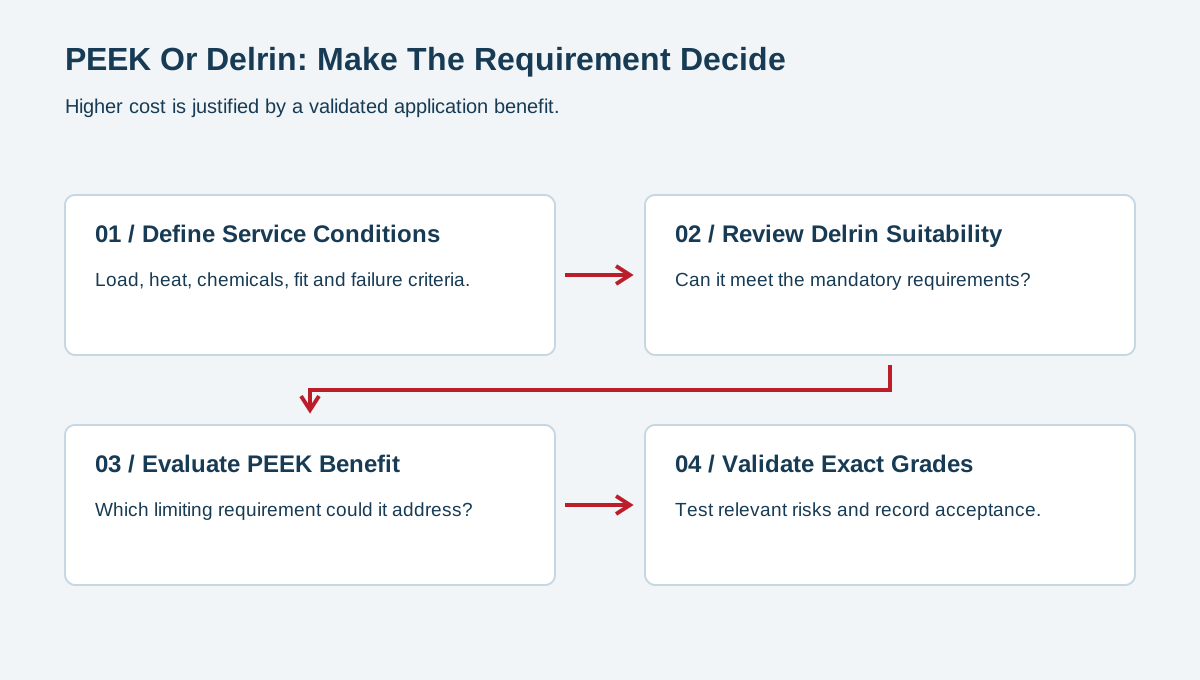
Validate the exact grade against the failure modes that matter to your component.
- Record load, temperature, chemicals, moisture, mating parts and required life.
- Identify critical fits, deformation limits and wear acceptance.
- Confirm grade designation, filler, stock form and required evidence.
- Review machining, inspection conditions and representative samples.
- Test the relevant service risks and record the approved specification.
For a bushing, measure clearance change during representative operation. For a loaded spacer, evaluate retained geometry over relevant time.
Dimensional inspection does not establish service life or chemical compatibility. Agree the separate test responsibilities before ordering.
TOPS Plastics can review drawing-based machining requirements for PEEK and Delrin/POM parts. Confirm exact grades and reporting during quotation.
Frequently Asked Questions
Choose between PEEK and Delrin using exact grades, defined operating conditions and relevant validation.
Is Delrin The Same As POM?
Delrin is a brand of acetal homopolymer, or POM-H. POM also includes copolymers, which should not be substituted automatically.
Is PEEK Always Better Than Delrin?
No. PEEK can address demanding conditions, but Delrin may meet your requirements at lower cost. Define the limiting requirement first.
Which Is Better For Gears And Bushings?
Both deserve consideration in suitable applications. Load, speed, temperature, counterface, lubrication and grade-specific wear performance determine the useful choice.
Does PEEK Guarantee Tighter Machining Tolerances?
No. Achievable tolerances depend on the feature, grade, geometry, machining plan and inspection conditions for either material.
Can You Identify PEEK Or Delrin By Color?
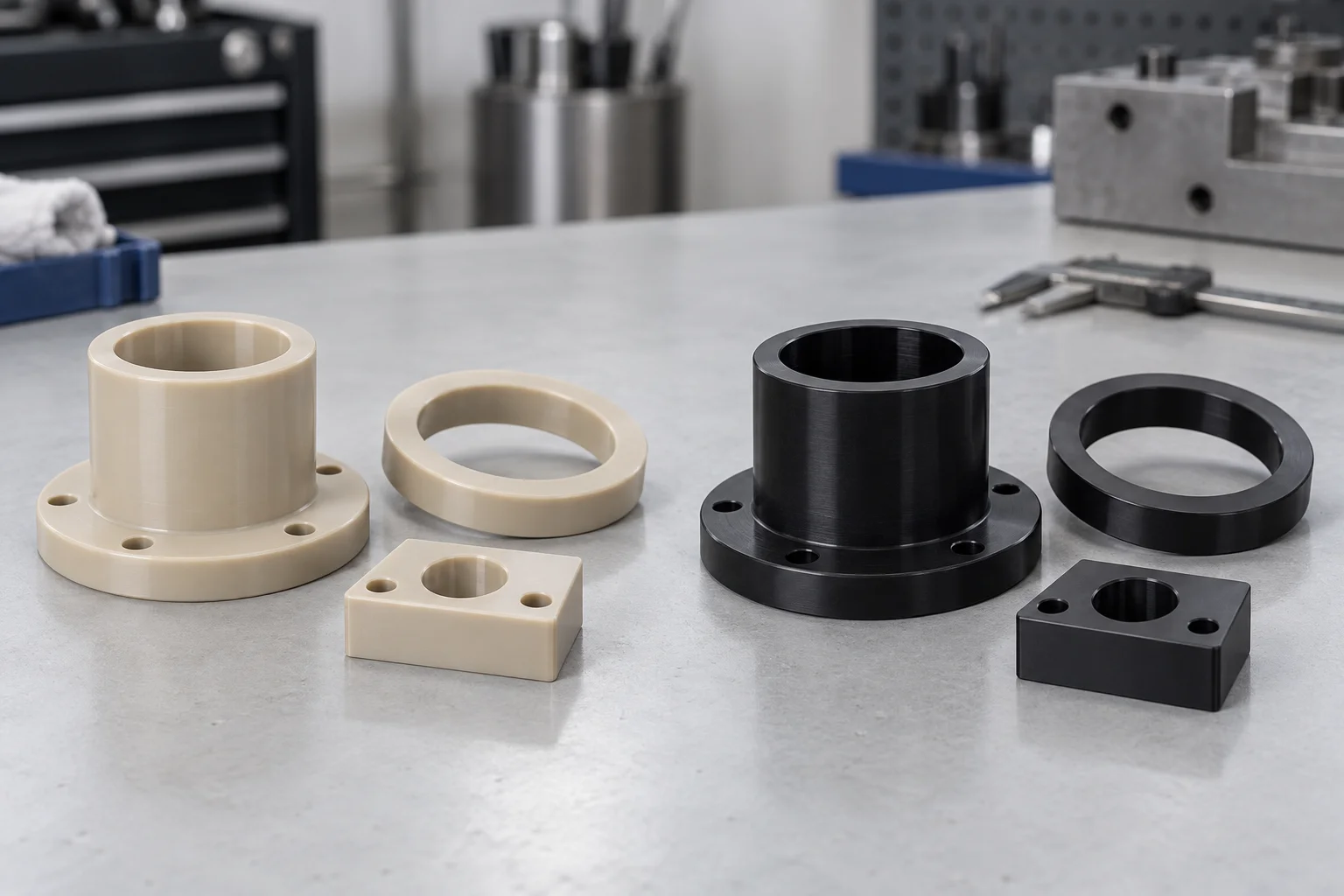
No. Color varies with grade and additives. Confirm supplier identification and documentation instead of using appearance as proof.
What Should You Include In A PEEK Vs Delrin RFQ?
Send the drawing, quantities, exact grade preferences and operating conditions. Identify critical dimensions, mating parts, inspection documents and qualification requirements.
Request A Drawing-Based Material And Machining Review
Send your drawing, service conditions and quantities before deciding between PEEK and Delrin. Identify the feature or failure risk driving selection. Contact us for a project-specific machining review and quotation.