
PTFE vs PEEK is a choice between different combinations of friction, chemical resistance, stiffness and dimensional behavior. PTFE deserves evaluation for compatible sealing and sliding duties. PEEK often merits consideration when a component must support load and retain geometry. Choose exact grades and validate the complete application.
What Is The Main Difference Between PTFE And PEEK?
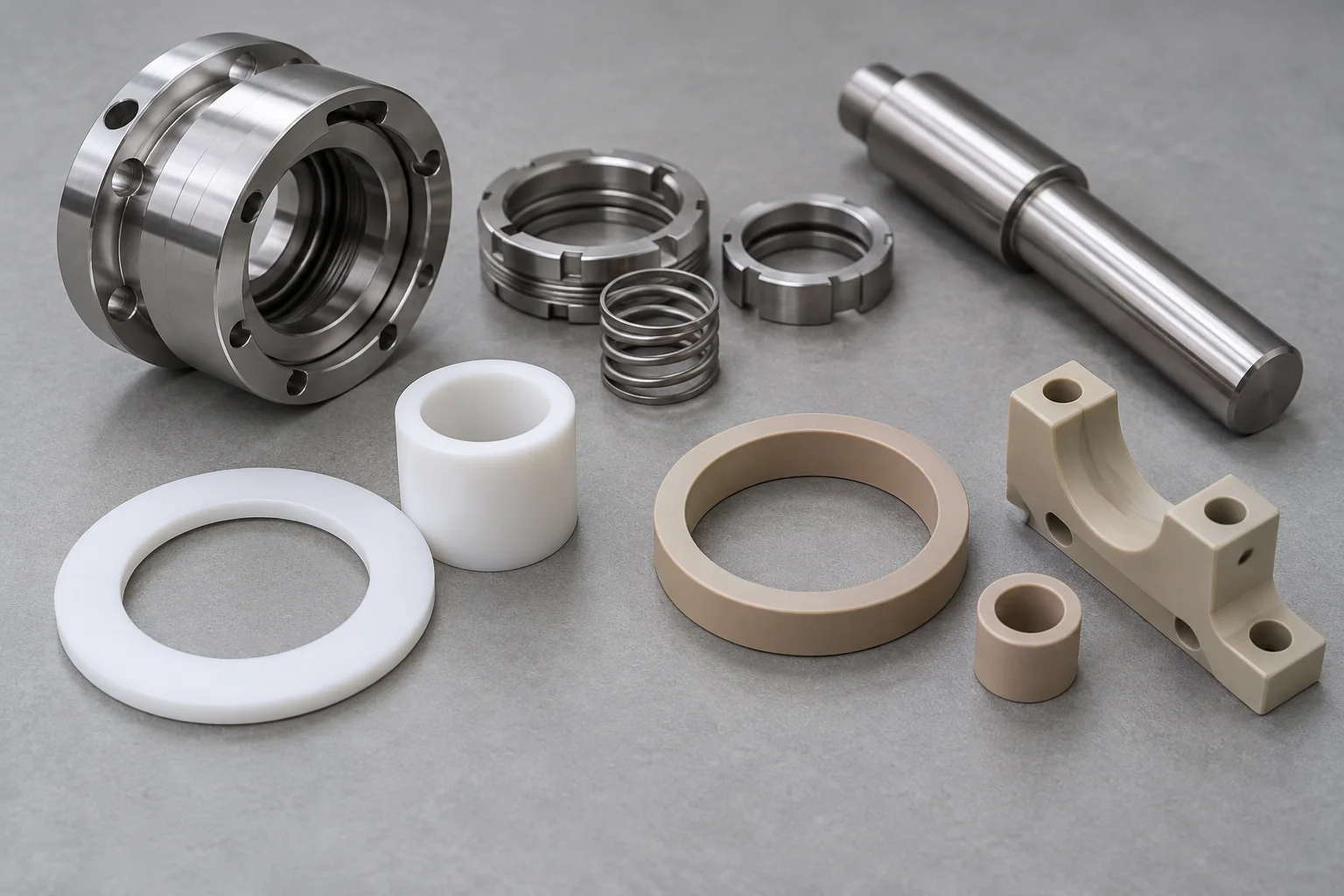
PTFE is a fluoropolymer commonly considered for low-friction and chemical-contact interfaces; PEEK is a high-performance structural thermoplastic.
Unfilled PTFE is comparatively soft and can deform under sustained pressure. PEEK generally offers greater stiffness and load-bearing capability.
That difference affects fit, support and sealing behavior. A property that helps one component conform may undermine another component’s alignment.
Both families include modified or filled grades. A comparison between virgin PTFE and reinforced PEEK includes formulation differences, not just polymer differences.
Teflon is a trademark covering several fluoropolymer products, including PTFE. Specify PTFE and the exact grade rather than relying on the brand alone.
| Decision Factor | PTFE | PEEK | What You Need To Define |
|---|---|---|---|
| Main selection reason | Compatible chemical-contact and low-friction interfaces | Demanding loaded components and stable geometry | The function that limits performance |
| Mechanical behavior | Softness and deformation need support review | Greater stiffness can help retain component shape | Load, contact area and allowable deflection |
| Sealing role | Conformability may be useful in a suitable design | May suit rigid seats or backup components | Seal geometry, pressure, temperature and leakage limits |
| Sliding role | Low friction does not guarantee low wear | Selected wear grades may suit demanding duty | Counterface, speed, load and lubrication |
| Chemical exposure | Broad resistance with grade and application limitations | Broad resistance with its own important limitations | Exact media, concentration, time and temperature |
| Precision machining | Measurement and clamping force require care | Stress, thin walls and grade still affect accuracy | Released or installed inspection condition |
| Material choice | Virgin, modified and filled grades differ | Unfilled, reinforced and wear grades differ | Exact supplier designation and evidence |
This comparison helps you shortlist materials. It does not establish a pressure rating or qualified component specification.
When Should You Evaluate PTFE First?
Evaluate PTFE when suitable chemical resistance, low friction or controlled conformability is central to the component’s function.
Potential applications include gasket elements, selected valve seats, sliding sleeves and electrical isolation components. The exact geometry and environment determine suitability.
Chemours describes lubricity and chemical resistance among the Teflon product family’s characteristic properties.
However, low surface friction does not establish bearing life. Softness does not establish a leak-tight seal either.
Review retained compression, extrusion gaps, mating finish and support. Ask how the dimensions may change after installation and sustained loading.
See PTFE machining when preparing grade details, sealing features and inspection conditions.
When Should You Evaluate PEEK First?
Evaluate PEEK when load support, dimensional retention or combined thermal and mechanical duty drives the material decision.
Candidates can include precision spacers, support rings, loaded bushings and selected pump or valve components.
A rigid backup ring has a different job from a conformable sealing element. PEEK may address support without replacing the seal itself.
Its greater stiffness does not automatically improve every assembly. Contact pressure, alignment and counterface wear can change after a material swap.
Review PEEK machining for drawing preparation. Confirm the particular grade, stock form and acceptance requirements.
How Do Creep And Cold Flow Affect Your Design?
Sustained load can change polymer geometry over time, making creep a central part of the PTFE versus PEEK comparison.
For PTFE, this behavior is often called cold flow. A compressed seal or sleeve may change shape after initial assembly.
The result depends on stress, time, temperature, support and formulation. Initial dimensions alone cannot predict retained fit or sealing force.
Modified and filled PTFE grades can change creep behavior. Chemours discusses lower creep and compression set for selected PTFE NXT products.
That does not make every modified or filled grade equivalent. Confirm the exact formulation and relevant data.
PEEK also requires creep review. Greater stiffness does not eliminate long-term deformation or relaxation under demanding loads.
Define allowable movement, retained compression and leakage before testing. Evaluate the installed assembly for a relevant time and duty cycle.
Which Is Better For Sliding, Bearings And Wear?
Compare the complete contact system rather than selecting either material from a single friction coefficient.
Specify load, speed, motion type, lubrication and permissible clearance growth. Include shaft material, surface finish, alignment and contamination.
PTFE can provide useful low-friction behavior. However, deformation or wear can still limit an unsupported contact.
Selected filled PTFE or PEEK wear grades may improve a particular duty. Their suitability depends on formulation and counterface compatibility.
Fillers can change mating-surface wear, electrical behavior or chemical suitability. Do not request a generic filled grade without identifying those consequences.
For plastic bearings, evaluate the installed clearance and actual mating surfaces. For sliding guides, include support and thermal movement.
Neither polymer family guarantees dry running, maintenance-free operation or a particular service life.
Which Offers Better Chemical Resistance?
Chemical suitability depends on the exact fluid and conditions; neither PTFE nor PEEK should be treated as universally resistant.
Record chemical identity, concentration, additives, temperature, exposure duration and mechanical stress. Include cleaners and maintenance fluids, not just process media.
PEEK has important exceptions despite broad resistance. Use the manufacturer’s chemical resistance guidance for the relevant exposure.
Do not assume a rating at one concentration or temperature applies elsewhere. A mixture may require supplier review or representative testing.
PTFE fillers can introduce compatibility limits absent from the base polymer. Confirm the compound when chemical purity or contamination matters.
For fluid-handling components, material compatibility is only one part of the review. Seals, fittings, pressure and deformation remain relevant.
How Should You Compare Temperature Performance?
Evaluate temperature together with load, time, fit and chemical exposure, rather than comparing headline temperature limits.
Melting point and heat-deflection temperature are not interchangeable service ratings. A material can retain chemical integrity while deforming too much for your application.
Record continuous temperature, short peaks and cycling. Include local frictional heating and the temperature of connected fluids.
Review the expansion difference between the polymer and its metal housing. Installed clearance or seal compression can shift during thermal cycling.
For both materials, request relevant grade-specific data. Avoid using one number to approve every seal, bearing or support geometry.
Are Virgin And Filled Grades Interchangeable?
Virgin, modified and filled grades should be compared as different material specifications, not interchangeable versions of the same name.
PTFE compounds can contain glass, carbon, bronze or other modifiers. PEEK grades can be unfilled, reinforced or designed for wear applications.
Fillers can change stiffness, creep, friction, thermal behavior and electrical properties. They can also affect machining and surface condition.
A formulation that suits a bearing may be inappropriate for an electrical insulator. Another may create unacceptable contact with the process fluid.
Specify supplier designation, filler and stock form before quotation. Require approval for substitutions.
For an application-led shortlist, see How To Choose Engineering Plastic.
How Does CNC Machining Differ Between PTFE And PEEK?
Machining plans must account for each grade’s stiffness, stress and dimensional behavior rather than copying one process between materials.
PTFE can deform under clamping or measurement pressure. Thin walls and slender features need suitable support and a defined inspection state.
A bore measured before press fitting may differ from the installed bore. State which condition controls acceptance.
PEEK also needs controlled workholding and machining sequences. Residual stress, cutting heat and filled-grade tool wear can affect the result.
Discuss tolerances feature by feature. Neither material guarantees a universal accuracy level simply because it is CNC machined.
Use Quality & Inspection to define datums, measurement conditions and reports.
If you consider molding instead, confirm the actual process. Conventional PTFE is not processed like a standard melt-injection thermoplastic.
How Do You Choose For Seals, Seats And Support Rings?
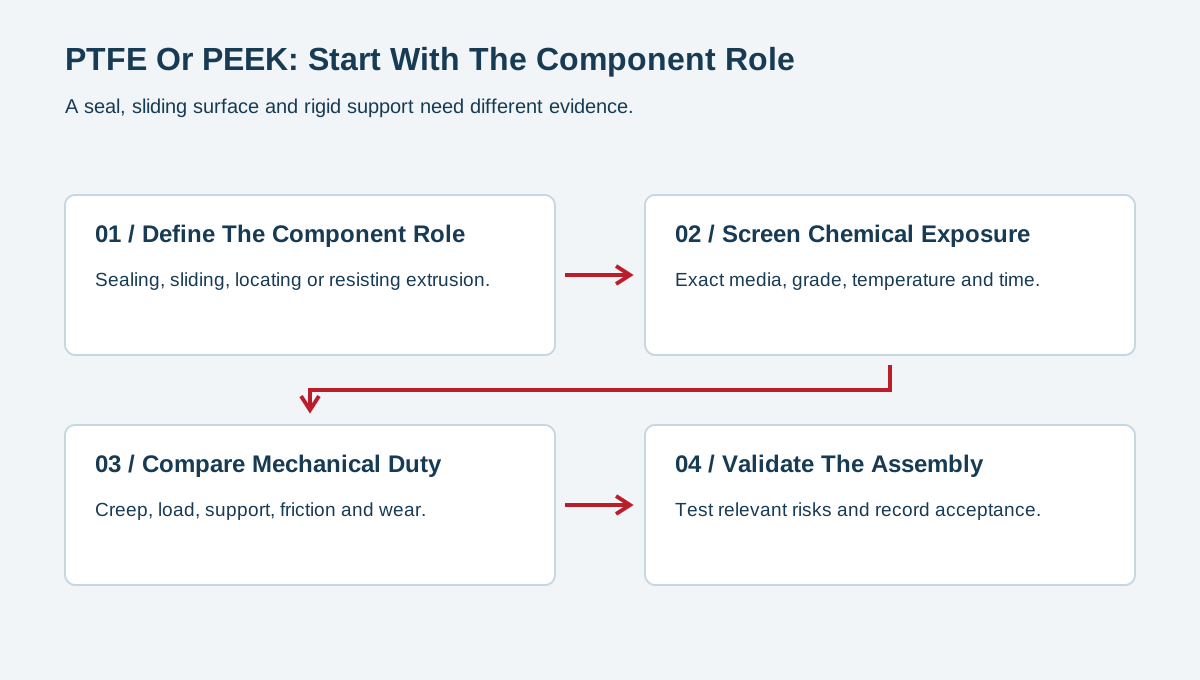
Choose by the component’s role in the assembly: sealing, sliding, locating or resisting extrusion.
| Component Role | Candidate Direction | Main Validation Question |
|---|---|---|
| Conformable gasket or sealing element | Evaluate suitable PTFE grades and seal design | Is compression retained within leakage and deformation limits? |
| Rigid backup or support ring | Evaluate suitable PEEK or other structural grades | Can it support the load and control the relevant gap? |
| Sliding sleeve or bearing | Compare suitable PTFE and PEEK wear grades | How do wear, clearance and counterface condition change? |
| Valve seat | Review both against media and seat geometry | Are leakage, contact stress and cycling acceptable? |
| Precision structural spacer | Evaluate rigidity and long-term load behavior | Will stack height and alignment remain acceptable? |
| Electrical isolation component | Compare exact insulating grades | Do electrical and mechanical requirements remain satisfied? |
These are screening directions, not qualified seal designs or TOPS customer case studies.
PTFE and PEEK can also perform different functions within one assembly. Combining them still requires a complete system review.
Can You Replace PTFE With PEEK To Increase Strength?
A stronger or stiffer replacement can fail if it removes the conformability or sliding behavior the original design needs.
Review contact pressure, mating geometry, thermal movement and assembly force. The same drawing dimensions do not ensure equivalent operation.
A PEEK seat may need a different geometry or sealing strategy. A PTFE replacement for a rigid support may deform excessively.
Compare the exact grades and installed conditions. Approve changes through the product’s engineering and qualification process.
For a related structural-material comparison, see PEEK Vs Delrin.
What Should You Compare Before Ordering Parts?
Compare total accepted-part cost and application risk, rather than selecting the cheapest stock or the most expensive polymer.
Include material use, machining, scrap, finishing, inspection and documentation. Consider replacement labor and downtime where relevant.
Use a controlled review:
- Define the function, service conditions and measurable failure criteria.
- Shortlist exact grades with relevant supplier data.
- Review support, fits, sealing features and manufacturing constraints.
- Test representative parts under relevant load, temperature and chemical exposure.
- Record the approved grade, drawing revision and acceptance requirements.
Dimensional conformity does not establish pressure capability or service life. Agree any separate functional tests and reporting responsibilities.
TOPS Plastics can review drawing-based CNC plastic machining requirements for PTFE and PEEK components.
Confirm material designation, quantities, critical tolerances and required documents during quotation. Application qualification remains project-specific.
Frequently Asked Questions
PTFE and PEEK solve different design problems, so the right choice depends on the complete application.
Is PEEK Better Than PTFE?
Not universally. PEEK can offer useful rigidity and load support; PTFE can suit compatible low-friction and conformable interfaces.
Which Material Is Better For Seals?
The seal design and service conditions decide. PTFE and PEEK may serve different sealing, seat or backup functions.
Does Low Friction Mean PTFE Has Better Wear Resistance?
No. Wear also depends on grade, load, speed, counterface, lubrication and temperature. Test the intended contact system.
Does Filled PTFE Eliminate Cold Flow?
No universal elimination should be assumed. A suitable formulation can change creep behavior, but support and operating conditions still matter.
Can PTFE And PEEK Both Be CNC Machined?
Yes, with grade-appropriate machining and inspection plans. PTFE’s softness and PEEK’s stress or filler behavior require different controls.
What Should You Include In A PTFE Vs PEEK RFQ?
Send drawings, exact grade preferences, quantities, media, pressure, temperature and load. Identify sealing geometry, critical fits and required inspection evidence.
Request A Drawing-Based Material And Machining Review
Send your component drawing and service conditions before choosing PTFE or PEEK. Identify whether sealing, sliding or structural support controls the design. Contact us for a project-specific machining review and quotation.