Compare PEEK vs PEI against your part’s temperature, chemical exposure, loading and electrical requirements. PEEK often merits screening for demanding chemical or wear conditions. PEI merits consideration for suitable structural and insulating components. Confirm the exact stock grade and acceptance plan before approving either material.
What Is The Practical Difference Between PEEK And PEI?
PEEK and PEI are different high-performance polymer families, not interchangeable versions of one material.
PEEK means polyetheretherketone and has a semi-crystalline structure. PEI means polyetherimide and is amorphous. Those distinctions influence material behavior, but your final decision still requires grade-specific evidence.
For a machined component, start with function rather than a material ranking. A sliding sleeve, electrical spacer and fluid-contact housing present different demands. Your preferred candidate should address the dominant requirement without failing the remaining checks.
List the required service conditions and drawing features together. Then ask what each candidate contributes and where it needs qualification. This produces a useful comparison instead of assuming the more expensive material is automatically better.
Are PEI, ULTEM And Machinable Stock The Same Thing?
PEI identifies a polymer family, while ULTEM identifies SABIC’s resin family and related grade designations.
SABIC’s ULTEM 1000 resin data sheet describes an unreinforced amorphous PEI resin. It supplies material information, not automatic approval for your finished machined component. Distinguish resin documentation from the stock product you actually purchase.
Ensinger’s PEI material overview describes PEI stock shapes manufactured using ULTEM resin. It also distinguishes unfilled and reinforced products. Your drawing should identify the required manufacturer and stock designation where they matter.
Apply the same discipline to PEEK. A resin name, stock supplier and modified compound can identify different parts of the supply chain. Record approved substitutions instead of accepting an undefined equivalent.
How Should You Interpret Temperature Data?
Compare the relevant loaded-service properties, rather than choosing a material from one temperature number.
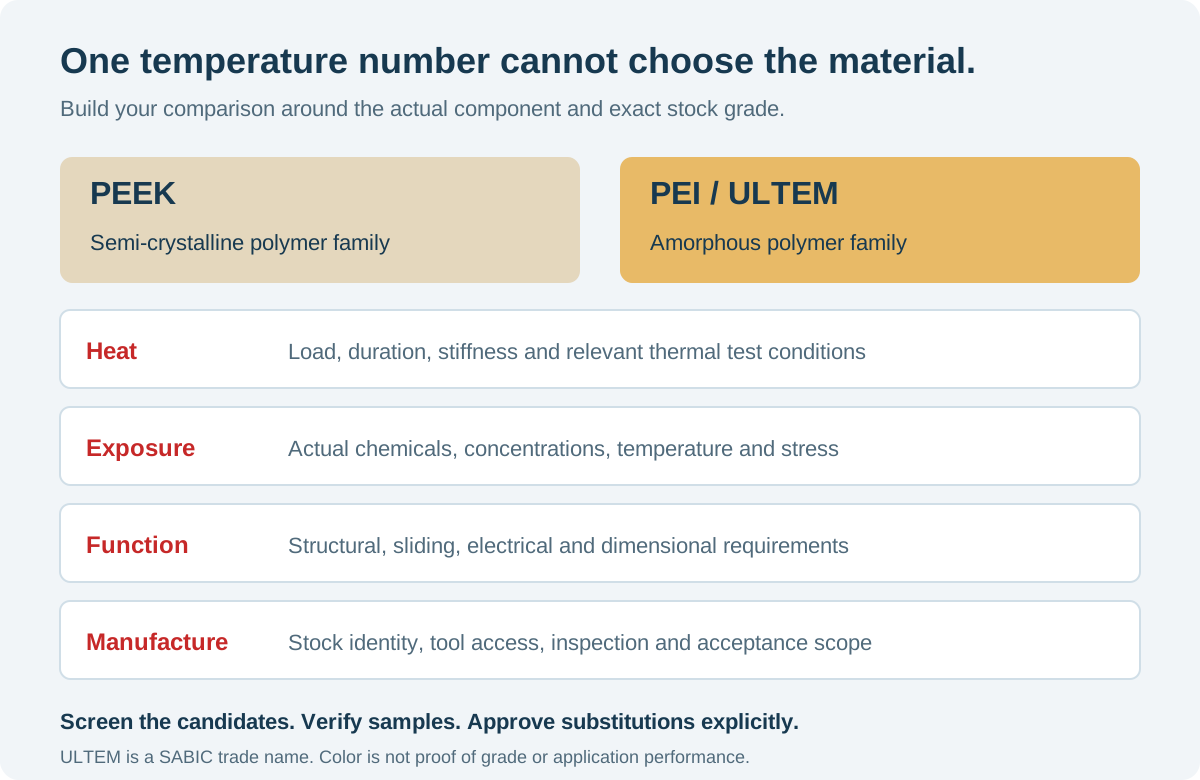
Glass transition, melting behavior, heat-deflection testing and continuous-service descriptions answer different questions. They are not interchangeable design limits. Check the test conditions and what the reported property actually represents.
PEI’s high glass-transition value does not alone prove that it outperforms PEEK at every operating temperature. PEEK’s semi-crystalline structure complicates that simple ranking. Review stiffness, deformation and chemical exposure at the conditions your component will experience.
For context, Ensinger’s PEEK overview discusses stock grades, thermal properties and application differences. Use the exact grade information when screening. Do not transfer a family-level temperature description into a guaranteed component operating limit.
Include startup, shutdown, cleaning and storage conditions where relevant. Record how long loads and temperatures persist. A brief hot exposure and sustained loaded operation need different evidence.
Which Material Fits Your Chemical Environment?
Your chemical environment must be checked against the exact PEEK or PEI grade and actual exposure conditions.
PEEK is often considered when chemical resistance drives selection. That does not mean universal compatibility. PEI can also serve compatible environments, but it should not inherit another polymer’s chemical approval.
Identify the fluid, concentration, temperature, exposure duration and mechanical stress. Include cleaning agents, process residues and unintended contact where foreseeable. A generic request for solvent resistance leaves important variables unresolved.
Use the chemical resistance guide to structure the discussion. Supplier data supports screening, while your application may need additional evaluation. Ask which evidence covers mixtures or conditions outside the published information.
Avoid approving a replacement solely because a room-temperature sample looks unchanged. Appearance is only one observation. Your functional dimensions and required material performance must remain acceptable under the agreed conditions.
How Do Sustained Loads And Wear Change The Choice?
Sustained loading and sliding contact require a different comparison from a short mechanical strength test.
For a structural support, identify the load direction, duration and permitted movement. For a sliding part, add mating material, speed, contact conditions and wear acceptance. These inputs determine which grade deserves evaluation.
A strong short-term test value does not establish long-term dimensional stability. Review the creep and stress-relaxation guide when loading persists. Your material specialist should identify relevant data at the actual temperature.
For wear service, compare purpose-designed formulations where appropriate. Do not assume unfilled PEEK, bearing-grade PEEK and glass-filled PEI behave alike. The best structural candidate may not be the best contact material for the mating surface.
Your prototype plan should test the intended function, not simply whether the component survives initial assembly. Record permitted wear, movement or fit change. Use those requirements to judge candidate materials consistently.
What About Electrical Performance And Appearance?
Specify electrical and appearance requirements separately from the basic PEEK versus PEI family comparison.
Both families include products considered for electrical applications. Your required property, conditions and test method determine suitability. Do not use an insulating grade’s approval for a conductive or dissipative formulation.
For an electrical support, define the voltage-related requirements, geometry and relevant environment through your responsible design team. Material data alone does not qualify the equipment. Avoid treating color as evidence of insulation or static-control behavior.
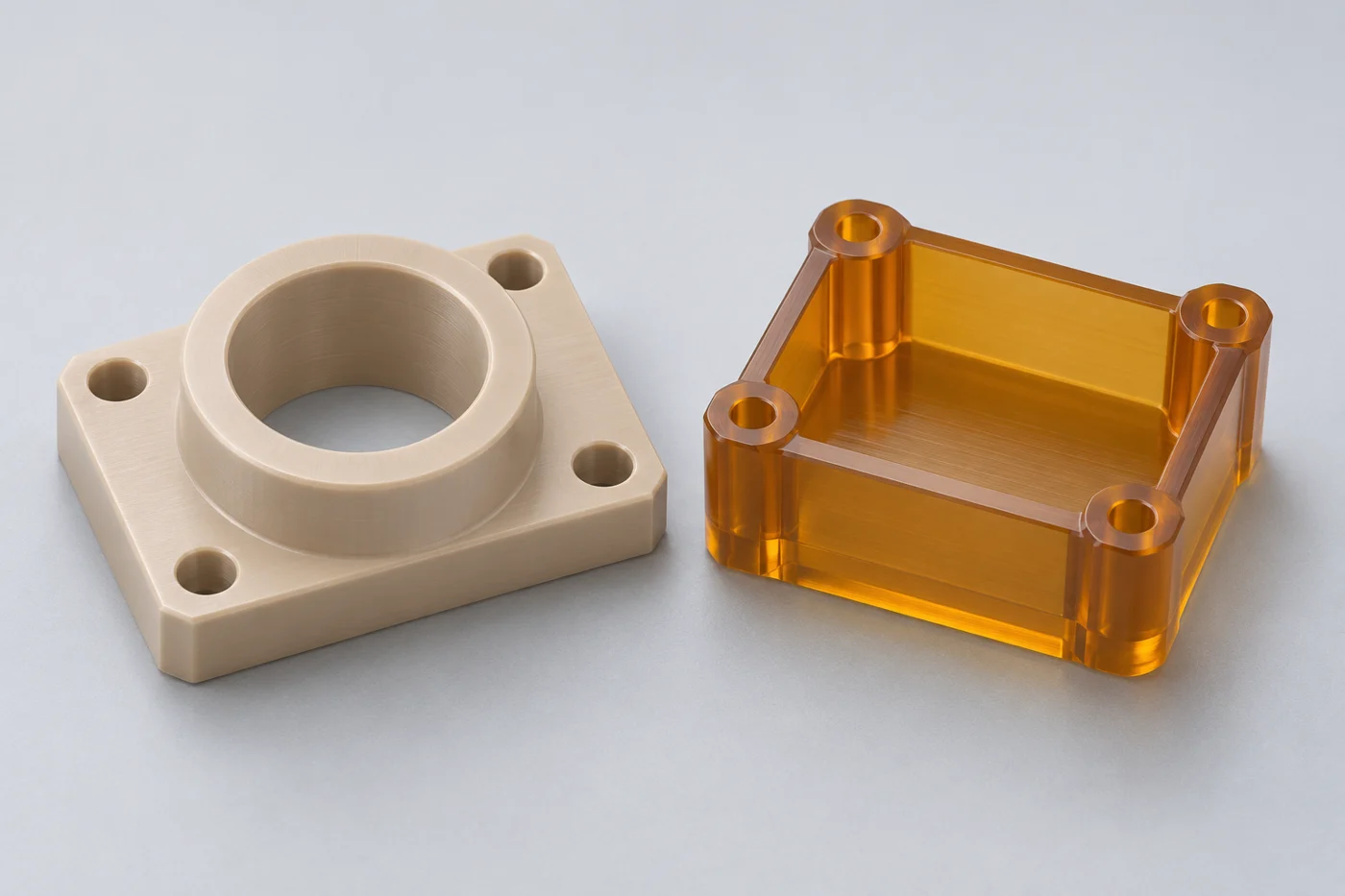
Unfilled PEI stock can have an amber translucent appearance, while natural PEEK is typically opaque. Those visual differences may matter for your design. They do not identify the supplied grade reliably or establish an optical acceptance standard.
The component illustration shows contrasting shapes and colors for discussion. It is not proof of material identity or tested performance. Use your material records and defined appearance criteria for acceptance.
Which Applications And Processes Should You Compare?
Compare candidate materials against a defined component function and a feasible machining route.
The table gives screening questions, not preapproved material recipes. Your final choice depends on grade, geometry and service requirements. Another polymer may remain a better candidate after review.
| Component Function | Machining Route To Review | PEEK Screening Question | PEI Screening Question |
|---|---|---|---|
| Electrical spacer or support | Turning, drilling or milling | Does its grade meet the full electrical and thermal need? | Can the specified PEI grade meet those conditions? |
| Sliding sleeve or guide | Turning or milling | Is a suitable wear formulation justified? | Is the proposed grade supported by relevant contact evidence? |
| Fluid-contact component | Milling, drilling and boring | Is compatibility established for the actual exposure? | Does its exact chemical envelope cover your process? |
| Structural fixture | Milling and boring | Are the additional properties needed for the task? | Can it meet loading, dimensions and exposure requirements? |
| Housing or bracket | Milling and multi-face operations | Does the application justify this stock and process? | Are mounting, temperature and appearance requirements acceptable? |
For each row, identify the feature most likely to cause rejection. It might be a bore, pocket, mounting face or electrical interface. That helps you focus the material and process review.
What Geometry Helps CNC Machining?
Your geometry should allow tool access, effective support and inspection of the functional features.
Show the supplier all relevant mating surfaces and assembly relationships. Mark critical datums and acceptance conditions on the controlled drawing. Do not expect a model alone to communicate every functional requirement.
Review these design points before requesting final prices:
- Provide practical internal radii where the function permits them.
- Identify thin walls and unsupported features early.
- Define threaded connections and required engagement details.
- Separate cosmetic faces from precision mating surfaces.
- Mark pocket intersections requiring edge inspection.
- Agree how released dimensions will be evaluated.
The plastic pocket design guide explains relevant access and remaining-material questions. Apply those questions to the selected stock grade. Neither PEEK nor PEI removes the need for a workable component design.
How Should You Compare Filled And Unfilled Grades?
Treat reinforced, wear-modified and electrically modified grades as separate candidates with their own evidence requirements.
Reinforcement can change stiffness, dimensional behavior and machining considerations. It can also affect mating-surface interactions or electrical properties. A favorable change in one property does not establish overall equivalence.
Use the reinforced plastics machining guide when reviewing those options. Identify the filler and stock designation explicitly. Confirm that the quoted material matches your approved candidate.
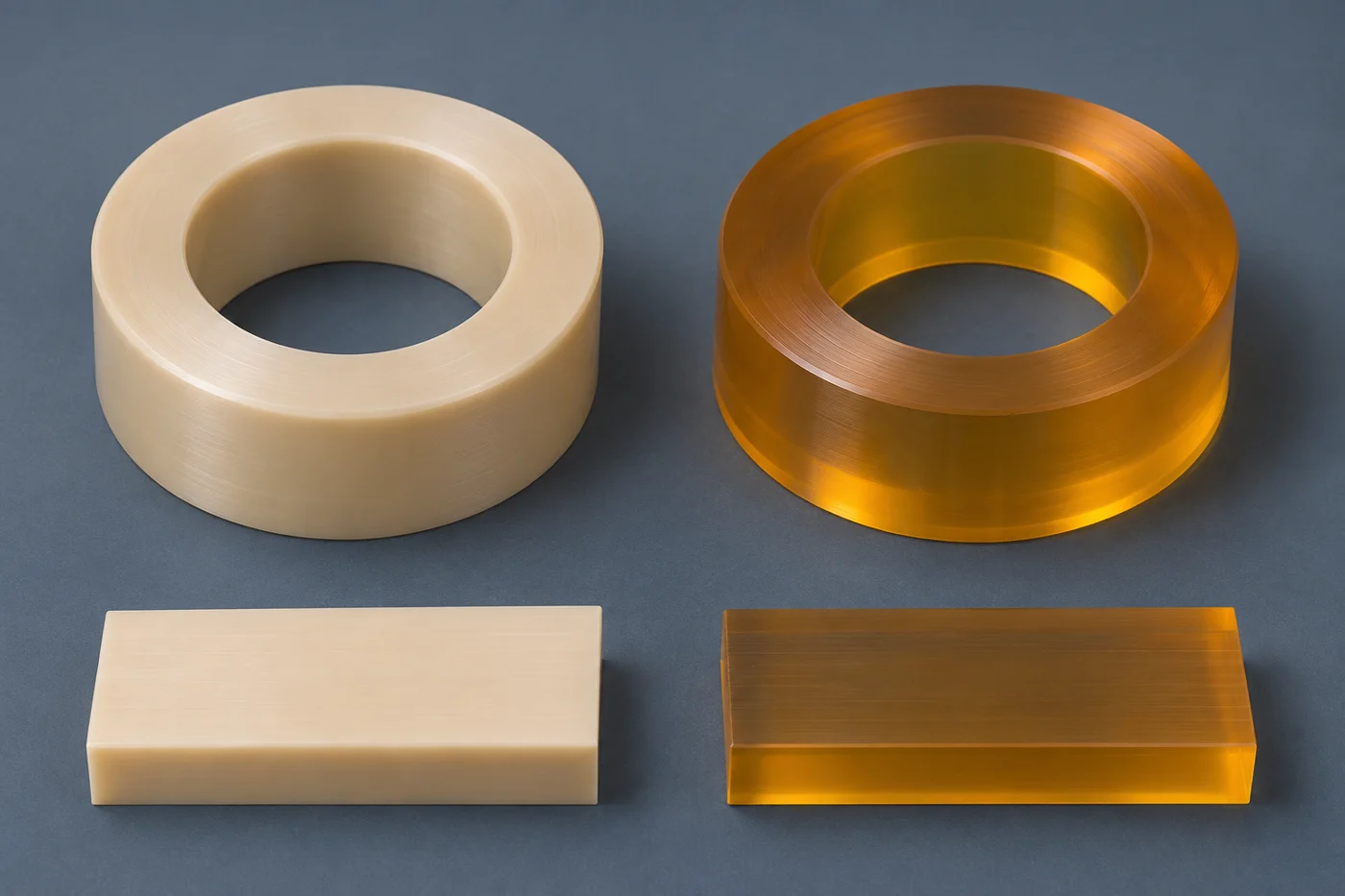
The stock illustration compares sample forms without assigning performance from appearance. Your finished-part specification still needs traceable identity. Do not approve a filled substitute merely because it is described as stronger.
Which Documents Should You Request?
Request documents that establish material identity and the specific requirements your application needs.
A material certificate, dimensional report and application qualification record serve different purposes. Identify which documents the machining supplier must provide. Keep equipment or end-use approvals with the responsible authority.
The material traceability guide helps connect received stock to finished components. Agree the required record depth before ordering. A broad polymer-family description is not a complete traceability requirement.
For regulated or specialized applications, confirm the applicable requirements separately. An industrial material should not inherit medical, aerospace or food-contact approval from a similar trade name. No such qualification is established by this comparison article.
How Should You Evaluate Prototype Parts?
Evaluate representative prototypes against the same functional questions used to select the candidate materials.
Keep material grade, drawing revision and process deviations visible. Measure critical features in the agreed state. Record conditioning, support and temperature where these affect the comparison.
A practical evaluation sequence is:
- Confirm the function and service-condition checklist.
- Approve exact candidate stock grades.
- Review geometry, machining access and inspection requirements.
- Produce representative samples with traceable records.
- Compare dimensional, visual and relevant functional results.
- Resolve failures or open questions before production release.
- Record substitution and change-control requirements for repeat orders.
Your first-article inspection plan can organize manufacturing evidence. Separate that evidence from service testing. A dimensionally correct component may still need application validation.
When a candidate fails, identify the failure mechanism before switching polymers. The cause could involve geometry, assembly or inspection conditions. Replacing the material without that understanding can repeat the same problem.
What Drives Total Accepted-Part Cost?
Your total accepted-part cost includes stock, machining, verification and qualification scope, rather than the resin family alone.
PEEK often enters comparisons as a premium candidate, but actual quotations depend on grade and supply conditions. Obtain project-specific pricing. Avoid applying a fixed price ratio across stock sizes or suppliers.
Ask whether the blank size suits the geometry efficiently. Large material removal, delicate features and repeated setups can change machining cost. Inspection records and special packaging can also change the quoted scope.
Compare both candidates using the same drawing and acceptance requirements. Identify prototype quantities and expected repeat demand. A lower price offers little clarity when it excludes essential verification or uses an unapproved substitute.
When Should You Reconsider Both Candidates?
Reconsider both materials when neither offers a justified match to your combined requirements and verification plan.
Your design may need another polymer, a metal insert or a different geometry. Do not select PEEK to conceal an unresolved design issue. Do not select PEI solely to meet an unsupported cost target.
Ask which requirements are essential and which can change with design approval. Revisit loading, interfaces and access before placing the production order. Keep any approved relaxation visible in the controlled records.
What Can You Review With TOPS Plastics?
You can discuss drawing-based PEEK and PEI machining through TOPS Plastics’ existing material service pages.
The PEEK machining page describes grade-specific component review. The ULTEM and PEI machining page covers related material and feature enquiries. Use those scopes to prepare your project discussion.
Confirm actual stock availability, feature feasibility and inspection deliverables before ordering. Request evidence for any equipment, certification or testing requirement that your project needs. This article does not establish an instrument inventory or completed customer qualification.
Frequently Asked Questions
Your PEEK versus PEI decision should follow the complete application; these answers address common shortcuts.
Is PEI The Same As ULTEM?
PEI is the polymer family, while ULTEM is SABIC’s resin family. Specify the actual grade and machinable stock. Do not treat every PEI product as identical.
Does A Higher Glass-Transition Value Prove Better Heat Performance?
No. Different thermal properties and loaded-service conditions answer different questions. Compare the relevant grade data and application evidence. Avoid ranking materials by one isolated temperature.
Can You Replace PEEK With PEI Without Testing?
Only use a substitution authorized by your design owner. Review chemistry, loading, electrical requirements and dimensional behavior. Record any required validation before releasing production.
Is PEEK Always The Better Chemical Choice?
No universal approval follows from the family name. Check the actual fluid, concentration, temperature and exposure conditions. Identify evidence gaps for the exact grade.
Which Material Holds Tighter Machining Tolerances?
Your result depends on geometry, stock, support, process and inspection method. Ask about the critical features on your drawing. Do not assume one universal tolerance for either family.
Can Reinforced PEI Replace Unfilled PEEK?
Compare it as a distinct material candidate. Reinforcement changes more than stiffness. Review the full application and obtain approval for any substitution.
Does Amber Color Verify The Supplied PEI Grade?
No. Appearance cannot replace material identity records. Specify the approved product and required documentation. Define cosmetic acceptance separately where it matters.
What Information Helps You Obtain A Useful Quote?
Send drawings, candidate grades, quantities and service conditions. Identify critical dimensions, surfaces and inspection deliverables. Explain the intended function and any unresolved material questions.
Request A Material Comparison Review
For a PEEK vs PEI review, send your drawing, candidate grades, service conditions and quantities. Contact TOPS Plastics to discuss machining and inspection scope. Agree confidential-file handling before sharing sensitive drawings, and assign application validation responsibilities separately.