Choose UHMW or HDPE by the component's job, not by appearance or the shared polyethylene name. UHMW deserves early consideration for sliding wear and abrasion duties. HDPE can be a practical candidate for machined plates and fabricated components where its particular properties and processing route fit the requirement. Neither family is an automatic substitute for the other.
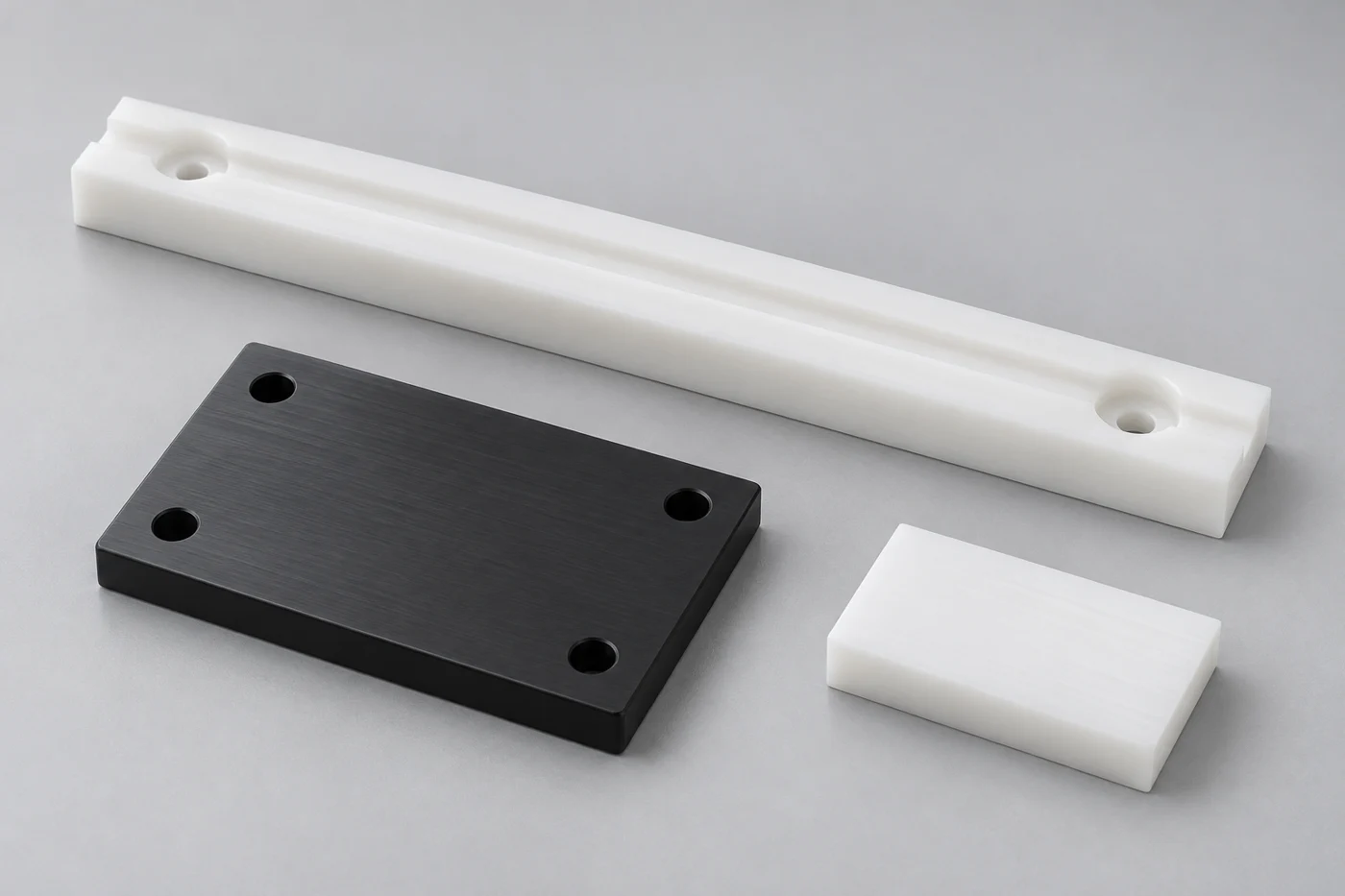
For a guide rail or wear pad, review contact conditions, mounting and the permitted change in shape or clearance. For a panel or fabricated assembly, joining and structural support may be more important than sliding performance. Start with those functions, then compare identified stock products and agree how the finished part will be accepted.
What The Material Names Actually Tell You
UHMW-PE means ultra-high molecular weight polyethylene. HDPE means high-density polyethylene, also written PE-HD. These names describe different material categories. Density and molecular weight are not interchangeable labels, and the word polyethylene alone is too broad for a controlled material purchase.
Supplier names and stock designations add another layer. Ensinger identifies TECAFINE PE1000 blue as a PE-UHMW stock product. A commercial number or familiar color should still be tied to the manufacturer's designation rather than used as an independent specification.
Record whether the candidate is an unmodified grade or contains additives. Also clarify whether virgin or reprocessed material is required. A drawing that names only white plastic gives the supplier little basis for controlling repeat orders or explaining a proposed alternative.
Use the stock supplier's current documentation to identify the actual product. If the drawing names a particular manufacturer or grade, ask whether alternatives need approval. Do not let a purchasing shorthand silently replace a material requirement that engineering intended to control.
Match The Shortlist To The Component's Main Job
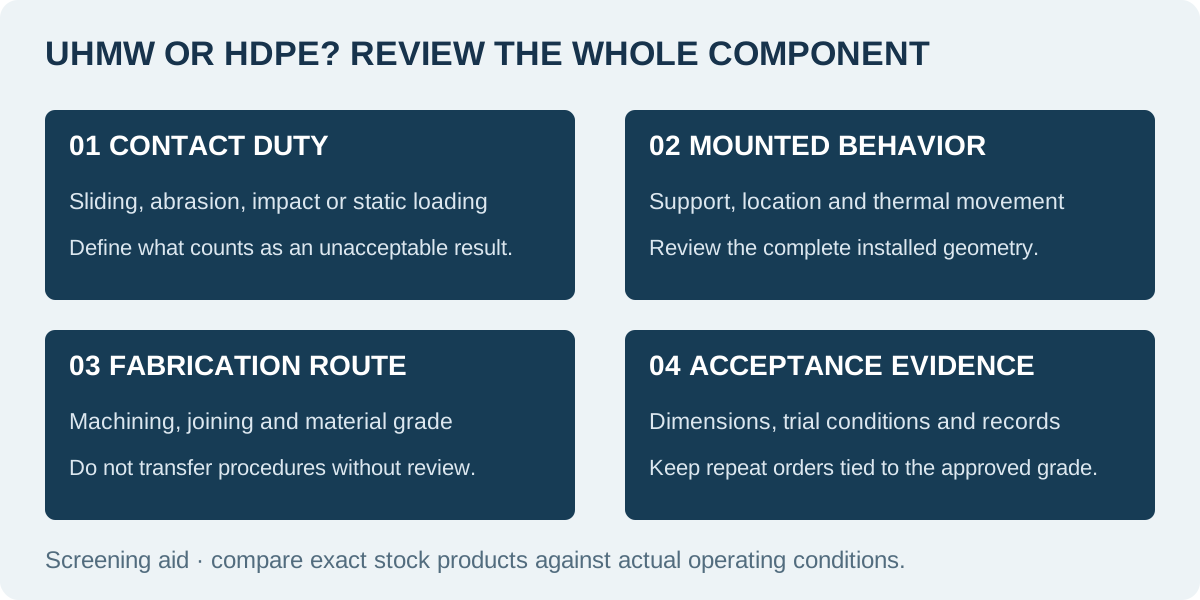
MCG's TIVAR 1000 UHMW-PE datasheet lists wear resistance, a low-friction surface and impact performance among that grade's characteristics. These properties explain its relevance to a wear-part shortlist. They do not predict the life of an untested rail in a specific machine.
For an HDPE example, Röchling lists good weldability and processing characteristics for Polystone G HD grey. That supports reviewing an identified HDPE product for an appropriate fabrication route. It does not establish that every polyethylene product can use the same joining procedure.
| Component priority | Useful starting point | What still needs checking |
|---|---|---|
| Sliding guide or replaceable wear strip | Review an appropriate UHMW stock grade | Counterface, load, motion and wear acceptance |
| Plate with machined mounting features | Compare candidate HDPE and UHMW products | Support, stiffness, dimensions and environment |
| Fabricated assembly with welded joints | Review a suitable HDPE grade and joining route | Procedure, joint design and finished acceptance |
| Pad carrying a sustained load | Evaluate the exact candidate grade and geometry | Contact stress, duration and deformation limits |
| Outdoor or special electrical duty | Identify a product designed for that condition | Relevant grade evidence and application requirements |
This is a screening framework, not a universal ranking. A component can combine several priorities. If wear, mounting and exposure all control acceptance, keep all three in the comparison rather than choosing from the most attractive single property.
Define Wear Before Asking Which Material Lasts Longer
Wear can mean loss of thickness, increasing clearance, surface damage or debris that interferes with the equipment. State the failure criterion before comparing materials. A rail that still looks smooth may already be outside its allowable alignment or clearance range.
Describe the mating surface and how it moves. Include material, finish, speed, travel, lubrication and the start-stop pattern where relevant. Sliding against a clean metal surface is a different evaluation from contact containing abrasive particles or product residue.
Identify whether the sliding component is intended to be sacrificial. If replacement is planned maintenance, useful evidence includes the replacement threshold and access requirements. The purchase decision may depend on predictable replacement and protected mating hardware as much as on minimum material loss.
Do not compare an internally lubricated UHMW grade with an unmodified product and attribute the result entirely to the polymer family. MCG describes TIVAR DrySlide as a modified UHMW product with an internal lubricant. Its properties belong to that formulation, not every UHMW blank.
Separate Abrasion, Impact And Sustained Loading
A material can be attractive for abrasion and still need a separate review for a continuously loaded contact. Ask whether the component slides, absorbs occasional contact or holds a static load for long periods. These are different duties even when the same pad experiences all of them.
For a pad, identify actual contact area and support beneath it. A broad supported surface and a narrow unsupported edge should not be evaluated as equivalent. The drawing and load description should make the relevant load path clear to whoever reviews the material.
For a guide, distinguish occasional collision from normal contact force. If impacts are part of the expected cycle, include them in a representative evaluation. An arbitrary drop or impact demonstration is not a substitute for the actual geometry and mounting.
For prolonged loading, review time-dependent movement and its effect on function. Our plastic creep and stress relaxation guide explains why a short-term strength result alone cannot establish the behavior of a continuously loaded polymer component.
Long Rails Need A Mounting Review
A long strip is part of an assembly, not an isolated material specimen. Define the locating feature, support spacing and any permitted movement relative to the metal structure. A material comparison cannot resolve an installation that overconstrains the rail or leaves the working surface inadequately supported.
Slots can be considered where the design needs controlled movement, but they are not a universal fix. Their direction, length, fastener arrangement and locating strategy need approval. A slot without a defined purpose can simply make alignment less repeatable.
Consider the operating and installation temperatures together. Establish how the rail is positioned and how adjacent sections meet. The plastic thermal expansion article develops the movement questions that should be reviewed before a long mounting pattern is finalized.
Also assess fastener recesses and remaining material beneath them. Hardware must seat as intended without interfering with the sliding path. Avoid assuming that a deeper counterbore is harmless merely because the outside dimensions of the strip remain unchanged.
Machining Requirements Must Follow The Geometry
A flexible wear strip, a broad plate and a short thick pad need different support during machining and inspection. Identify which dimensions control installation and which surfaces are simply clearance. A uniform tight tolerance across every feature can create work that does not improve the assembly.
For a guide channel, specify the functional width and its relationship to the mounting datum. For a pad, identify thickness or flatness requirements in the correct support condition. Those notes give a supplier a clearer target than a general request for precision polyethylene machining.
Discuss edge condition separately. An entry edge that guides product may need a defined radius or chamfer, while another surface only needs an agreed burr condition. Removing too much material during finishing can change a small but functional contact feature.
Review the planned sequence where substantial stock is removed. Ask how the part will be held without obscuring its free-state behavior. The machining route should support the specified result rather than depend on holding a flexible component forcibly flat during final measurement.
Joining Can Change The Material Decision
A fabricated panel assembly and a replaceable mechanically fastened wear strip can lead to different material choices. Establish the joint requirement early. Do not select one stock product for its wear description and assume it will support a joining method developed for another grade.
If welding is proposed, identify the exact material, joint design, procedure and relevant inspection requirement. A supplier statement that a grade is weldable is not evidence that a particular finished joint meets a load or leak requirement. Define any application-specific validation separately.
For an adhesive proposal, request an explicit review of the substrate and preparation route. Do not treat successful bonding of a different plastic as evidence for polyethylene. Mechanical assembly may be worth considering, but it also needs a defined load path and locating arrangement.
Discuss the complete part with the supplier before freezing the route. The HDPE machining page is a starting point for reviewing an identified grade and geometry, including any additional fabrication requirements that influence selection.
Review Exposure And Documentation By Exact Grade
List cleaners, process media and relevant outdoor exposure. Include concentration, temperature, contact duration and frequency where they affect the application. Resistance to one substance does not establish suitability for an entire cleaning schedule or an unspecified chemical mixture.
Color does not prove UV resistance, electrical behavior or detection capability. If one of those functions matters, name the required property and review the specific product evidence. The same applies to modified grades marketed for specialist wear or operating conditions.
Food-contact requirements should be handled through documentation for the exact grade, color and intended conditions. A general statement about polyethylene is insufficient to approve every finished component. Keep the material declaration distinct from any requirement for cleaning, traceability or equipment qualification.
Avoid copying a supplier's maximum temperature into a component operating guarantee. Check the test basis and the actual combination of load, exposure and geometry. A qualified application review may need evidence beyond the short-term or indicative values listed in a stock datasheet.
Example: Replacing A Conveyor Guide Rail
Consider a hypothetical packaging conveyor with a replaceable plastic guide. The original rail has worn enough to affect product tracking, and purchasing receives quotations for both UHMW and HDPE. This is a decision example, not a customer case or a claimed TOPS performance result.
First, record the current geometry and the reason for replacement. Identify the contact surface, travel, cleaning sequence and mounting arrangement. Distinguish actual wear from movement or alignment changes, because a different polymer will not necessarily correct an installation problem.
Then identify the candidate products and agree the evaluation. Use the same drawing revision, support arrangement and operating conditions where possible. Record thickness or clearance changes, tracking behavior and any relevant debris, rather than relying only on a visual impression after a short run.
The illustration shows a slotted polymer guide beside a separate support rail. It is a mounting concept, not a prescribed installation. The responsible designer must establish whether slots, a fixed location or another arrangement suits the actual machine.
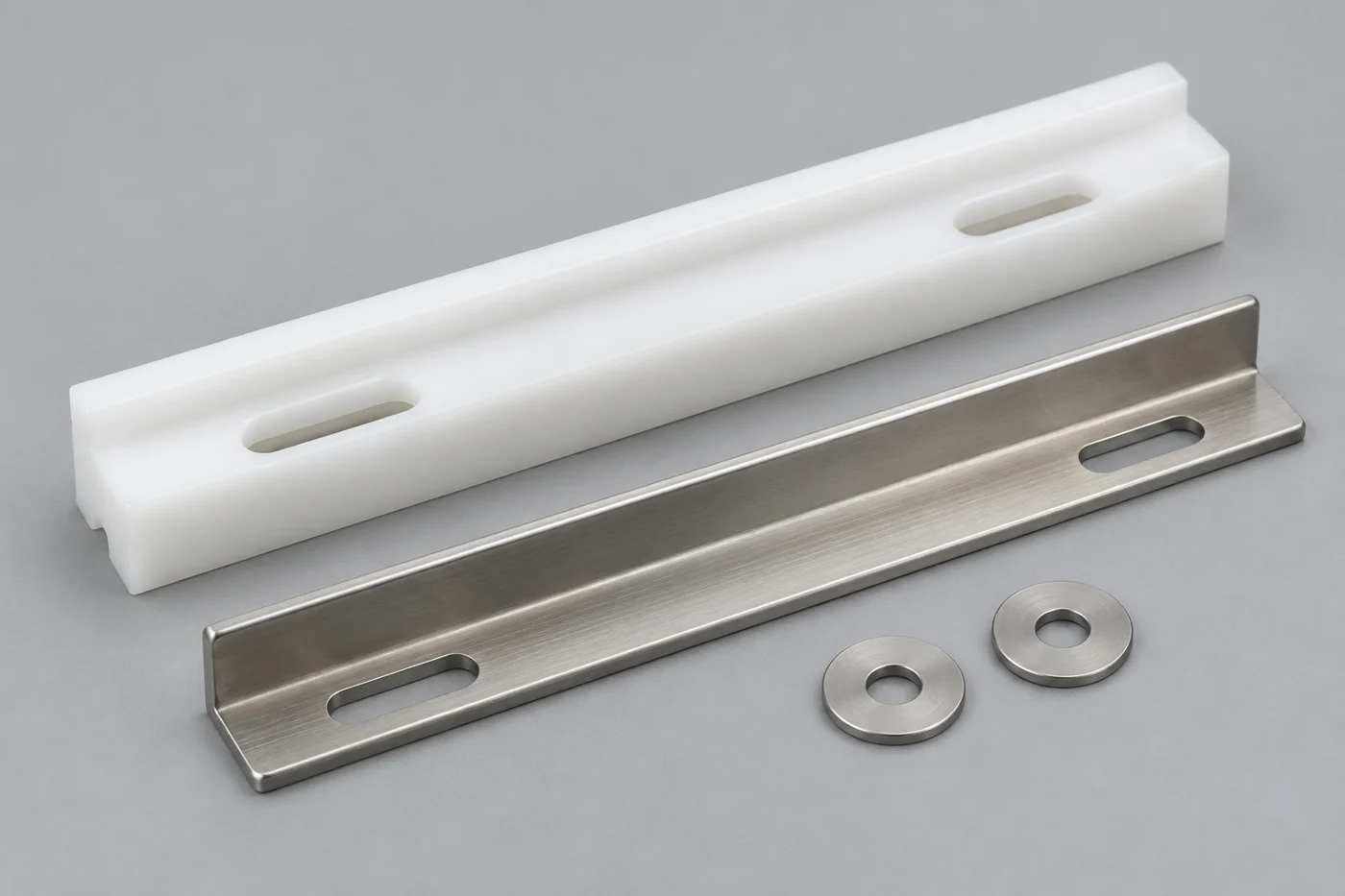
If a candidate passes, record the stock grade and accepted route for repeat orders. If neither passes, review geometry, contact conditions and alternative materials. A useful trial can reveal that the problem needs a design change rather than a simple UHMW-to-HDPE substitution.
Compare The Cost Of An Accepted Component
Include stock size, usable material yield, machining, joining, documentation and inspection when comparing quotations. A lower blank price can be offset by additional work or a route that requires more validation. Ask suppliers to explain scope differences before treating them as material price differences.
For wear parts, include replacement access and the agreed service threshold in the purchasing discussion. A component that is inexpensive to buy but difficult to replace may create a different commercial result from one designed for straightforward maintenance.
Keep an approved alternative list when the design permits it. Specify which changes require review, such as grade, stock source or formulation. This lets purchasing respond to availability without losing the evidence that supported the original component approval.
Frequently Asked Questions
Is UHMW The Same Material As HDPE?
They are different polyethylene material categories. Do not treat their names as interchangeable on a drawing. Identify the exact stock product and the properties needed for the component before approving either a first purchase or a substitution.
Should Every Wear Part Use UHMW?
No. UHMW is a useful candidate for many sliding and abrasion duties, but the complete application controls selection. Check loading, support, exposure and the intended failure threshold. A material family name does not establish an acceptable service life.
Can HDPE Replace UHMW Without A Trial?
Follow the agreed substitution rules. A material change may require drawing review, documentation or representative testing. Do not assume that matching outside dimensions establishes equivalent wear behavior or installed performance.
Does A Slotted Hole Solve Thermal Movement?
Only when it is part of an approved locating and fastening strategy. Review the direction of movement, available travel and how alignment is maintained. Slots alone do not define the mounting arrangement or guarantee that a rail will remain straight.
Can I Select The Material From A Black Or White Sample?
Appearance is insufficient for reliable identification. Use the manufacturer, grade and material records. Color also does not establish a special UV, electrical or detection property unless that function is supported for the identified product.
What Should An RFQ Include?
Send the drawing, quantity, part number and destination country. Add the exact grade or candidate materials, contact conditions, loading, exposure and critical inspection needs. Identify any joining requirement and explain whether alternatives need approval.
Request A Polyethylene Part Review
Send TOPS Plastics your drawing and operating details through the contact page. Mark the functional contact surfaces, mounting features and critical dimensions. If UHMW versus HDPE is still undecided, explain the wear, loading and fabrication priorities so the quotation review can address the actual component requirements.