
Electrical insulating plastics should be selected by exact grade, service conditions and the requirements of the complete assembly. A favorable datasheet value does not establish a finished component’s voltage rating. Define the electrical function, mechanical interfaces, documentation and validation responsibilities before approving material or machining.
What Is The Component Expected To Insulate?
Start with the electrical function rather than a polymer name. Identify the conductive parts that must remain separated in the intended assembly.
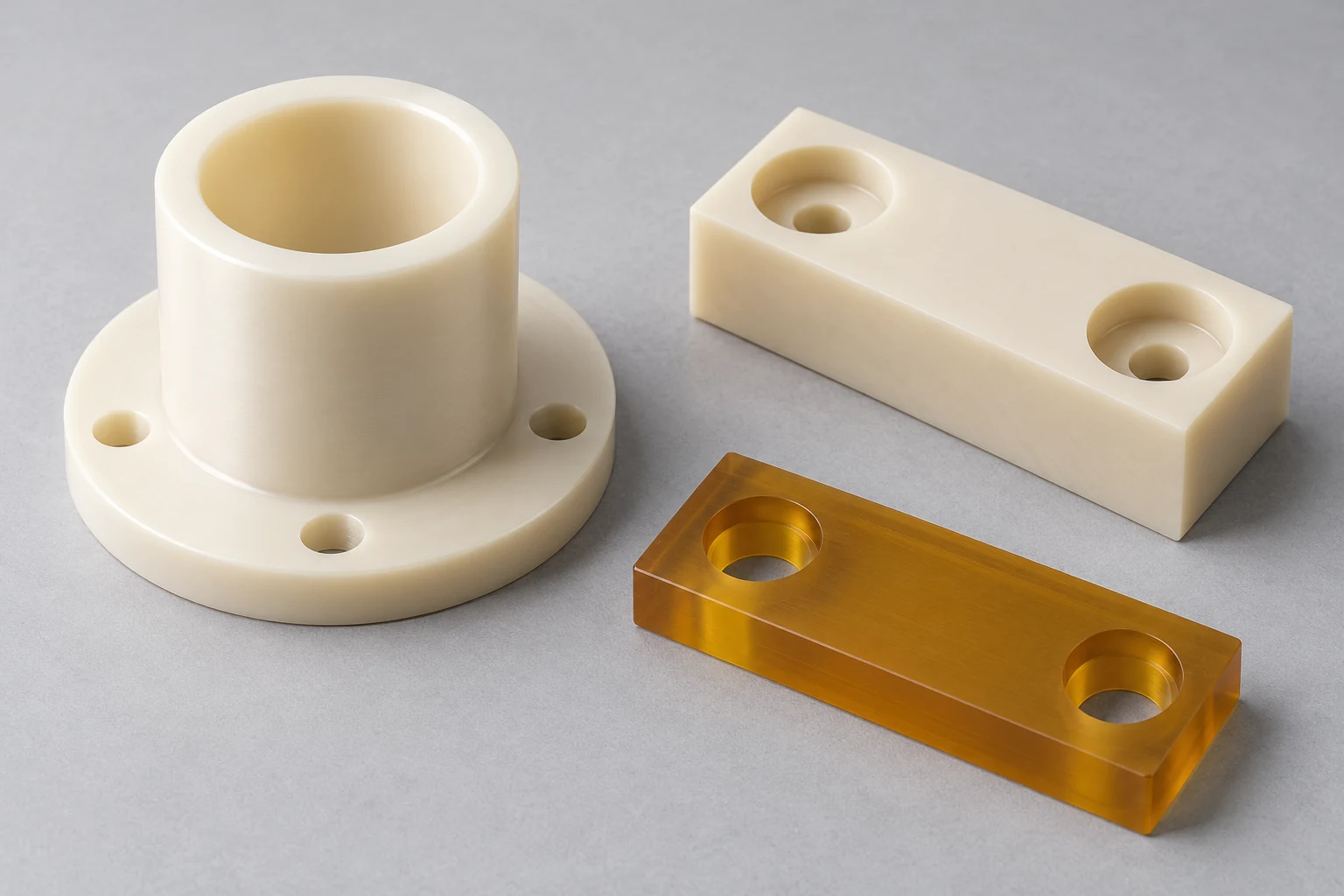
A sleeve, mounting block and insulating washer can serve different purposes. Their material requirements cannot be inferred from their appearance alone.
Document whether the part positions hardware, separates conductors or provides a barrier. Include the relevant equipment specification and responsible design authority.
Do not ask a machining supplier to infer electrical requirements from an incomplete drawing. Provide the approved interfaces and identify unresolved design decisions.
For custom plastic insulators, send the drawing together with the exact grade and application context.
The practical starting point is a requirements sheet. It connects the material request to the actual assembly without claiming qualification prematurely.
Which Electrical Properties Answer Different Questions?
Separate resistance to current flow from resistance to electrical breakdown. Also distinguish bulk behavior from behavior along a surface.
Mitsubishi Chemical Group’s engineering design guide describes dielectric strength and the test conditions that influence its interpretation.
| Property Or Requirement | What It Helps Describe | What It Does Not Establish Alone |
|---|---|---|
| Volume resistivity | Resistance to current flow through material | Finished assembly qualification |
| Surface resistivity | Electrical behavior along a material surface | Required creepage distance |
| Dielectric strength | Breakdown behavior under specified test conditions | A universal component working voltage |
| Comparative Tracking Index | Resistance to tracking under its test method | Complete equipment spacing requirements |
| Permittivity and loss | Dielectric response under relevant conditions | Suitability at every operating frequency |
| Flammability classification | Response in a specified fire test | Electrical insulation performance |
Request the test method, specimen condition and relevant units with each value. Similar-looking numbers can describe different measurements.
A material comparison should preserve those distinctions. Avoid creating one combined “insulation score” that hides the actual acceptance requirements.
Why Can You Not Multiply A Datasheet Value By Wall Thickness?
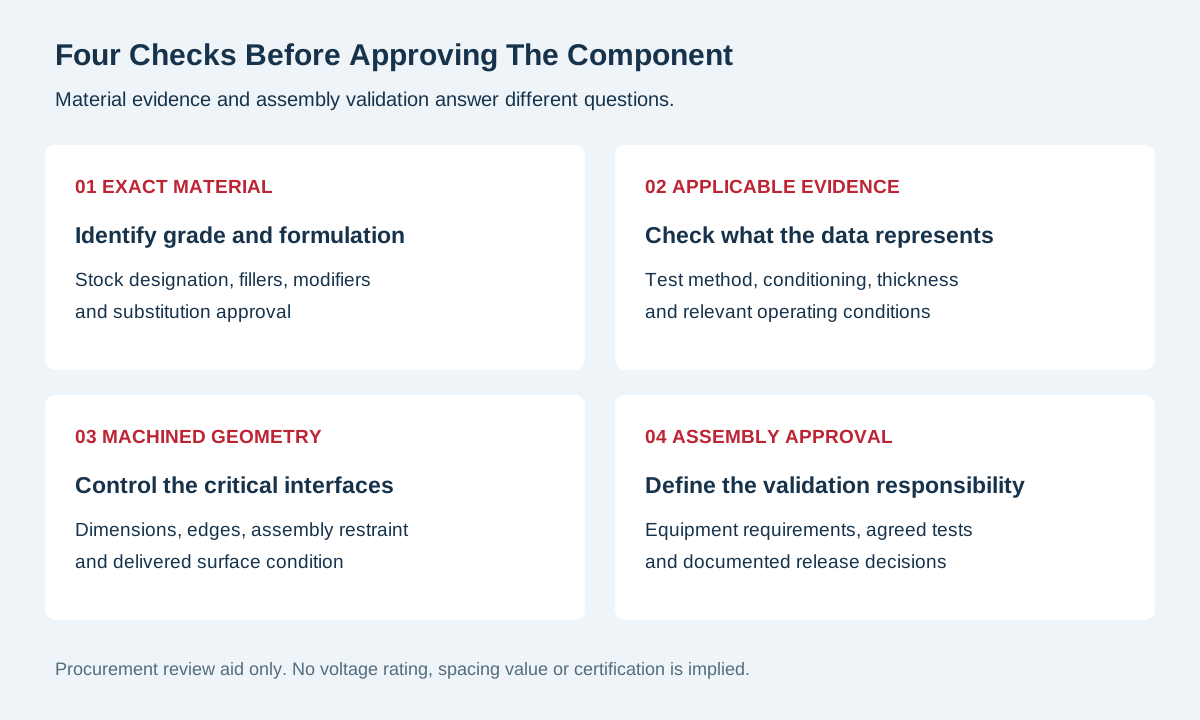
A dielectric-strength value belongs to a particular test configuration. Treating it as a universal allowable field can overlook important differences.
Ask whether specimen thickness, conditioning, temperature and test duration represent the proposed use. Record where they do not match.
A finished part also includes geometry, surfaces and interfaces that differ from a standardized specimen. The complete assembly needs its own assessment.
Do not convert a catalog value into a promised component voltage rating on a purchase order. Request approval from the responsible electrical designer.
If qualification testing is required, define its scope and acceptance separately from dimensional inspection. Confirm availability before including it in the quotation.
This keeps the manufacturing request specific while preserving responsibility for the electrical design and its verification.
How Do Creepage And Clearance Enter The Drawing Review?
Clearance concerns separation through air. Creepage concerns the path along an insulating surface between conductive parts.
Connection-system manufacturer Weidmüller explains these distinct paths and the application conditions involved in determining them.
The equipment designer should identify the applicable requirements and approved dimensions. This article provides no universal spacing values or replacement for that assessment.
A machined groove may alter one surface path without answering every air-spacing question. Assess the complete arrangement rather than one isolated feature.
Include fasteners, inserts and nearby metalwork when reviewing the assembly. A plastic part’s outer dimensions do not reveal every conductive path.
Provide controlled dimensions, datums and installation details to the supplier. Identify features whose tolerances contribute to the required separation.
Which Operating Details Should The Requirements Sheet Include?
Record the relevant electrical service conditions as specified by the equipment designer. Distinguish normal operation from transients and qualification-test conditions.
Identify whether frequency-dependent behavior matters to the application. A value measured under one frequency or waveform should not silently represent another.
Provide the relevant component temperatures rather than only the surrounding air temperature. State whether those conditions are measured, specified or provisional.
Include expected contamination, humidity, cleaning and maintenance. Ask which assumptions need confirmation before the design can be approved.
Use an explicit open-items list when the equipment specification is incomplete. Assign each question to the party responsible for answering it.
Close those items before converting a preliminary quotation into a production order. This prevents uncertain application details from becoming undocumented supplier obligations.
Why Must The Exact Grade Include Fillers And Modifiers?
A polymer family name does not identify every formulation. Reinforcement, conductive additives, pigments and other modifiers can change relevant material behavior.
Do not substitute a conductive or dissipative formulation for an insulating grade because both share the same base polymer.
Conversely, do not choose an insulating material when the application requires controlled charge dissipation. These functions need different specifications.
Request the complete supplier designation, stock form and supporting data. Record which substitutions require written approval before procurement.
Color is a useful identification aid only within an established material-control system. It is not independent proof of composition or electrical properties.
Our engineering-plastic selection guide helps organize the wider requirements before narrowing the exact grade.
Which Candidate Families Might Enter A Machining Review?
Build a shortlist from documented requirements, then compare actual grades. The following table lists review questions rather than a material ranking.
| Candidate Family | Questions To Resolve Before Approval |
|---|---|
| PEEK | Which formulation, temperature conditions and electrical evidence apply? |
| PTFE | How are deformation, dimensional requirements and exact compound addressed? |
| PEI | Which grade, stock specification and required classification are documented? |
| PET | Do electrical, environmental and mechanical data match the application? |
| Polyamide | How are conditioning and moisture exposure represented in the evidence? |
| PAI | Which grade, processing condition and verification requirements apply? |
For PEEK machining, identify the exact formulation instead of treating every reinforced or modified grade as interchangeable.
For PTFE machining, specify the compound and dimensional requirements alongside the electrical function.
The cheapest stock or highest single datasheet value may not satisfy the complete requirement. Compare the accepted component and documentation scope.
How Should You Account For Moisture And Contamination?
Define expected humidity, condensation, liquid exposure and cleaning conditions. Include storage and maintenance where they affect the intended service environment.
Ensinger’s electrical-insulation guidance notes that moisture absorption can influence electrical properties, particularly for moisture-absorbing plastics such as polyamide.
Ask which conditioning state the supplied evidence represents. A dry laboratory specimen may not represent every environment in which the component operates.
Specify any relevant restrictions on residues and handling. Confirm that cleaning products and packaging are appropriate for the exact material and application.
Do not assume ordinary shop cleaning proves a specialized cleanliness requirement. Define the method and acceptance where additional verification is necessary.
Record these requirements with the part specification. A separate, unreferenced cleaning email can be missed when the next order is placed.
What Mechanical Conditions Can Undermine The Intended Geometry?
The component must maintain its required interfaces during assembly and service. Review load, temperature, fastening and permitted movement together.
A thin flange may deform under clamping. A mounting block may shift as the surrounding assembly heats or remains loaded.
Identify the dimensions and contact faces that control the insulating arrangement. Ask whether inspection is required in a free or installed condition.
Our plastic thermal-expansion guide explains how to organize temperature-related dimensional questions.
For prolonged loading, our plastic creep guide distinguishes initial dimensions from long-term movement or retained force.
Neither a dimensional pass nor an acceptable electrical material datasheet should silently replace validation of the complete operating assembly.
What Does A Flammability Rating Actually Add?
Flammability is a separate requirement from electrical insulation. If a classification is needed, identify the exact evidence required by the equipment specification.
UL Solutions describes plastics fire testing in relation to test specimens and material thickness.
Ask whether the supporting classification covers the relevant material designation, thickness and other applicable conditions. Do not infer coverage from a family name.
A material test classification is not, by itself, certification of your machined part or finished equipment. Confirm the necessary acceptance route separately.
Keep supplier declarations, material information and independent certification records clearly distinguished. Use each document only for the claim it actually supports.
TOPS Plastics should not be assumed to provide a particular certification or electrical test unless that scope is explicitly agreed.
Which Machined Features Need Particular Attention?
Identify minimum wall sections, insulating shoulders, mounting bores and any surfaces used in the approved electrical arrangement.
Mark functional edges that cannot receive an unspecified chamfer or radius. Extra material removal can change a dimension used by the design.
Ask how burrs, chips and exposed interfaces will be addressed. The delivered condition matters alongside nominal feature size.
Our plastic deburring guide separates unwanted-material removal, intended edge geometry and cleanliness.
For plastic milling, identify pockets, slots and surfaces on multiple faces that require defined inspection.
Confirm any proposed manufacturing change before approval. A supplier should not redesign an electrically significant feature to simplify machining without authorization.
Example: Reviewing An Insulating Shoulder Bushing
Consider a hypothetical polymer shoulder bushing fitted into a metal plate. This is an illustrative review, not an electrically qualified assembly.

The flange locates against one face, while the sleeve passes through the plate bore. A separate washer may serve another interface.
First, identify the conductive parts and the required separation in the complete equipment. Let the responsible designer establish the relevant requirements.
Next, define the grade, flange dimensions, sleeve wall and installation condition. Include tolerances that influence fit or the approved arrangement.
Review clamping, temperature and contamination assumptions. Ask whether the mechanical assembly can change the required geometry during its intended service.
Separate the machining checks from required electrical validation. Record who approves the design and who performs any specified qualification test.
Only release production after the open actions are resolved. A visually similar sample cannot establish the electrical suitability of an unspecified substitute.
What Documentation Should A Buyer Request?
Request records that address actual purchasing requirements. More paperwork is not automatically stronger evidence if it concerns the wrong grade or test condition.
| Document Or Record | Purpose To Clarify |
|---|---|
| Material designation | Identifies the approved supplier grade and stock |
| Material datasheet | Provides properties with their stated conditions |
| Traceability record | Connects supplied material and parts to the order |
| Dimensional report | Records agreed manufacturing checks |
| Classification evidence | Supports a specific declared material classification |
| Validation report | Records an agreed component or assembly assessment |
| Change approval | Controls substitutions and revised specifications |
State which records accompany each delivery and which belong to initial qualification. Identify the revision and approval owner for each requirement.
If evidence is missing, document the gap before ordering. Do not let an assumption become a claim in the final purchasing specification.
What Information Belongs In The RFQ?
Provide the drawing, quantity and complete material designation. Add the electrical function and reference the applicable equipment requirements.
Describe service temperatures, exposure, loads and assembly interfaces. Mark dimensions that require special attention and identify prohibited substitutions.
List required inspection, traceability and reporting. Confirm any specialist electrical testing, certification or external laboratory work as a separate scope.
For CNC plastic machining, distinguish manufacturing acceptance from design qualification in the order.
Use our quality and inspection page to organize questions about manufacturing checks and documentation.
Ask the quotation to list exclusions and unresolved assumptions. Resolve them before comparing suppliers solely on unit price.
How Should Repeat Orders And Changes Be Controlled?
Keep the approved grade, drawing and supporting evidence connected by revision. Record which changes require another technical review.
A new color, filler, stock source or cleaning process can introduce a question that the previous approval did not address.
Likewise, a revised fastener or mating plate can change the assembly without changing the plastic component’s part number. Include those interfaces in change control.
Request notice before substitutions and preserve written dispositions. Avoid descriptions such as “equivalent insulating plastic” unless equivalence criteria and approval are defined.
If a delivered part differs from the specification, separate material identity, dimensional condition and electrical performance questions during investigation.
Do not approve rework solely because the part looks acceptable. Confirm that the responsible parties have reviewed any affected functional requirements.
Frequently Asked Questions
Are All Grades Of An Insulating Polymer Electrically Insulating?
No. Check the exact formulation, including fillers and modifiers. A base-polymer name does not establish every grade’s electrical behavior.
Does A Dielectric-Strength Number Give My Part A Voltage Rating?
No. Review the test conditions and complete assembly requirements. Component suitability needs the relevant design assessment and agreed validation.
Is A Flame-Retardant Plastic Automatically A Better Insulator?
No. Flammability and electrical properties address different requirements. Compare the evidence for each rather than treating one classification as a substitute.
Can An ESD Grade Replace An Insulating Grade?
Do not assume that it can. Charge-dissipative and insulating functions require different specifications and approval of the actual application.
Can Color Confirm The Correct Material?
Not independently. Use the approved designation and traceability records; similar-looking components can have different formulations and properties.
What Should I Send For A Machining Quotation?
Send the drawing, exact grade, quantity and assembly details. Identify critical dimensions, environmental conditions and any required documentation or specialist verification.
Connect Material Evidence To The Finished Assembly
Define the electrical function, exact grade and mechanical interfaces before ordering. Keep manufacturing inspection separate from electrical qualification. Contact TOPS Plastics with your drawing and documented requirements to discuss the machining scope.