
Nylon moisture absorption matters whenever a machined component must keep a defined fit through storage, shipment and service. A dimension accepted immediately after machining may change as the material takes up or releases moisture. The purchasing requirement should therefore describe the material grade and the condition in which the part must meet its drawing.
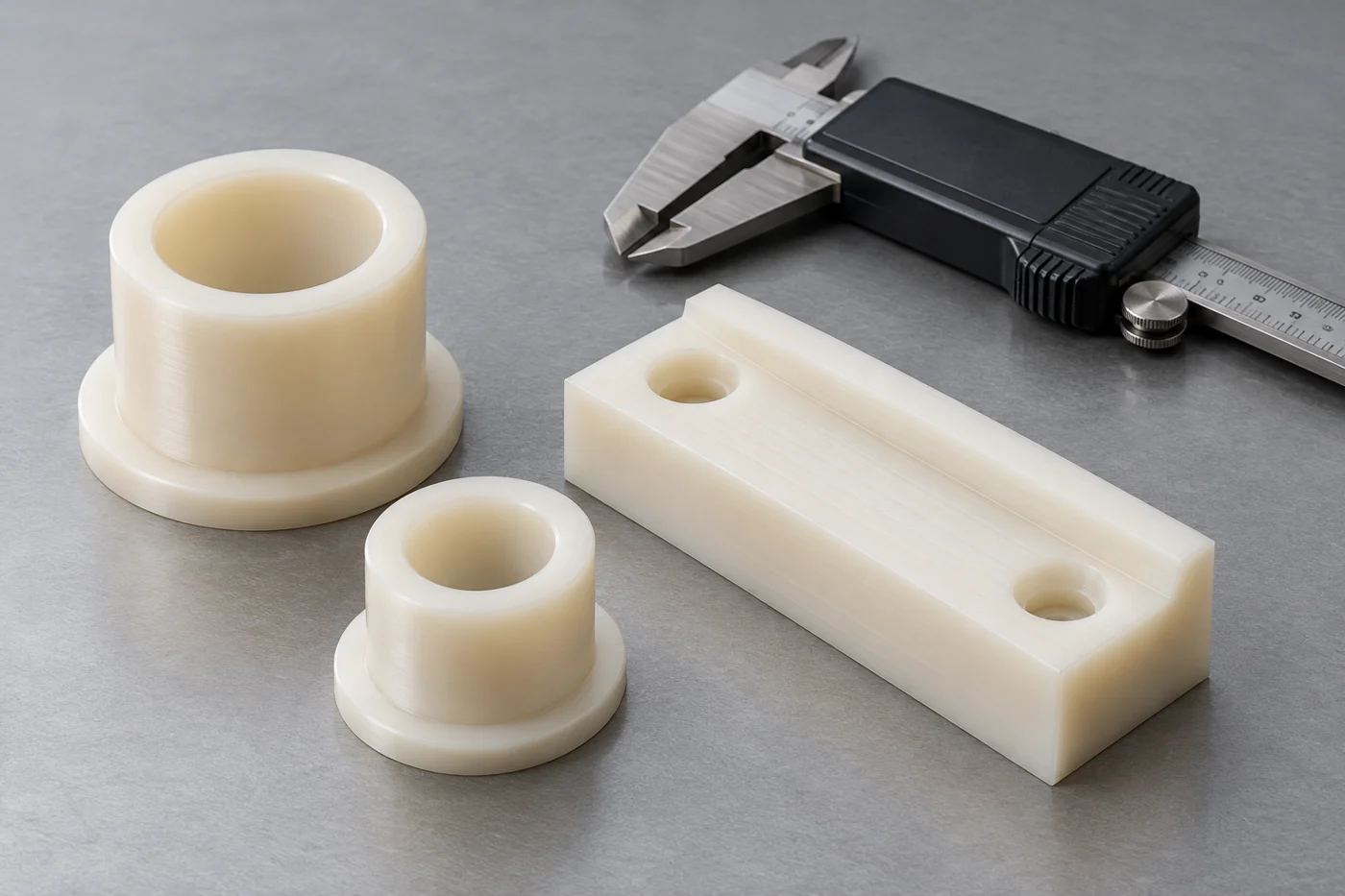
The practical response is to connect operating conditions, material selection, inspection and packaging before production. There is no universal conditioning time or dimensional correction for every nylon component. Geometry, material formulation and exposure history all deserve review. This guide explains the decisions a buyer and engineer should settle for a bushing, guide, roller or insulating part.
Why Moisture Belongs In A Dimensional Review
Polyamides can absorb water from their surroundings. Moisture uptake and release can affect dimensions, so an apparently simple room-temperature inspection does not describe the whole material state. Ask what happened to the stock and component before measurement, including storage and any deliberate conditioning step.
Ensinger’s machining guidance identifies moisture uptake and release as contributors to swelling and shrinkage in polyamide products. This supports reviewing moisture alongside other causes of dimensional movement. It does not provide a universal finished-part allowance for every nylon grade or geometry.
A dimensional discrepancy can have several contributors. Temperature changes, restraint during measurement, residual stress and machining history may also matter. Avoid attributing every change to humidity without comparing the relevant conditions. A useful investigation records observations and separates possible mechanisms before changing the drawing or process.
For example, a bore measured under one set of conditions may later be checked with different support, temperature or instrument force. The two measurements need a shared basis before they can establish a material-related change. Recording those conditions is often more useful than repeating measurements without understanding the difference.
Specify Which Nylon Product Is Being Ordered
Nylon is a material family rather than a complete purchase specification. Identify the manufacturer, designation, polymer type and any fillers or modifiers. Record the stock form when it matters to the approved manufacturing route. A description such as natural nylon leaves important choices unresolved.
Different formulations should not inherit the same assumed moisture behavior. Mitsubishi Chemical Group describes reduced moisture absorption for its specific Nylatron NylOil PA6 product. That product-specific statement is a reason to compare identified grades, not a reason to assign its behavior to every nylon bearing material.
Review the application before choosing a modified grade. Lubricants, reinforcement or other additives can affect properties beyond moisture response. The relevant questions may include wear, mating-surface compatibility, electrical function, chemical exposure and permitted contact conditions. A material change needs a complete functional review.
Use the material traceability guide to connect the approved designation to the supplied stock. A clear grade requirement loses value if repeat orders cannot establish which product was actually used.
Describe The Real Exposure Pattern
Start with where the component operates and how it gets there. A part stored indoors, washed regularly or exposed to outdoor weather may experience different conditions. Identify direct liquid contact separately from humid air. State whether exposure is continuous, intermittent or limited to maintenance.
Also consider the interval between production and installation. Parts may remain in a warehouse or travel through changing climates before assembly. If fit is critical at installation, the acceptance discussion should address that stage rather than assuming shipment and service are identical.
Temperature remains relevant even when moisture is the main concern. The thermal expansion article discusses a separate source of dimensional change. Define the temperature basis of the drawing and avoid treating a humidity review as permission to ignore thermal movement.
Provide the supplier with the useful operating information instead of an unexplained request for weather-resistant nylon. The design team can then decide which material information, exposure evaluation or prototype checks are needed. The machining supplier should not have to invent the machine’s service environment.
Distinguish Conditioning, Drying And Annealing
Conditioning establishes or approaches an agreed material state through a defined treatment or exposure. The word needs a procedure and acceptance basis. Leaving parts on a bench for an unspecified period does not create a reproducible condition that another supplier or inspector can necessarily repeat.
Drying reduces moisture under a defined procedure. It should not automatically be specified merely because a component will be machined. The desired delivery or service state may require a different approach. Discuss the identified grade and the actual objective before prescribing a treatment.
Annealing addresses a different process question involving heat treatment and stress relief. The plastic annealing guide explains the need for material-specific review. Conditioning and annealing should not be treated as interchangeable words on a purchase order.
If a treatment is proposed, establish who approves it, when it occurs and what evidence demonstrates completion. Include any subsequent machining or storage step that can alter the condition before final inspection. The procedure should describe a controlled route rather than a single isolated operation.
| Decision | Information to define | Why it matters |
|---|---|---|
| Material identity | Manufacturer, grade and modifiers | Family names do not define identical behavior |
| Exposure | Humidity, liquid contact and temperature | Establishes the environment to evaluate |
| Conditioning | Procedure, sequence and acceptance basis | Makes the requested state reproducible |
| Inspection | Support, timing and environmental conditions | Makes dimensional results comparable |
| Shipment | Packaging, identification and storage instructions | Preserves the agreed handling approach |
Review Geometry And Fits Together
A moisture-related change matters through its effect on the assembly. Identify which features locate, slide, seal or transmit load. A mounting hole with generous clearance presents a different problem from a closely fitted sleeve, even when both are cut from the same stock.
Do not apply a single percentage allowance to every dimension without an approved basis. Different features interact with the surrounding geometry and assembly restraint. A bushing’s installed behavior also involves its housing and shaft. The design authority should evaluate the complete fit rather than adjusting an isolated drawing dimension by intuition.
The plastic bushing clearance guide provides a framework for discussing the installed relationship. When moisture is relevant, include it in that discussion alongside loading, temperature and mounting. Ask which operating condition is intended to govern clearance.
Wall thickness and section transitions also deserve attention when planning an evaluation. A sample that differs substantially from the production part may not represent its exposure response. Use representative geometry where practical, and record the limitations of any simplified test coupon.
Agree The State For Final Inspection
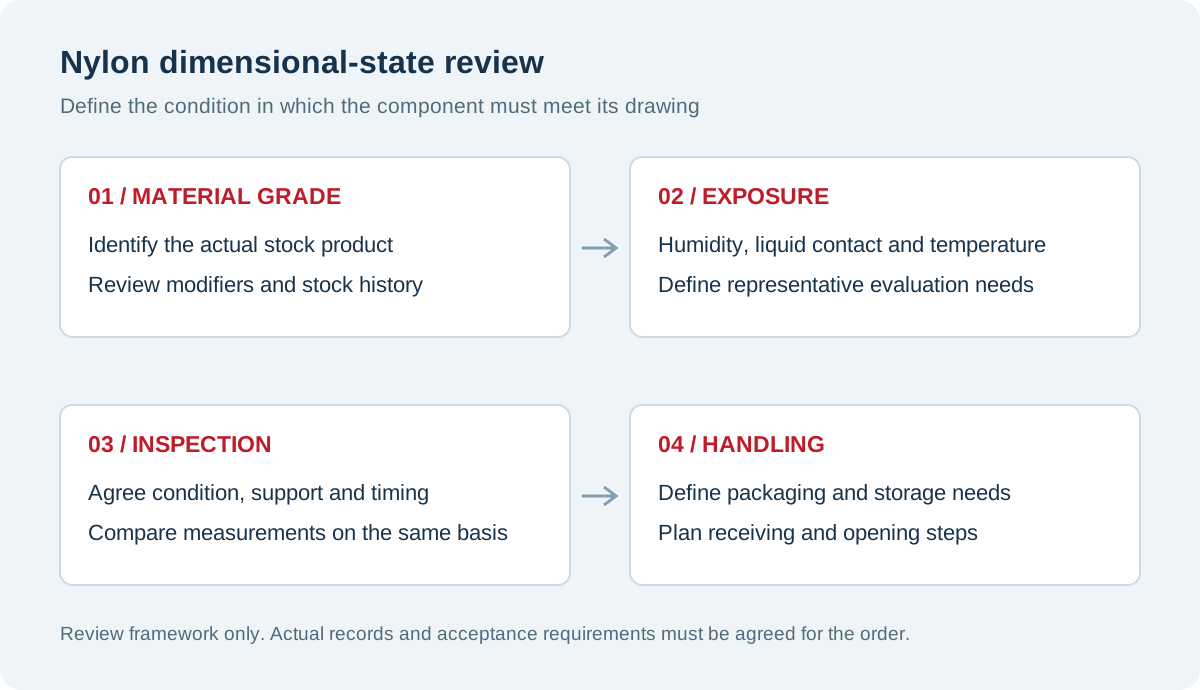
Define when the component is measured relative to machining and any approved treatment. Record temperature, environmental conditions and support as required by the inspection plan. If a specific moisture state is essential, agree how it will be established and verified rather than relying only on a calendar duration.
A drawing may need to distinguish free-state dimensions from dimensions under defined restraint. This becomes especially important for a flexible guide or thin section. Inspection pressure can influence apparent geometry. Specify the relevant arrangement so the receiving team does not compare an unsupported part with a supplier’s restrained measurement.
Use consistent instruments and methods for the features that control assembly. If the buyer and supplier obtain different results, compare their methods before concluding that the machining operation was incorrect. Check whether the part experienced different storage or conditioning between the two measurements.
The quality and inspection page is an appropriate starting point for discussing a project-specific plan. Request the records needed to explain acceptance, including the drawing revision and relevant material state. A list of dimensions without their measurement context may leave the main question unanswered.
Plan A Representative Evaluation
Where dimensional change could affect function, agree an evaluation before committing to a production quantity. Select the identified grade and representative geometry. Define the baseline condition, exposure, measurement sequence and functional acceptance criteria. This makes the trial useful for a purchasing decision.
Measure the features that influence the assembly, not merely the easiest exterior surfaces. A guide may need checks of mounting relationships and a sliding channel. A sleeve may need a defined installed evaluation. Establish what constitutes an acceptable result before the sample is exposed.
Record the exposure and any uncertainty. A short trial in one environment does not demonstrate every possible service condition. If the test differs from the application, describe that difference when interpreting the result. Avoid turning a successful prototype check into an unrestricted guarantee.
The outcome may support the proposed material, a geometry change, a wider functional allowance or another candidate. Treat these as engineering decisions with documented approval. A trial is most valuable when it changes a clear decision rather than simply generating measurements for a report.
Use Packaging As Part Of The Handling Plan
Packaging can protect cleanliness, identity and physical condition, but it should not be assumed to maintain a particular moisture state indefinitely. If environmental protection is required, define the packaging performance, storage conditions and permitted time before use. Confirm the arrangement with the responsible supplier.
The packaging illustration shows nylon-like bushings in a protective pouch beside unpacked parts. It illustrates a handling discussion. The image does not establish the pouch’s barrier performance or demonstrate a validated storage method for a specific nylon grade.
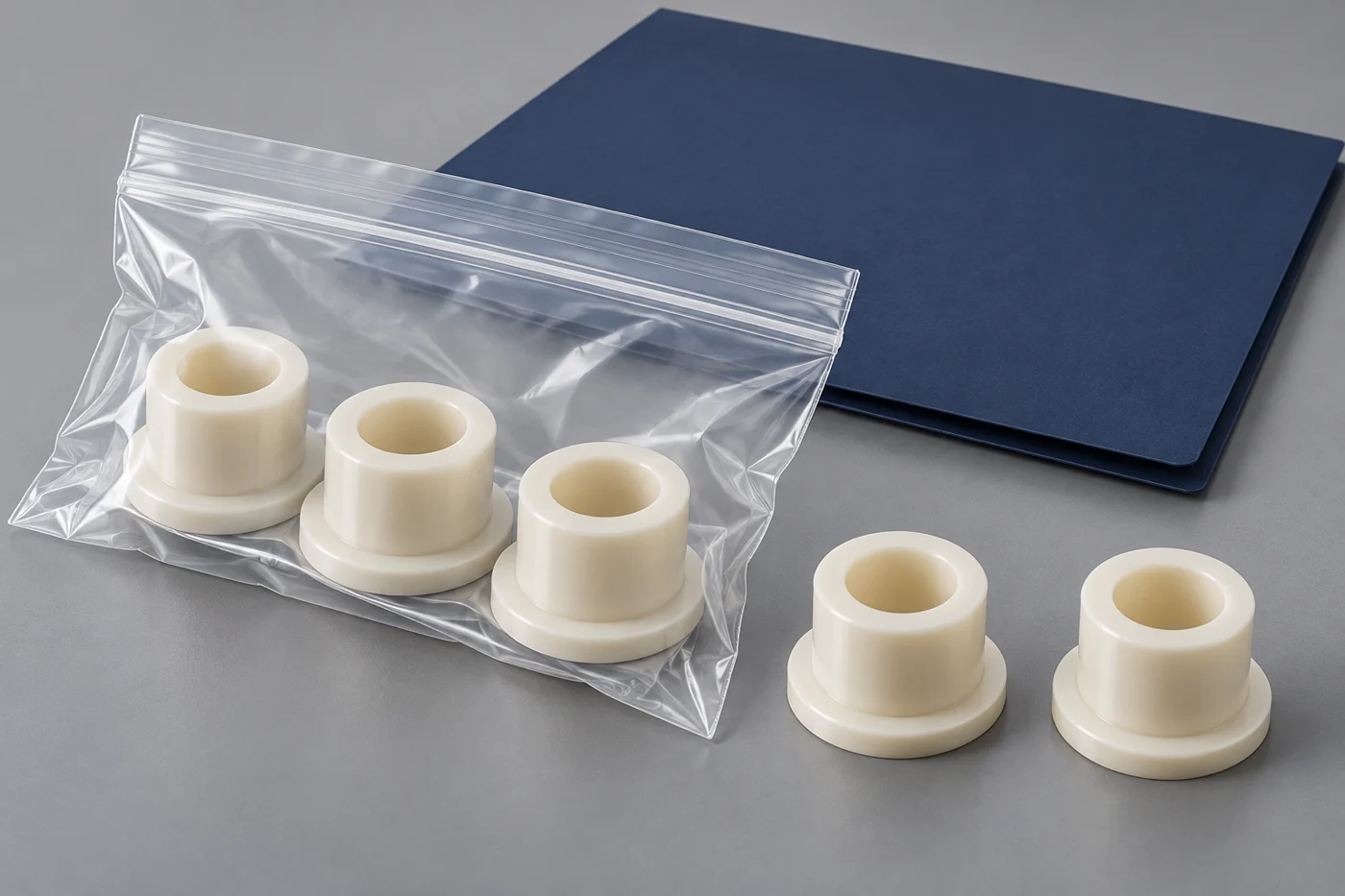
Consider what happens when packaging is opened for receiving inspection. Parts may then remain exposed before assembly. Agree any resealing instructions or restrictions that the project requires. An instruction that applies only to an unopened shipment may not address the buyer’s actual workflow.
Keep material and lot identification associated with the parts throughout storage. Mixing quantities from different deliveries can make later investigation harder, even when their dimensions appear identical at receipt. Traceable records help relate an observed fit change to the relevant supply and handling history.
A Hypothetical Guide-Rail Investigation
Imagine a machined nylon guide accepted at the supplier but found tight around a mating element after storage at the buyer. This is a hypothetical example, not a TOPS customer case. The first useful step is to compare material identity, measurement conditions and storage history.
The team should also examine mounting restraint and the mating component. Humidity may be relevant, but a changed fastener sequence or a different temperature can complicate the comparison. Keep the investigation tied to evidence instead of choosing the most familiar explanation.
A controlled re-evaluation can then compare the same critical features under agreed conditions. The resulting information may justify a revised clearance, a defined conditioning route or another material. Record the approved change so future orders do not repeat the original ambiguity.
Compare Alternatives Against The Same Job
If dimensional stability under changing moisture exposure dominates the design, review other engineering plastics as candidates. The Nylon versus Delrin comparison discusses differences relevant to selection. A lower-moisture-uptake option still needs to satisfy loading, wear, chemical and temperature requirements.
Changing material can also alter machining, fastening and assembly behavior. Do not preserve every assumption from the nylon design without review. Update the material designation and approval records, then confirm the inspection and application requirements for the selected product.
A premium material is not automatically the best purchasing choice. Evaluate the total accepted component and the evidence needed for release. The useful comparison includes functional performance, availability, manufacturing route and inspection effort rather than stock price alone.
What To Send With Your RFQ
Include the current drawing, model, quantity and exact grade or approved selection criteria. Describe the service environment and the interval before installation. Mark the critical fits and state any conditioning, packaging or receiving requirements already defined by the design team.
Ask the supplier to identify unresolved assumptions before quoting. If a prototype evaluation is needed, separate its scope from the eventual production order. Agree the evidence required at each stage so both parties understand which decisions remain open.
Frequently Asked Questions
Can Machined Nylon Change Size After Delivery?
Yes, moisture uptake or release can contribute to dimensional change. Temperature, stress and measurement conditions can also matter. Compare the relevant conditions before assigning a cause or changing the drawing.
Is There One Conditioning Time For Every Nylon Part?
No. The grade, geometry, starting state and exposure procedure need review. Specify an approved method and acceptance basis rather than treating one duration as suitable for every component.
Will Sealed Packaging Guarantee Stable Dimensions?
A seal alone does not define barrier performance or the starting material condition. Agree the packaging, storage and opening requirements if preservation of a particular state is important to the project.
Should Nylon Automatically Be Replaced With POM?
No. Compare the complete application. Moisture behavior is one selection factor alongside wear, loading, chemicals, temperature and assembly design. Any substitute needs approval against the actual requirements.
Discuss Your Nylon Component
Send TOPS Plastics your drawing and application conditions. Include quantity, material identity, critical fits and the required inspection state. Those details support a practical discussion of machining, evaluation and delivery requirements before production.