POM-C and POM-H are both acetal engineering plastics, but they should not be treated as automatic substitutes. For a machined part, compare the exact stock products against mechanical loading, exposure, internal material quality and the required fit. The better choice is the one supported by the application requirements and an approved material specification.
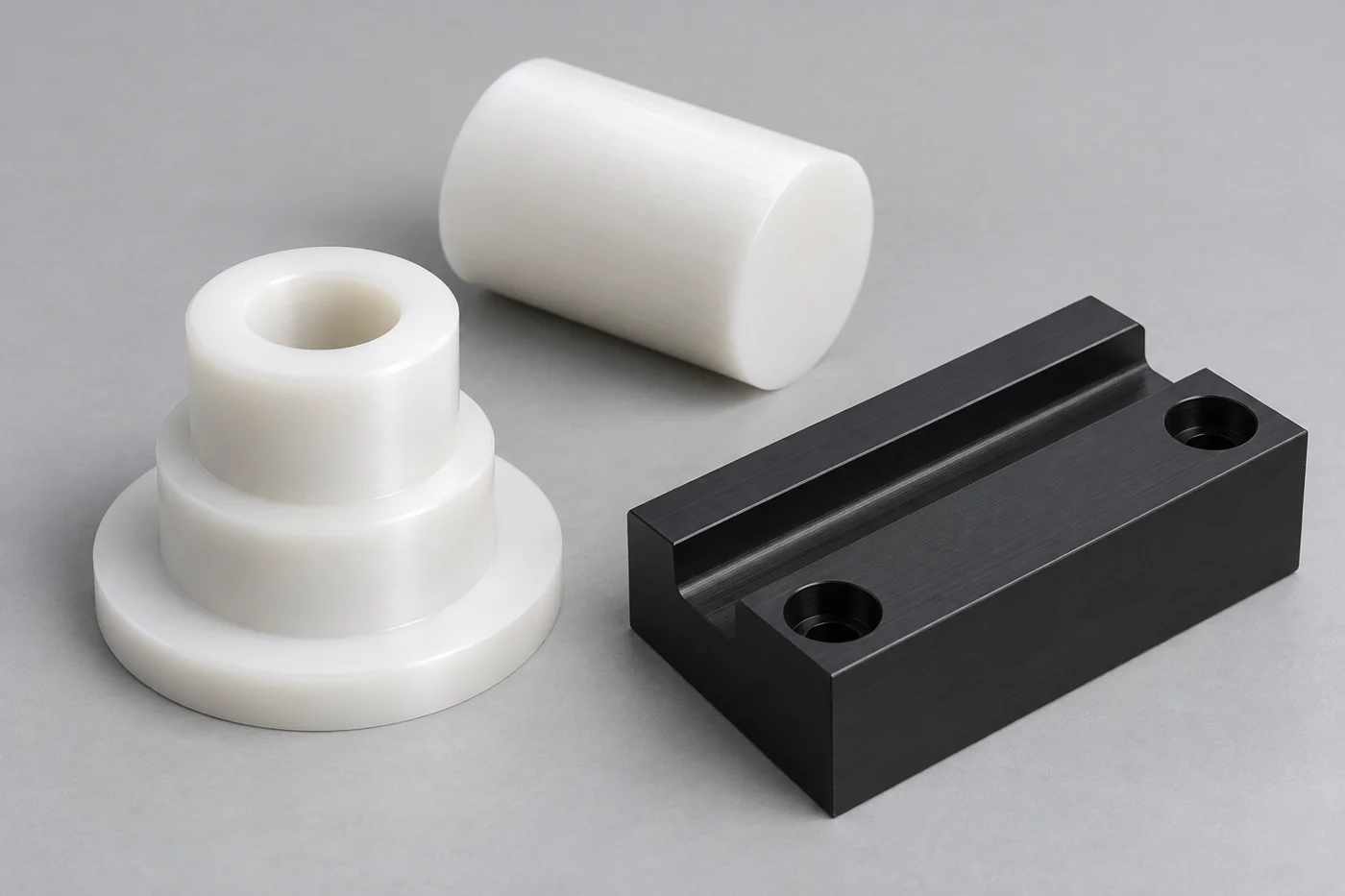
As an initial screening direction, POM-H deserves consideration where mechanical properties drive selection. POM-C deserves attention where the exposure environment or stock core quality is especially important. These directions help organize a review. They do not establish an acceptable grade, finished tolerance or service life by themselves.
Decode Acetal, POM And Delrin On The Drawing
POM is the abbreviation for polyoxymethylene, commonly called acetal. POM-C identifies copolymer acetal and POM-H identifies homopolymer acetal. Both are semicrystalline plastics. A drawing that specifies only POM leaves a material decision unresolved unless another controlled document identifies the approved product.
Delrin is a brand associated with acetal homopolymer. The Delrin product reference guide identifies this distinction and describes a range of grades. A requirement for a particular Delrin product cannot be satisfied simply by supplying any material described commercially as acetal.
Likewise, the names used for finished stock matter. Resin designation, stock manufacturer and stock product designation may represent different levels of information. Ask which identification controls the purchase, particularly when a drawing was originally written for a molded component and is now being used to source machined stock.
Do not identify POM-C or POM-H by color. Both families can be supplied in different colors, and appearance does not establish the formulation. Connect the delivered component to material records rather than relying on a white or black sample retained from an earlier order.
Use A Screening Comparison Without Hiding The Grade
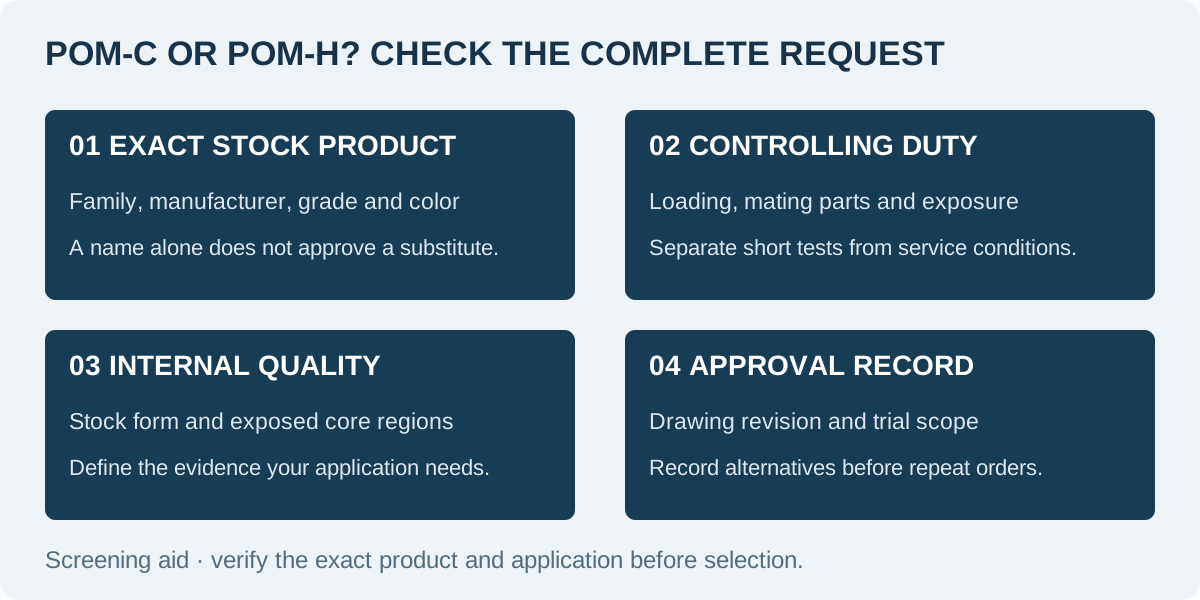
MCG's POM material overview describes the broad tradeoff between mechanical performance and chemical resistance in its homopolymer and copolymer offerings. It also discusses reduced centerline porosity in copolymer acetal. Use those observations to choose the questions for a grade comparison, not to approve every product sharing an abbreviation.
| Selection issue | POM-H screening direction | POM-C screening direction |
|---|---|---|
| Mechanical demand | Review strength, stiffness and sustained loading data | Check that the selected grade meets the same requirement |
| Wet or chemical exposure | Examine limitations for the exact environment | Consider relevant resistance advantages, then verify conditions |
| Stock core quality | Review the stock form and any core-related concern | Review supplier porosity statements and applicable scope |
| Sliding contact | Identify unmodified or wear-modified formulation | Identify unmodified or wear-modified formulation |
| Purchasing control | Name the approved grade and permitted alternatives | Name the approved grade and permitted alternatives |
A screening table is deliberately incomplete. It cannot capture load duration, cleaner concentration, mating surface or geometry. Make the final decision from the controlling application conditions, then keep the approved grade attached to the drawing and purchase record.
Compare Mechanical Properties Under Matching Conditions
A stiffness value describes a response under a particular test method. It does not directly tell you how far a long guide will deflect in an assembly. Translate the functional requirement into a part-level question before comparing datasheet values.
For a gear, identify transmitted load, speed, tooth geometry and the mating gear. For a spacer under a fastener, identify contact area and the duration of the clamping load. Those components do not become equivalent material selection problems merely because both are made from acetal.
Distinguish short-term strength from time-dependent deformation. A favorable tensile result alone is insufficient for a continuously loaded support. Ask for information appropriate to the expected temperature and duration, and evaluate the assembled geometry where the fit depends on movement over time.
Our guide to plastic creep and stress relaxation explains that distinction. Use it to identify what additional evidence is needed rather than converting a single room-temperature property into an unsupported operating guarantee.
Understand The Centerline Porosity Question
Centerline porosity concerns the internal condition of certain stock shapes. It is different from a burr, a scratch or a hole left by the machining operation. If a design exposes the stock core, internal material quality becomes part of the review rather than an issue that can be judged from the original outside surface.
Ensinger describes TECAFORM AH natural POM-C as an unfilled porosity-free stock product. That statement belongs to the identified supplier product. Do not extend it automatically to every unknown copolymer blank or treat it as qualification of a complete fluid system.
A central bore or deep pocket may expose material that was not visible on the blank. Ask the supplier to consider where the final surfaces lie within the proposed stock. Identify any requirement for exposed internal surfaces, cleanliness or material integrity before the machining route is finalized.
Avoid using a catalog photograph as evidence of internal quality. If the application needs a defined verification or functional test, agree its method and acceptance criteria. The material designation and finished dimensions alone do not establish that a manifold is leak-tight or suitable for an assigned pressure.
Review Hot Water And Cleaning Separately From Dry Heat
A dry-air temperature rating does not automatically cover repeated washing or immersion. Specify the liquid, temperature, contact time and repetition. Include the cleaning chemical and its concentration where relevant. The service environment is a sequence of exposures, not simply a maximum temperature.
Ensinger's TECAFORM AD natural POM-H datasheet explicitly lists a hot-water limitation for that product. This illustrates why the exact grade guidance must remain attached to the comparison. A mechanical advantage does not cancel an exposure restriction.
If POM-C is proposed for a washing environment, verify that particular product against the actual cleaning sequence. A general resistance advantage is not a blanket approval for every cleaner, prolonged exposure or sterilization method. Ask what evidence supports the conditions rather than accepting the phrase chemical resistant.
For a food-contact component, request the relevant declaration for the specific grade, color and intended use. Material family selection and regulatory documentation are separate decisions. The responsible application owner should confirm whether the available documents cover the finished part and exposure conditions.
Keep Friction And Wear As A Separate Comparison
Do not compare an internally lubricated formulation with an unmodified grade and attribute the entire difference to POM-C versus POM-H. Record additives and modifications before using a wear result to shortlist a material. The same family name can cover products intended for different functions.
Describe the complete contact system: mating material, finish, lubrication, movement, load and contamination. An intermittent guide and a continuously rotating sleeve can have different acceptance priorities. Identify whether the concern is drive force, clearance growth, visible debris or another defined outcome.
A representative trial should preserve those conditions. If dry operation is required, do not let an assembly lubricant silently become part of the successful test configuration. Record the trial route so a future replacement part can be evaluated against the conditions that were actually approved.
For rotational parts, send the shaft and housing relationships with the drawing. The plastic bushing clearance guide develops the installed fit questions that remain relevant whichever acetal grade is selected.
Machinability Does Not Set A Universal Tolerance
Both candidate stock products need a process appropriate to the actual geometry. A short sleeve, a thin open frame and a deeply pocketed block present different support and measurement questions. Avoid specifying a single tight material tolerance as if it applies equally to every feature.
Identify functional datums and critical dimensions. Ask the supplier how the component will be supported and when important features will be finished relative to major stock removal. If a treatment or stabilization step is proposed, clarify its scope and the condition in which final acceptance occurs.
For a through bore, confirm the required size along the relevant length, not only at the entrance. For a blind hole, distinguish usable depth from the drill tip. Clear requirements can resolve a manufacturing question more effectively than changing the polymer family without changing an ambiguous drawing.
Discuss those details through the Delrin and POM machining page. The starting point is a drawing review of the proposed grade and geometry, rather than a promise that all acetals can achieve an identical result.
Example: Reviewing A Manifold Material Substitution
Consider a hypothetical acetal manifold with internal passages, mounting counterbores and removable connections. The existing drawing names a POM-H product. A supplier proposes POM-C because a suitable stock size is readily available. This is a substitution review example, not a reported customer case.
Begin by identifying what the original approval covered. Was it based on a mechanical trial, a cleaning assessment, material documentation or simply an early prototype? Recover that information before deciding which comparisons are necessary. The existing material name alone may not explain the original design intent.
Next, review internal passages and exposed stock regions. Record relevant cleaning exposures and connection loads. If the current application requires a functional check, define it explicitly with the responsible party. Do not assume a new stock product inherits the earlier component's acceptance.
Compare candidate samples using the same drawing revision and inspection state. Record dimensional results, any specified internal inspection and application testing. If a difference is acceptable, document why and identify the approved alternative. If it is not acceptable, retain the original requirement or revise the design through the appropriate process.
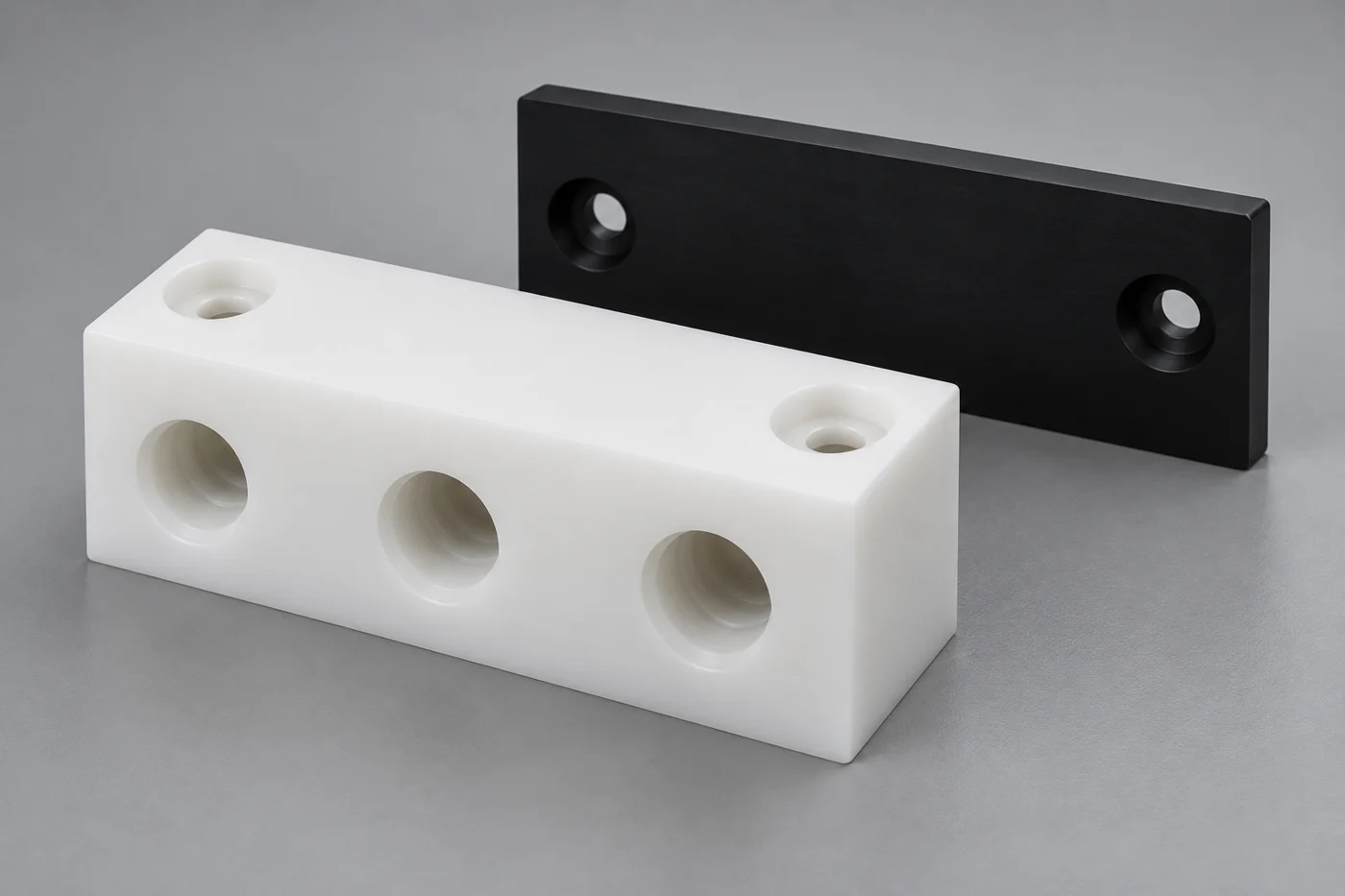
The product illustration shows only a possible component form. It does not demonstrate material identity, fluid compatibility or a pressure rating. For an actual project, include the operating and inspection details with your plastic manifold inquiry.
Write A Material Note That Supports Repeat Orders
A useful note identifies the approved stock product, color and any permitted alternative route. If substitutes require approval, say so. If a family-level requirement is sufficient, document the properties and evidence that establish acceptability instead of relying on an unrestricted equivalent allowance.
Keep the inspection scope clear. A material certificate addresses a different question from a dimensional report or a functional test record. Request the deliverables needed for the application and include them in quotation comparisons, so suppliers price the same acceptance package.
For repeat orders, record changes to stock manufacturer, grade, formulation or material route. Agree which changes require renewed review. This prevents the first successful trial from becoming disconnected from the product supplied several purchase orders later.
For example, a review request can identify the current stock product, the proposed replacement, the reason for the change and the required evidence. Attach the current drawing revision and list the decisions still open. This makes it easier to distinguish a material substitution from a simultaneous geometry change, and prevents a successful sample from approving more changes than the trial actually evaluated.
Compare Total Accepted-Part Cost
A lower stock price does not necessarily mean a lower delivered cost. Include available stock dimensions, material yield, machining operations, inspection and the qualification effort associated with a substitute. A product already approved for the application may avoid review work that a nominally cheaper option creates.
Ask suppliers to explain the scope behind a price difference. One quote may include documentation or additional bore finishing that another omits. Compare those items directly before attributing the difference to copolymer versus homopolymer alone.
If both candidates satisfy the requirements, commercial factors can guide the final choice. Record the selected grade and the approval basis. That gives purchasing a practical rule for repeat orders without implying that the same decision applies to every acetal part.
Frequently Asked Questions
Is POM-C The Same Material As Delrin?
No. POM-C identifies copolymer acetal, while Delrin is associated with acetal homopolymer products. Confirm the required grade rather than treating the names as interchangeable on a drawing or purchase order.
Is POM-H Always The Better Mechanical Choice?
A broad material trend does not establish the best finished component. Compare the candidate grades under relevant load, temperature and duration conditions, then evaluate geometry. A short-term datasheet result alone is not a complete design decision.
Does POM-C Automatically Make A Manifold Leak-Tight?
No. Supplier statements about stock porosity do not qualify connections, passage geometry or the complete assembly. Define any required integrity or functional evaluation separately, with its acceptance conditions and responsible reviewer.
Can I Identify The Two Materials From Color?
No reliable purchasing control should depend on appearance alone. Use the material designation and batch documentation to identify the approved stock. Similar-looking white or black components can have different grades or formulations.
Can A Supplier Substitute POM-C For POM-H?
Only within the agreed approval rules. Review the properties, exposure requirements and documentation that controlled the original selection. Update the material record or drawing when an alternative is approved so the decision remains traceable.
What Is The Best First Step For An Undecided Part?
Describe the function and controlling conditions before requesting candidate grades. Include loading, mating parts, exposure, quantity and inspection needs. A focused comparison is more useful than asking for whichever acetal happens to be available.
Request An Acetal Material And Drawing Review
Send TOPS Plastics your drawing through the contact page, together with quantity, part number and application conditions. Identify POM-C, POM-H or the named product if it is mandatory. If selection is open, explain the fit, loading and cleaning requirements so the quotation discussion can address the material decision as well as machining.