Select a plastic machining coolant by the identified material, cutting operation and finished-part requirements. A fluid that works on a metal job is not automatically suitable for a polymer component. The useful question is whether the proposed cooling and cleaning route controls machining heat while preserving the properties, dimensions and surface condition needed for acceptance.
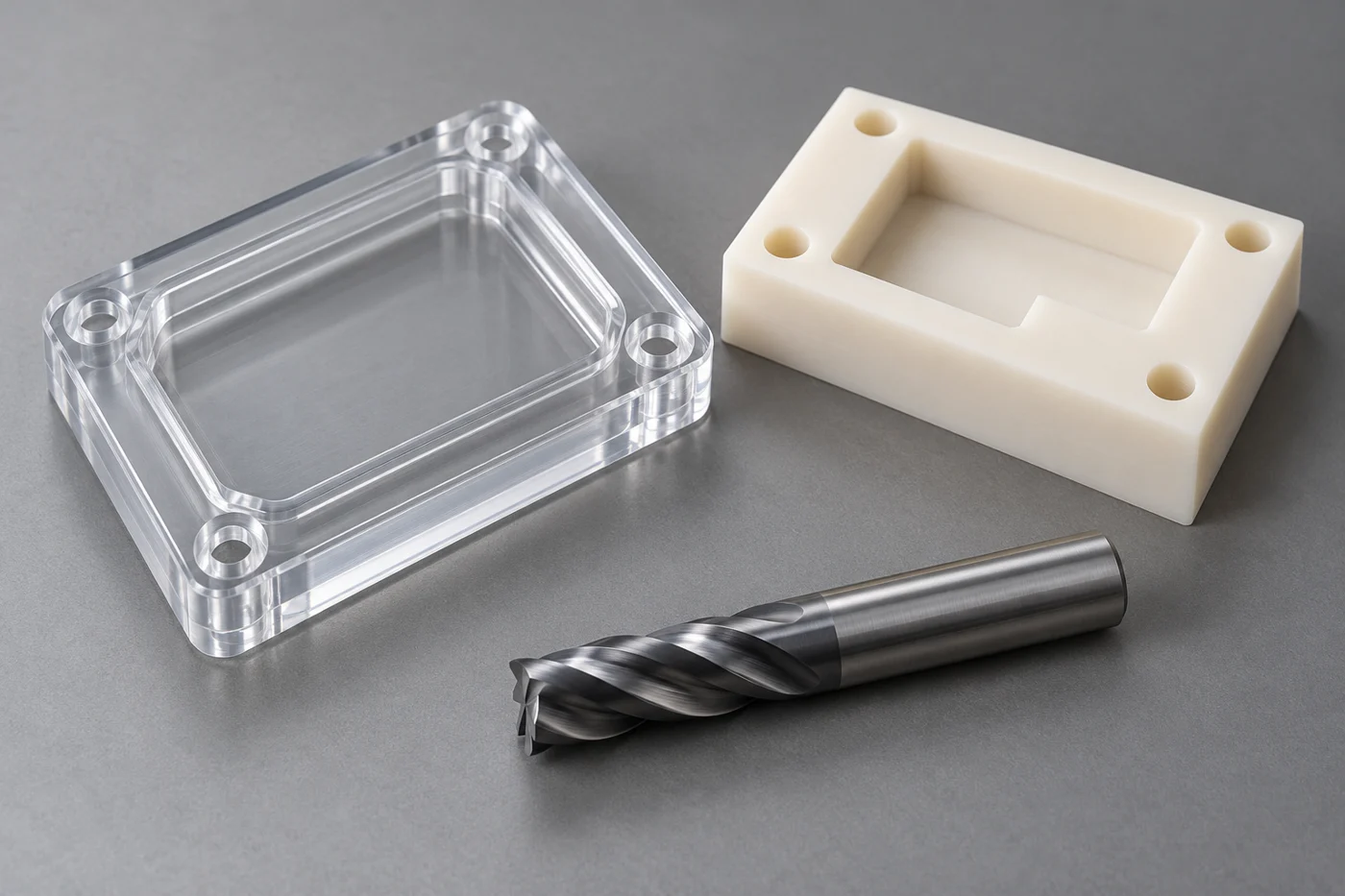
Buyers do not need to prescribe every machining parameter. They do need to communicate restrictions that affect the process and agree how critical results will be checked. This guide explains the discussions needed before ordering a transparent cover, insulating plate, precision housing or another machined plastic component where process-fluid exposure could matter.
Start With The Material And Operation
Specify the manufacturer and stock designation where the drawing requires a particular product. Identify fillers, modifiers and relevant surface requirements. A polymer family name helps screen a process, but the actual formulation and supplier guidance should inform the decision about exposure to a machining fluid.
Describe the features that make the operation demanding. A deep bore, narrow pocket or interrupted cut presents different access and chip-clearance questions from an open face. The process review should connect those features to heat control, support and the permitted condition of the finished surfaces.
Ask the supplier to identify any conflict between the drawing and its proposed route. If a required surface cannot tolerate the selected fluid or cleaning method, resolve the issue before production. An unexplained instruction to use standard coolant can leave the most important compatibility assumption unreviewed.
Use the engineering plastic selection guide to establish the material requirements first. Process convenience should be evaluated within those requirements rather than silently changing the material or acceptance scope.
Understand Why Heat Control Needs A Process Review
Cutting generates heat, and the local conditions depend on tool engagement, sharpness, chip formation and evacuation. Adding liquid is only one possible response. A process that repeatedly rubs or recuts chips may need a tooling or access change as well as a review of cooling.
Mitsubishi Chemical Group’s machinist toolkit describes several cooling approaches and discusses operations where cooling can be useful. Its guidance supports reviewing the operation rather than assuming every plastic job requires the same fluid system. Apply recommendations to the actual stock product and geometry.
Heat-related movement can also complicate inspection. A feature measured immediately after cutting may not represent the agreed final condition. Define the relevant temperature and timing of acceptance checks, particularly when a tight fit or a broad flat surface controls assembly.
The thermal expansion guide provides background for that discussion. Cooling during machining and dimensional acceptance after machining are connected decisions, but they should not be reduced to a single undocumented shop preference.
Separate Cooling Options From Compatibility Claims
A process review may consider air, a mist or an appropriate liquid system. Each option needs evaluation for the machine, operation and material. This article does not recommend a universal cooling method or a fluid recipe, because the necessary conditions have not been defined for an individual job.
For air-assisted cutting, consider whether chips can leave the cutting zone and whether the arrangement supports the required result. A label such as dry machining does not establish low temperature or an acceptable finish by itself. The supplier still needs a reproducible cutting and evacuation strategy.
For a liquid system, identify the actual product and its working condition when compatibility is important. Concentration, contamination and contact duration may be relevant to the review. A product name without its intended use conditions can leave uncertainty about what the component will actually encounter.
For a mist system, the same material and acceptance questions remain. A smaller quantity of fluid is still an exposure. Confirm any restrictions on residue, subsequent bonding or sensitive surfaces before approving a route merely because it uses less liquid than another process.
Take Stress-Cracking Concerns Seriously
Chemical exposure and mechanical stress can interact in a polymer component. The relevant stress may include assembly loading or residual stresses associated with the stock and processing history. A compatibility review should therefore consider more than whether an unstressed sample looks unchanged after brief contact.
MCG’s metric machining guide warns that some general-purpose mineral-oil-based fluids can contribute to stress cracking in particular amorphous plastics. Treat that as a reason to verify the grade and process, not as a claim that every fluid or every amorphous product behaves identically.
Ensinger’s machining FAQ also identifies coolant-related material effects as a consideration in process selection. Obtain current guidance for the proposed stock and fluid combination. If the evidence is insufficient, agree an appropriate evaluation before exposing the production quantity.
Visible cracks can have multiple causes. Tool loading, restrained geometry and handling damage deserve investigation alongside chemistry. Record the observed condition and processing history rather than assigning a cause from a photograph alone. The purpose is to identify the mechanism and prevent recurrence.
Define The Exposure Beyond The Cutting Cycle
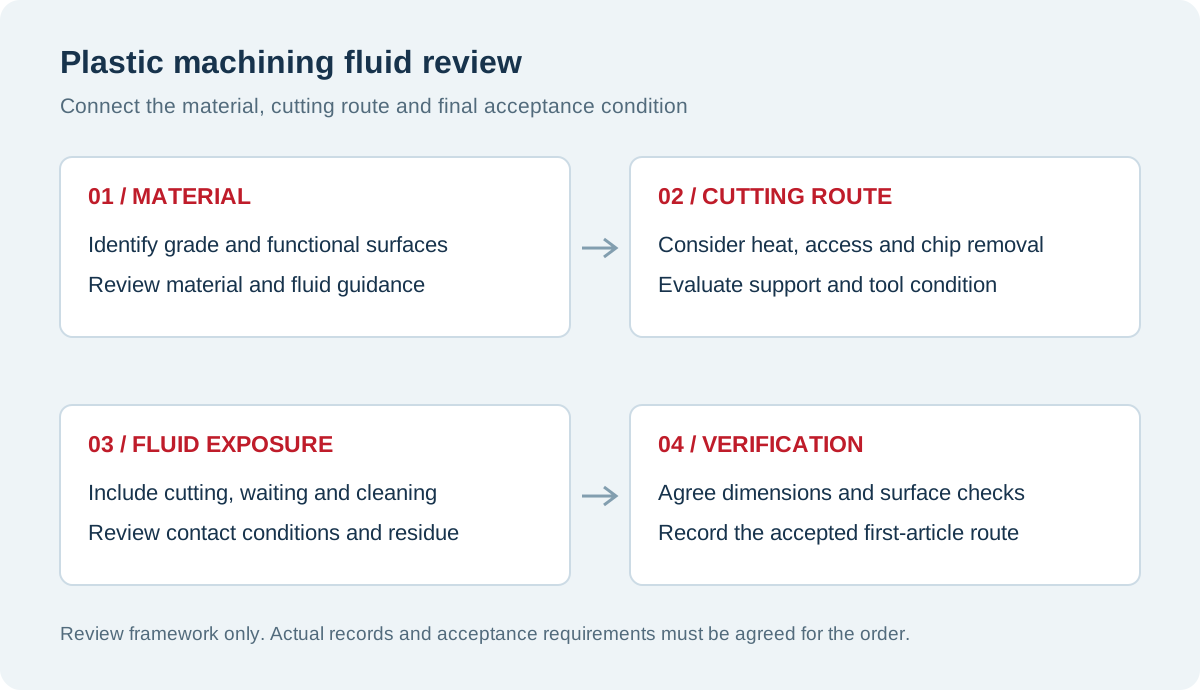
The component may contact fluid during machining, waiting between operations, washing or storage. Include those stages when describing the proposed route. A short cutting cycle does not necessarily mean a short total exposure if parts remain wet in a container afterward.
Review the sequence between roughing, finishing and inspection. Fluid retained in blind features or close-fitting fixtures may create a different contact pattern from an open surface. Ask how the supplier handles the geometry rather than assuming every face dries or drains in the same way.
The chemical resistance guide explains why medium, concentration, temperature and exposure duration belong together. Use that framework for process fluids as well as service chemicals. Both can influence the material entering the finished assembly.
If the customer requires a specific restriction, state it in the drawing or order documentation. Examples may include an approved fluid list or a requirement to review cleaning agents. The restriction should have an identified purpose and approval owner so the supplier can evaluate it before quoting.
| Process question | Information to establish | Acceptance implication |
|---|---|---|
| Material identity | Manufacturer, grade, modifiers and stock form | Determines which compatibility guidance is relevant |
| Cutting challenge | Feature depth, access, support and chip removal | Helps select a workable heat-control route |
| Fluid exposure | Product, working condition and contact sequence | Defines the actual combination to review |
| Post-machining handling | Drainage, cleaning and storage arrangement | Addresses exposure after the tool has stopped |
| Final verification | Dimensions, surfaces and required records | Connects the process to the delivered component |
Keep Cleaning Within The Approved Route
Cleaning deserves its own compatibility review. A solvent that removes one residue effectively may be unsuitable for the particular polymer, surface state or downstream application. Do not copy a general cleaning recipe into every plastic purchase order without confirming its scope.
Ask what needs to be removed and what condition must remain. A cosmetic cover, adhesive-bonded part and component with a controlled cleanliness requirement can need different evidence. Define the requirement before selecting the agent and method intended to achieve it.
Where supplier guidance proposes a post-machining treatment, confirm that it applies to the actual product and use. The review should include the material, fluid and cleaning sequence together. This article deliberately avoids prescribing solvents, temperatures or exposure times for an unspecified component.
Record approved changes. Replacing a cleaning product or altering a sequence can affect the basis on which a first article was accepted. The responsible team should decide which changes require renewed review instead of assuming all products sold for cleaning are interchangeable.
Protect Functional And Transparent Surfaces
Identify the surfaces that matter to function before machining begins. A transparent cover may have appearance and visibility requirements that differ from a hidden mounting face. Specify the relevant viewing conditions and permitted marks so the acceptance decision is more useful than a subjective request for a perfect finish.
Surface changes can include marks, deposits or damage, but appearance alone does not establish their cause. Compare the condition before and after the relevant operations where investigation is needed. Preserve material identity and processing information so the comparison concerns the same candidate route.
The product illustration shows transparent plates supported for handling and inspection. It represents a surface-review discussion rather than a documented factory procedure. Actual support points and contact materials should protect the faces identified as critical on the drawing.
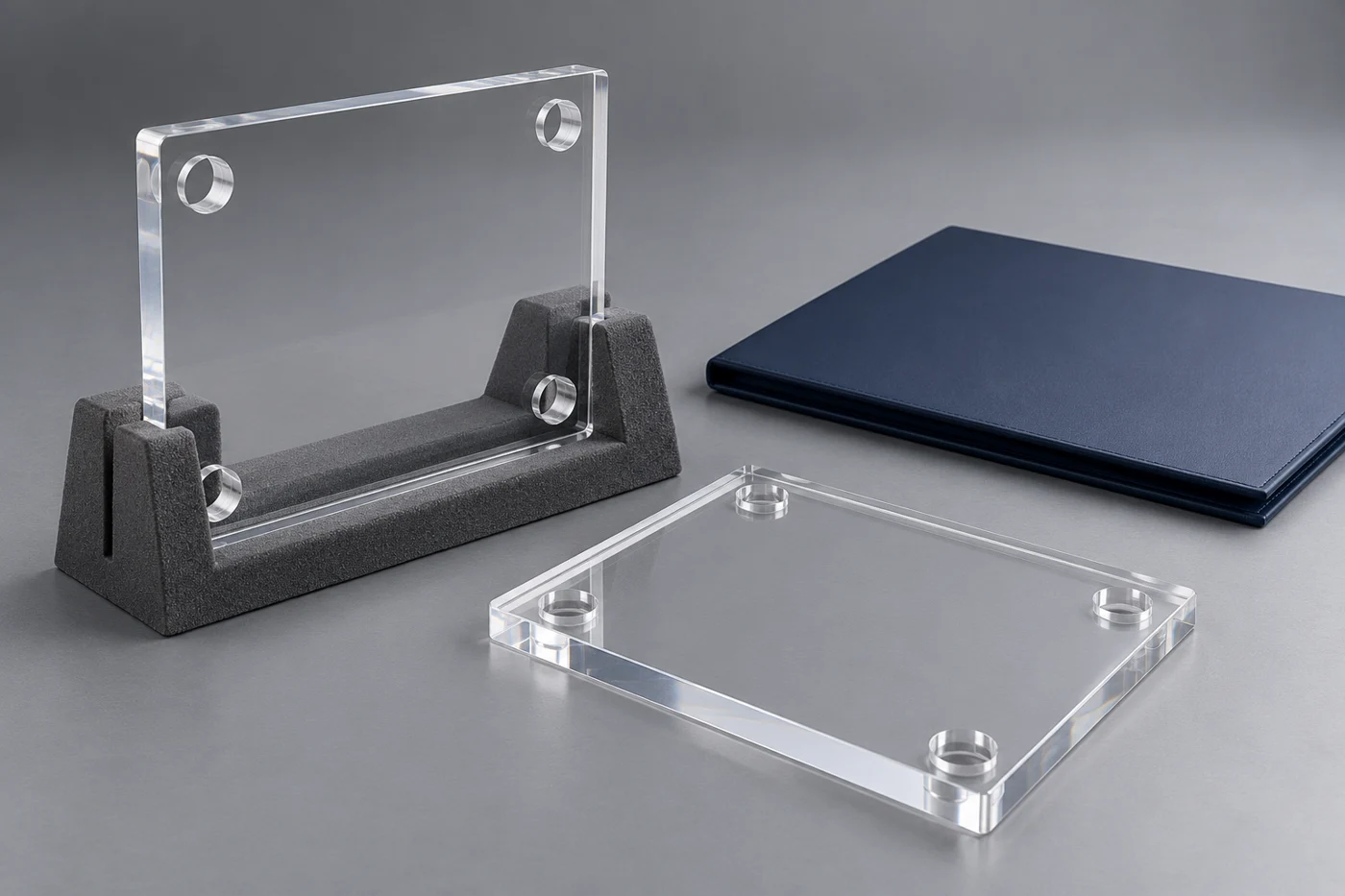
For polycarbonate components or acrylic components, review the specific stock and required surface result. Do not infer identical processing behavior merely because both materials can be supplied as transparent parts.
Include Dimensional And Moisture Effects
If a material can take up moisture, a water-containing process may deserve attention in the dimensional review. Establish the measurement state and any approved conditioning requirements. The effect cannot be represented by one correction that applies to every grade, geometry and exposure history.
The nylon moisture article explains why storage and inspection conditions matter for polyamide components. Use that background when defining the relevant delivery state. A correct measurement needs a shared basis between the machining supplier and receiving inspector.
Temperature, restraint and stress redistribution remain separate contributors to movement. The warpage guide helps organize those questions. A coolant change should not be treated as proof that every dimensional issue has been resolved.
When comparing methods, record how and when the measurements are taken. Otherwise, one route may appear more accurate simply because the parts were checked in different states. The first-article plan should create a fair comparison tied to the actual acceptance requirement.
Use A Representative First Article
Select the proposed stock grade and representative features for the trial. Include the surfaces and geometries most likely to challenge the process. A flat sample may help screen an exposure, but it cannot by itself establish the outcome for a deeply pocketed or mechanically restrained component.
Agree what the trial must demonstrate before making the parts. This may include critical dimensions, an agreed visual inspection and evidence relevant to downstream use. If additional material testing is needed, specify its purpose, method and acceptance basis with the responsible technical team.
Record the process conditions necessary to interpret the result. A successful sample is most useful when its material identity, route and inspection conditions are known. The buyer can then determine whether a proposed production change remains within the accepted basis or requires another review.
A limited trial does not establish every service outcome. State any differences between the trial and the intended application, particularly where exposure, stress or duration differs. This helps the approval team use the evidence without turning it into a broader guarantee than the evaluation supports.
A Hypothetical Transparent-Cover Review
Imagine a buyer sourcing a transparent machined cover with mounting holes and a recessed edge. The initial inquiry specifies dimensions but does not define the visible-face acceptance or process-fluid restrictions. This is a hypothetical example, not a TOPS customer case.
The review identifies the stock designation, functional viewing area and assembly loading around the fasteners. The supplier then explains its proposed cutting, cleaning and handling sequence. Any uncertain compatibility question is addressed before the production quantity is exposed.
The resulting first article can be evaluated against a defined visual and dimensional plan. If a change is needed, the parties record it before release. The improvement comes from connecting the material, process and acceptance conditions rather than relying on a generic statement that the shop uses plastic-safe coolant.
Make Your RFQ Useful To The Machining Supplier
Send the current drawing and model, quantity and material identity. Mark critical surfaces, fits and downstream operations such as bonding or polishing. Include any customer-defined restrictions on machining fluids or cleaning agents, together with the person responsible for approving exceptions.
Request a review of unresolved assumptions before production. If the supplier cannot confirm a required material-fluid combination, agree the next evaluation or an alternative route. Separate the first-article decision from release of the remaining quantity when the project needs that control.
Compare quotations against the same deliverable. A route that includes additional cleaning, inspection or documentation is not directly comparable with an offer that omits those requirements. Clarify the scope so the purchasing decision reflects the accepted component rather than only machine time.
Frequently Asked Questions
Do All Plastics Need Liquid Coolant During CNC Machining?
No. The operation, grade, geometry and acceptance requirements determine the appropriate route. Review tooling and chip evacuation as well as cooling. A universal instruction cannot represent every plastic component.
Can Metalworking Coolant Be Used On A Plastic Part?
Do not assume compatibility from its use on metal. Identify the fluid and material, review supplier guidance and address any evidence gap. Some combinations can create material or surface concerns that are absent on the metal job.
Is Cleaning After Machining Always Harmless?
No. Cleaning agents and methods also need material and application review. Define the residue-removal objective and permitted surface condition. Approve the complete route rather than evaluating machining and cleaning independently.
Does A Clear First Article Prove Long-Term Compatibility?
A good appearance is useful evidence within the agreed inspection scope. It does not automatically establish every exposure or loaded-service outcome. Define any additional evaluation needed for the application before production release.
Discuss Your Plastic Machining Requirements
Send TOPS Plastics your drawing for review. Include material identity, quantity, critical surfaces and any process-fluid restrictions. Those details support a practical discussion of machining, cleaning and acceptance before a production commitment.