Choose PEEK or PPS by the operating requirements of the finished component and the properties of an identified stock product. PEEK deserves consideration where demanding thermal and mechanical requirements drive selection. PPS can be a useful candidate where its particular combination of chemical resistance, dimensional behavior and manufacturability satisfies the application. Neither family name establishes a complete component specification.
For a buyer, the practical task is to compare two approved material routes against the same drawing, service conditions and acceptance plan. A cheaper stock quotation is meaningful only if the resulting component still performs its job. This guide explains what to review before ordering a machined bracket, sleeve, insulator, manifold component or precision spacer.
Start With The Component’s Job
List the requirements that would cause the part to fail if they were missed. These may include load at temperature, chemical exposure, clearance, electrical function or a mating-surface requirement. Separate essential conditions from preferences so the selection does not become a comparison of unrelated data-sheet advantages.
Describe how the component works in its assembly. A spacer that maintains a gap has a different acceptance problem from a sliding sleeve or a part exposed to process fluid. The same material family may be suitable for one role and unsuitable for another because geometry and operating conditions change the decision.
Specify normal operation, startup, shutdown and maintenance exposure where relevant. A short temperature peak or cleaning step may matter even when ordinary service appears mild. Include the duration and frequency of those events rather than giving the supplier one unexplained maximum value.
Use the engineering plastic selection guide to organize the requirements. A useful comparison begins with the application and then tests each candidate against it, instead of selecting a familiar polymer and trying to justify it afterward.
Understand The Family Names And Grade Differences
PEEK is polyetheretherketone. PPS is polyphenylene sulfide. Both names cover products with different formulations and processing histories. Identify the actual manufacturer designation and stock form when comparing candidates. An unfilled stock product and a reinforced grade should not share an assumed property set merely because their family name matches.
Ask whether the grade contains glass, carbon, lubricants or other modifiers. These additions can change properties relevant to stiffness, wear, conductivity and machining. Evaluate the complete formulation against the function. A material selected for a bearing role may not be an appropriate substitute for an electrical insulator.
Ensinger’s PPS material overview discusses both the comparison with PEEK and applications where PPS can be considered. Treat that overview as a starting point for a grade-specific review. It does not establish that any PPS product can replace an unspecified PEEK component.
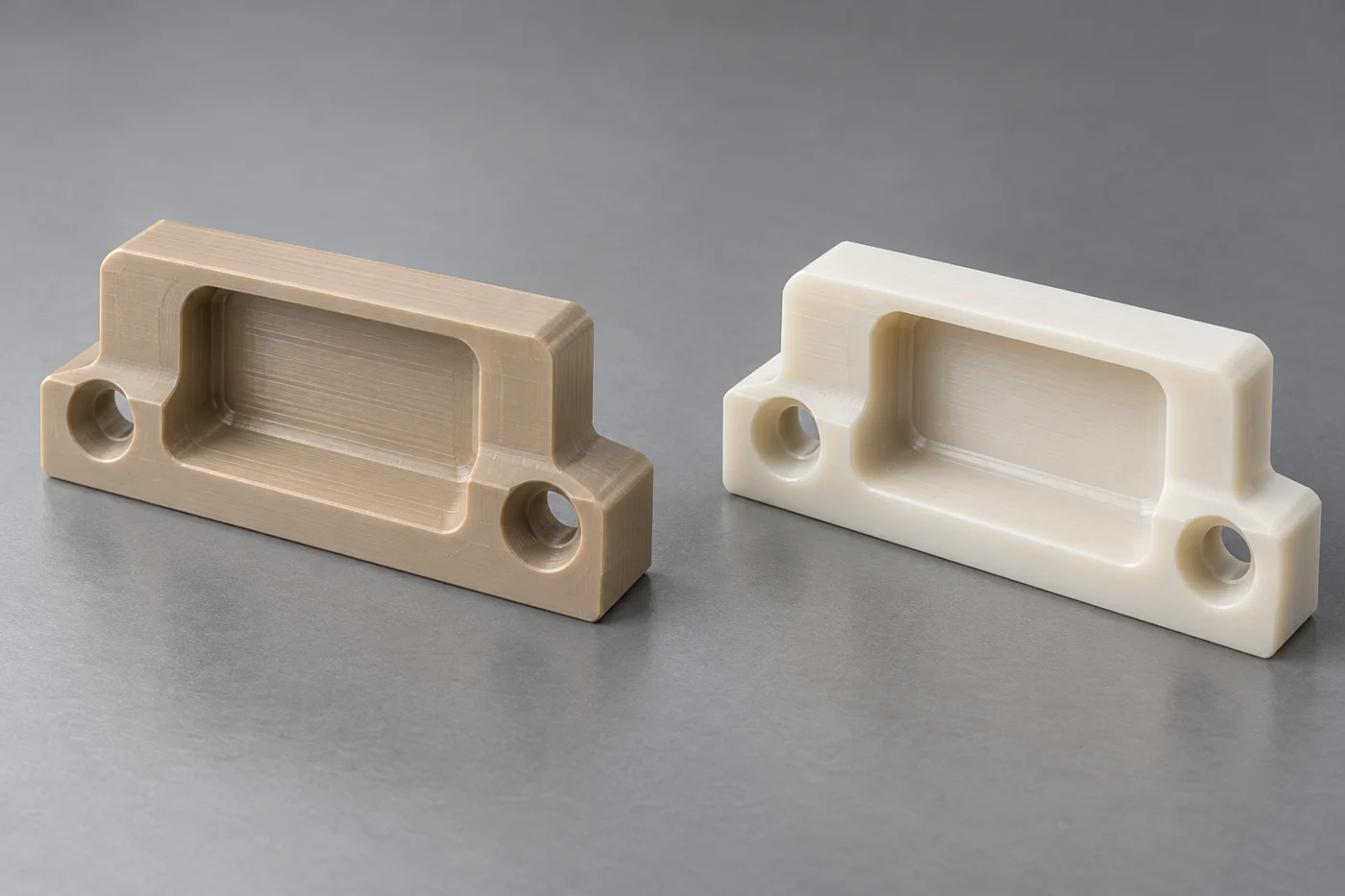
Color is not a reliable material specification. The illustrations in this article use different tones to make candidate parts easy to distinguish. Confirm identity through the approved designation and supply records, using the material traceability guide where documentation is important.
Compare Temperature And Load Together
Temperature capability needs an application context. A published thermal property does not automatically describe the allowable load or deformation of a particular machined part over its operating life. Review the property definition, test conditions and any supplier guidance applicable to the identified grade.
A lightly loaded insulating feature and a continuously loaded support can produce different selection outcomes. Ask how much movement is acceptable and over what duration. The surrounding metal assembly, fasteners and mating components also influence whether a change in shape becomes a functional problem.
For sustained loading, review creep rather than relying only on a short-term strength value. The plastic creep and stress relaxation article explains why a component can need a time-dependent assessment. Obtain relevant material information and validate the proposed geometry where the requirement demands it.
Avoid comparing heat-deflection temperature from one source with continuous-use guidance from another as though they were the same metric. Keep the test method and definition visible in the comparison. If the available data do not answer the operating question, identify the missing evaluation instead of creating a numerical guarantee.
Review Chemical Exposure In Detail
List the actual medium, concentration, temperature and contact pattern. Include cleaning agents and accidental exposures that the design must tolerate. A general statement that a polymer has broad chemical resistance is useful for screening, but it does not describe every combination of stress, fluid and service history.
Mitsubishi Chemical Group’s Techtron PPS range emphasizes chemical resistance as a feature of its products. The purchasing decision still needs the particular grade and exposure conditions. Do not convert a family-level description into an unrestricted compatibility statement for a finished component.
Consider the mechanical condition during exposure. A clamped part, threaded connection or loaded corner may present a different situation from an unstressed sample. Ask the responsible engineer whether representative testing is needed when supplier information does not cover the combination being proposed.
The chemical resistance guide provides a structured way to collect these details. Keep the material comparison tied to the complete process environment so a later cleaning change does not silently invalidate the original assumptions.
Evaluate Dimensional Stability As An Assembly Requirement
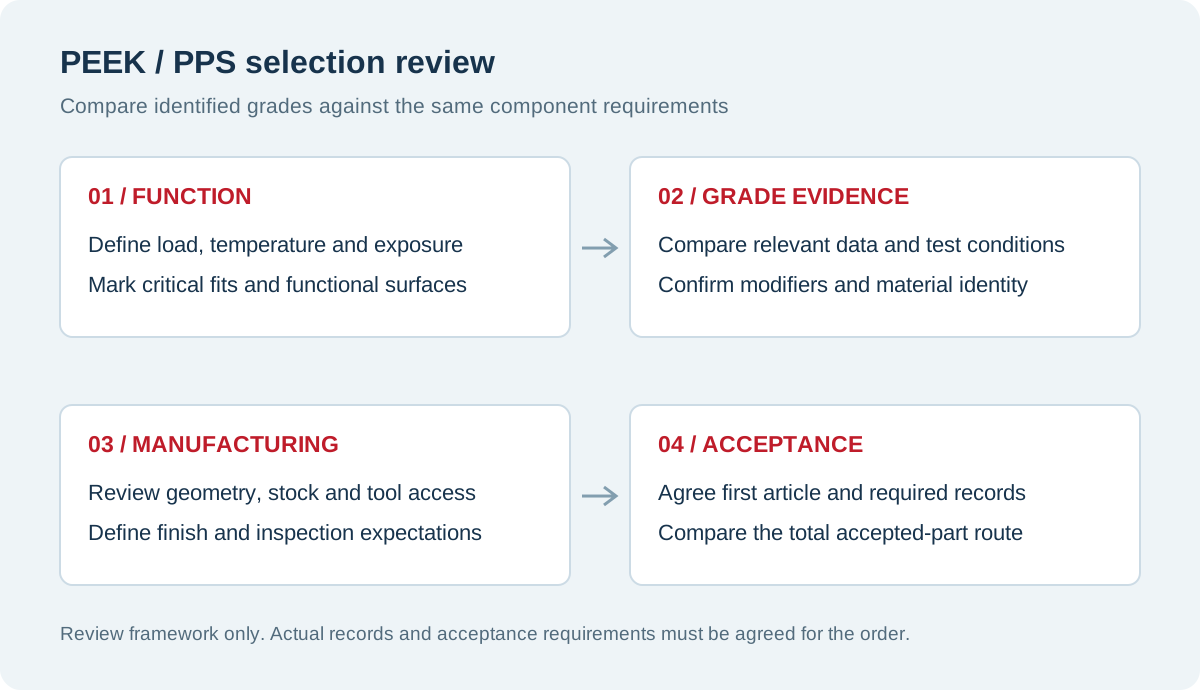
A material with favorable dimensional characteristics still needs a clear inspection state and tolerance strategy. Identify which bores, faces or mounting relationships control function. Define whether acceptance applies to the free part or a documented restrained condition, and establish the relevant temperature basis.
MCG describes Techtron 1000 PPS through low moisture absorption and favorable dimensional stability. That is information about an identified stock product. It is not a promise that every machined feature will remain unchanged after substantial stock removal or under an unspecified service load.
Review thermal movement against the mating assembly. A close fit can be affected by differences between the polymer and its surrounding components even when the part was correct at inspection. The thermal expansion guide explains why operating clearance deserves separate attention.
When a tight tolerance is proposed, ask why it is required and how it will be verified. Concentrate precision on functional relationships instead of assigning the same demanding limit to every exterior surface. This makes the quotation and first-article plan more meaningful for either material.
| Selection question | Evidence to compare | Decision it supports |
|---|---|---|
| Load at operating temperature | Grade-specific data, duration and allowable movement | Whether the candidate can support the function |
| Fluid or cleaning exposure | Medium, concentration, temperature and stress condition | Whether further compatibility evaluation is needed |
| Critical fit | Mating geometry, inspection state and thermal movement | Which tolerance and clearance requirements matter |
| Sliding contact | Counterface, lubrication, load and motion pattern | Whether a bearing grade or another design is needed |
| Production acceptance | Stock identity, machining route and inspection scope | Whether quotations cover the same deliverable |
Match Wear And Electrical Requirements To The Grade
For a sliding part, identify the mating surface, lubrication condition and motion pattern. Wear performance depends on the contact system. A standard stock grade should not inherit the performance of a specially modified bearing formulation, and a laboratory friction value should not be treated as a service-life prediction.
For electrical insulation, define the relevant conditions and required evidence. Fillers and modifiers can affect behavior, so the polymer family alone is insufficient. Check the identified product rather than assuming every PEEK or PPS grade serves the same insulating role.
The electrical insulating plastics guide discusses the information to include in that review. If a specific approval or test is required, confirm its scope and applicability to the supplied grade before placing the order.
The product illustration shows candidate sleeve, spacer and plate geometries. These shapes illustrate different functional roles. Their appearance does not establish material identity, electrical performance or suitability for any particular operating condition.

Review Machining Access And Geometry
Both candidates need a manufacturing review of the actual drawing. Deep pockets, small internal radii, slender walls and interrupted features affect tool access and support. A statement that a material machines well does not answer whether the proposed geometry can be produced and accepted consistently.
Discuss the stock form and material-removal sequence. A heavily pocketed plate can expose movement that was not apparent in the starting blank. The plastic machining warpage article explains why material condition, restraint and stock removal belong in the same planning discussion.
Reinforced grades can require different tooling and surface expectations from unfilled products. Confirm which surfaces are functional and whether exposed reinforcement or machining texture creates an application concern. Do not substitute one formulation solely to improve stiffness without reviewing those consequences.
Use the PEEK machining page and PPS machining page as starting points for a drawing-based discussion. Ask for proposed exceptions and design changes to be documented before the quotation becomes a production commitment.
Compare Accepted-Part Cost
Compare quotations using the same quantity, drawing revision, documentation and inspection requirements. Stock cost is only one part of the total. Setup, tool access, material yield, additional processing and verification can change which route is practical for a particular component.
Avoid publishing or relying on a fixed PEEK-to-PPS cost ratio without a current quotation for the identified products. Prices and availability depend on grade, source, size and order conditions. A material that appears economical in one stock size may produce a different result for another geometry.
Consider what happens after an unsuccessful first article. A low initial quote can lose its advantage if an unapproved substitution or unclear acceptance condition forces rework or another material purchase. Define the evidence needed to release the part before comparing the offers.
A suitable decision balances function, supply and manufacturing requirements. If both candidates satisfy the approved specification, the commercial comparison can then focus on the actual accepted component. If evidence remains incomplete, make that uncertainty visible instead of hiding it inside a price decision.
Use A Focused First-Article Evaluation
Choose representative geometry and the exact proposed stock grade. Identify the critical features and any application trial needed before ordering the production quantity. A generic sample block may help demonstrate finish, but it cannot establish every behavior of a slender, loaded or chemically exposed component.
Agree the measurement method, support and environmental conditions. If the evaluation includes service exposure, record what is being tested and the limits of the trial. One successful short test does not prove unrestricted life under every operating condition.
Keep material changes controlled during development. If a prototype uses one grade and production is quoted in another, review the difference explicitly. Record approval, affected revisions and any additional checks so the trial remains connected to the material that will actually be delivered.
A Hypothetical Spacer Decision
Imagine a buyer evaluating a machined spacer used near a heated process area. The original drawing specifies PEEK without a grade or load-duration requirement. This is a hypothetical example, not a TOPS customer case or a claim about an existing application.
A useful review establishes the actual temperature history, compressive loading, permitted movement and exposure to cleaning fluid. The buyer can then compare identified PEEK and PPS candidates using relevant evidence. The decision may favor either material or reveal a need to change the geometry.
The important improvement is a controlled specification. The chosen grade, inspection conditions and accepted evidence become part of the order. Future sourcing then has a clear reference instead of depending on the color of an old sample or an unexplained material abbreviation.
What To Include In Your RFQ
Send the current drawing and model, quantity, material designation and application conditions. Mark critical fits, loaded areas and functional surfaces. State which substitutions are permitted and who approves them, especially when the comparison is intended to identify an alternative to an existing grade.
List the inspection records and material documents needed at delivery. Ask the supplier to identify unavailable evidence or proposed exceptions before production. If a first-article stage is required, agree its scope separately from the remaining quantity so the release decision is clear.
Frequently Asked Questions
Is PPS Always A Substitute For PEEK?
No. Compare identified grades against the actual load, temperature, chemicals and functional requirements. Similar material categories do not establish interchangeability. Any substitution needs approval against the component specification.
Which Material Costs Less?
Obtain current quotations for the exact grade, stock size and quantity. Compare machining, inspection and documentation as well as material cost. A fixed price ratio cannot represent every order.
Can Both Materials Be Used For Precision Parts?
Both deserve application-specific consideration. Achievable acceptance depends on geometry, stock condition, manufacturing and inspection. Favorable material properties do not remove the need for a clear drawing and first-article plan.
Should A Filled Grade Be Preferred Automatically?
No. Review the effect of modifiers on all relevant functions, including wear, electrical behavior and surface requirements. A benefit in one property does not establish suitability for the complete component.
Discuss Your PEEK Or PPS Component
Send TOPS Plastics your drawing for review. Include quantity, the proposed grade and the operating conditions that drive selection. Those details support a practical comparison of material, machining and acceptance requirements before production.