
Choose between PET and POM by checking the exact grade against the way the part fits, moves and encounters its environment. Both can be useful engineering plastics for machined components. Neither material name alone establishes a running clearance, wear life, cleaning limit or finished tolerance.
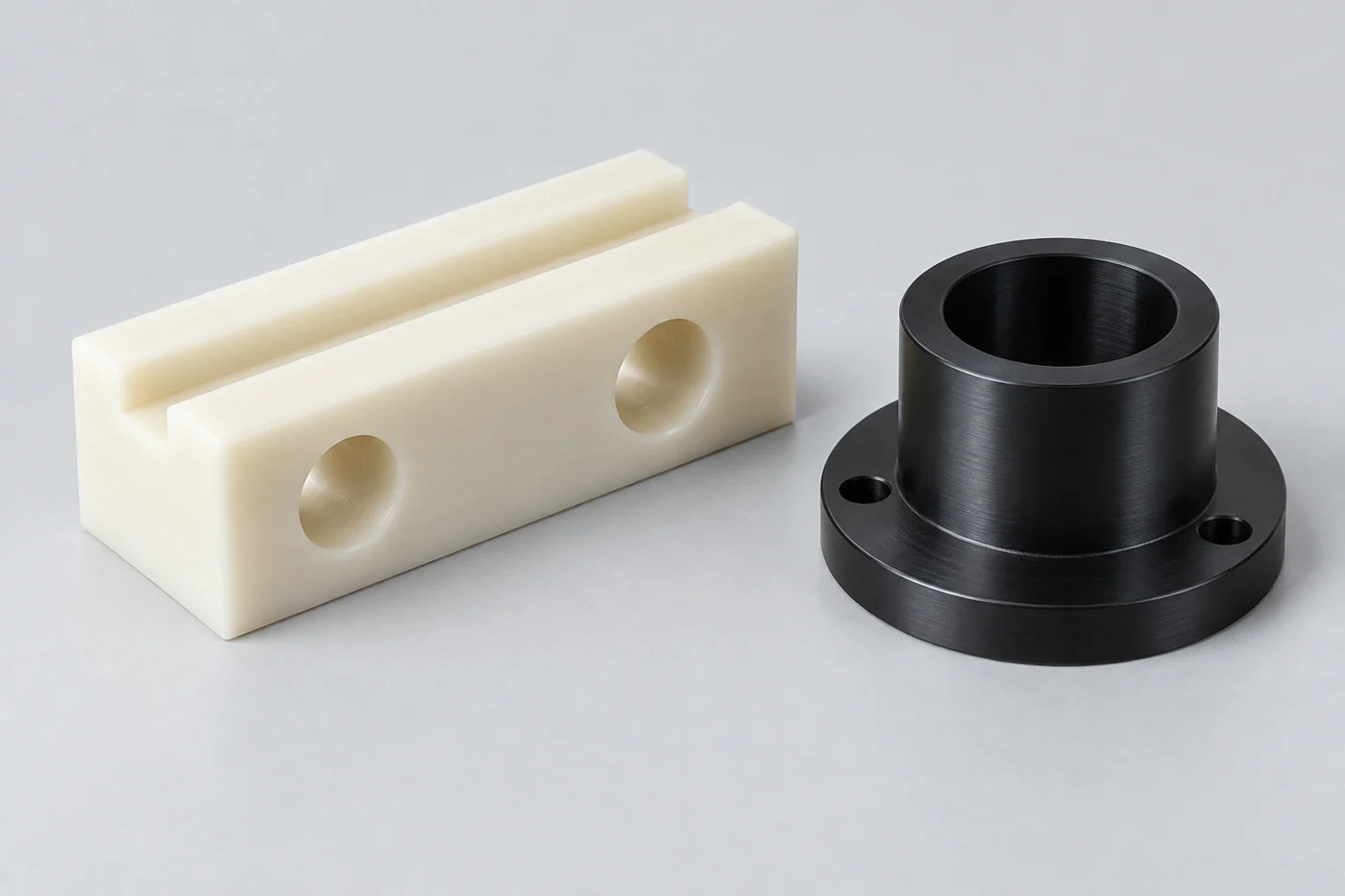
For an initial shortlist, consider engineering PET stock for precision guides and wear components, and acetal POM for general mechanical components such as sleeves, gears and spacers. Then compare the actual stock products. A purchasing decision becomes stronger when the drawing, material designation and application trial describe the same conditions.
Start With The Right Material Names
Here PET means engineering stock intended for machining, commonly described as PET-P. Do not substitute packaging sheet or recycled bottle material merely because the polymer abbreviation matches. Stock form, formulation and production history belong in the specification alongside the polymer family.
MCG identifies its Ertalyte family as semicrystalline PET products for mechanical precision components, with dimensional stability and wear among its listed characteristics. That is a useful starting point for a shortlist, rather than proof that every PET formulation suits your part.
POM means polyoxymethylene, also called acetal. POM-C identifies copolymer acetal; POM-H identifies homopolymer acetal. Delrin is a brand associated with acetal homopolymer, not a generic name covering every POM stock product. If a drawing names a brand or grade, clarify whether an alternative is permitted before quoting.
For example, Ensinger lists low water absorption, machinability and dimensional stability for TECAFORM AH natural POM-C. These are product characteristics. An approved substitution still needs a comparison of the properties that matter to the actual assembly.
Compare Decisions, Not A Single Winning Number
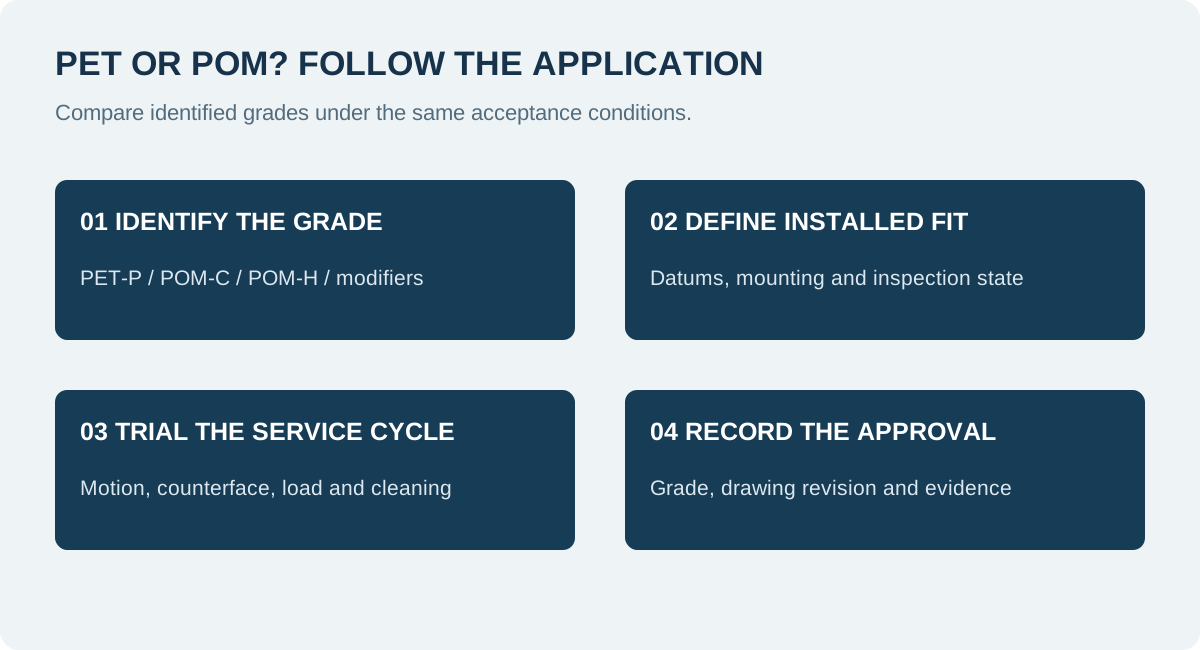
A useful comparison table identifies questions to resolve. It should not turn unmatched datasheets into a universal ranking. Test temperature, conditioning, loading and specimen preparation can change what a published result means.
| Decision | PET candidate review | POM candidate review |
|---|---|---|
| Precision fit | Confirm stock grade, conditioning and finished geometry | Confirm POM-C or POM-H and the inspection state |
| Sliding contact | Compare unmodified and bearing grades separately | Identify any lubricant or wear additive |
| Repeated movement | Assess contact stress and the complete motion cycle | Assess fatigue, impact and engagement geometry |
| Cleaning exposure | Check exact chemical, concentration, time and temperature | Check the same exposure sequence and stressed condition |
| Production purchase | Check available sizes, traceability and usable yield | Check approved supplier grade and substitution rules |
Avoid choosing from color. White PET and white acetal can look similar. A black component does not reveal whether it contains a functional additive. Use material identification and supplier documentation to connect the finished part to the approved stock.
Check Installed Fit Before Tightening The Drawing
A measured bore is only one part of a running fit. The shaft size, mounting constraint, temperature and service environment also matter. Start with the permissible assembled clearance or interference. Work backward to the dimensions each component must have at the agreed inspection condition.
For a flanged sleeve, separate the bore function from the outside diameter and flange seating function. Pressing the sleeve into a housing can affect its installed bore. A tighter free bore tolerance does not automatically produce a better operating fit after installation.
The comparison should include a defined measurement method. A compliant component may respond differently to a plug gauge, contact probe and handheld instrument. Decide how the part will be supported, where measurements will be taken and whether acceptance occurs before or after assembly.
Use the same measurement plan for PET and POM trial parts. Otherwise, a difference attributed to material may actually come from fixturing or inspection. Our guide to plastic bushing clearance develops the fit questions in more detail.
Treat Wear As A System Test
A low friction claim is not a service life prediction. The mating surface, lubrication, debris, load, velocity and start-stop pattern all belong in the comparison. A slowly oscillating sleeve and a continuously sliding rail can demand different compromises even when their nominal loads appear similar.
Keep unmodified grades separate from modified bearing grades. MCG describes Ertalyte TX as an internally lubricated PET grade. Its intended role should not be transferred automatically to plain PET stock or used to predict performance against an untested shaft surface.
For either polymer, ask what failure would look like. Excessive clearance, scoring, stick-slip, debris generation and rising drive force are different outcomes. Set the acceptance limits before testing so that a smooth first run does not conceal unacceptable wear over repeated cycles.
Record the counterface material and finish in the trial report. Also record whether lubrication is permitted in production. A test performed with an assembly aid can produce a misleading result if the delivered equipment must operate dry.
Review Moisture And Temperature Together
Low moisture absorption does not mean dimensions remain unchanged under every operating condition. Separate the inspection environment from the operating environment. A room temperature measurement cannot demonstrate clearance during a hot process or immediately after a cleaning cycle.
Ask for grade data using comparable conditioning and test methods. A short immersion result and a saturation result answer different questions. Likewise, a heat deflection temperature is a particular loaded test result, not an automatic continuous operating temperature for your component.
Ensinger describes TECAPET white as a formulated PET stock product with low moisture absorption and sliding properties. Its published data include different thermal test conditions. This illustrates why the grade and test basis must remain attached to any numerical comparison.
For a constrained component, review temperature changes alongside mounting geometry. Slots, separate locating features or a different support arrangement may address movement more effectively than a material substitution alone. Read the related discussion of plastic thermal expansion before freezing a long guide assembly.
Evaluate Cleaning And Chemical Exposure Precisely
Do not approve either material from the phrase chemical resistant. Identify the substances actually present, including cleaners, lubricants and residues. State concentration, exposure duration, operating temperature and whether the part remains under mechanical stress during contact.
A cleaning schedule can be more demanding than normal operation. Distinguish a brief wipe from repeated immersion, hot washing or an extended soak. Ask the stock supplier for information on that specific sequence rather than relying on a broad family compatibility chart.
Where published evidence is incomplete, arrange a representative evaluation. Compare dimensions, appearance and function before and after exposure. A part can retain an acceptable appearance while losing a critical fit, so visual inspection alone may be insufficient.
Food contact requirements introduce a separate documentation question. Neither PET nor POM is automatically approved for every food application. Request the declaration relevant to the exact grade, color and intended conditions, and have the responsible party review its applicability to the finished assembly.
What Changes At The Machine Shop?
Begin with the functional surfaces and the amount of stock removal. A thick block with a shallow pocket and a thin open frame have different distortion risks. Ask the shop to review support, clamping and machining sequence against the finished geometry.
Do not assign a universal PET or POM tolerance to every feature. A short external diameter, long slender bore and broad thin wall do not present the same manufacturing or inspection problem. Identify the few features that control function, then allow practical tolerances elsewhere.
Edge condition deserves its own note. Define permitted edge breaks where a part contacts product, slides against another component or locates against a shoulder. A deburring operation should not remove a small functional land or change an intended sealing edge.
Discuss any proposed stabilization or additional processing before approval. If the process route changes, the first article should represent that route. Our PET machining and Delrin and POM machining pages provide starting points for a drawing review.
Example: Comparing Two Candidates For A Sliding Guide
Consider a hypothetical packaging machine guide. It locates a moving carriage, experiences intermittent sliding and is removed for cleaning. The existing drawing lists only white plastic. That specification cannot reliably control repeat purchases or explain why replacement guides behave differently.
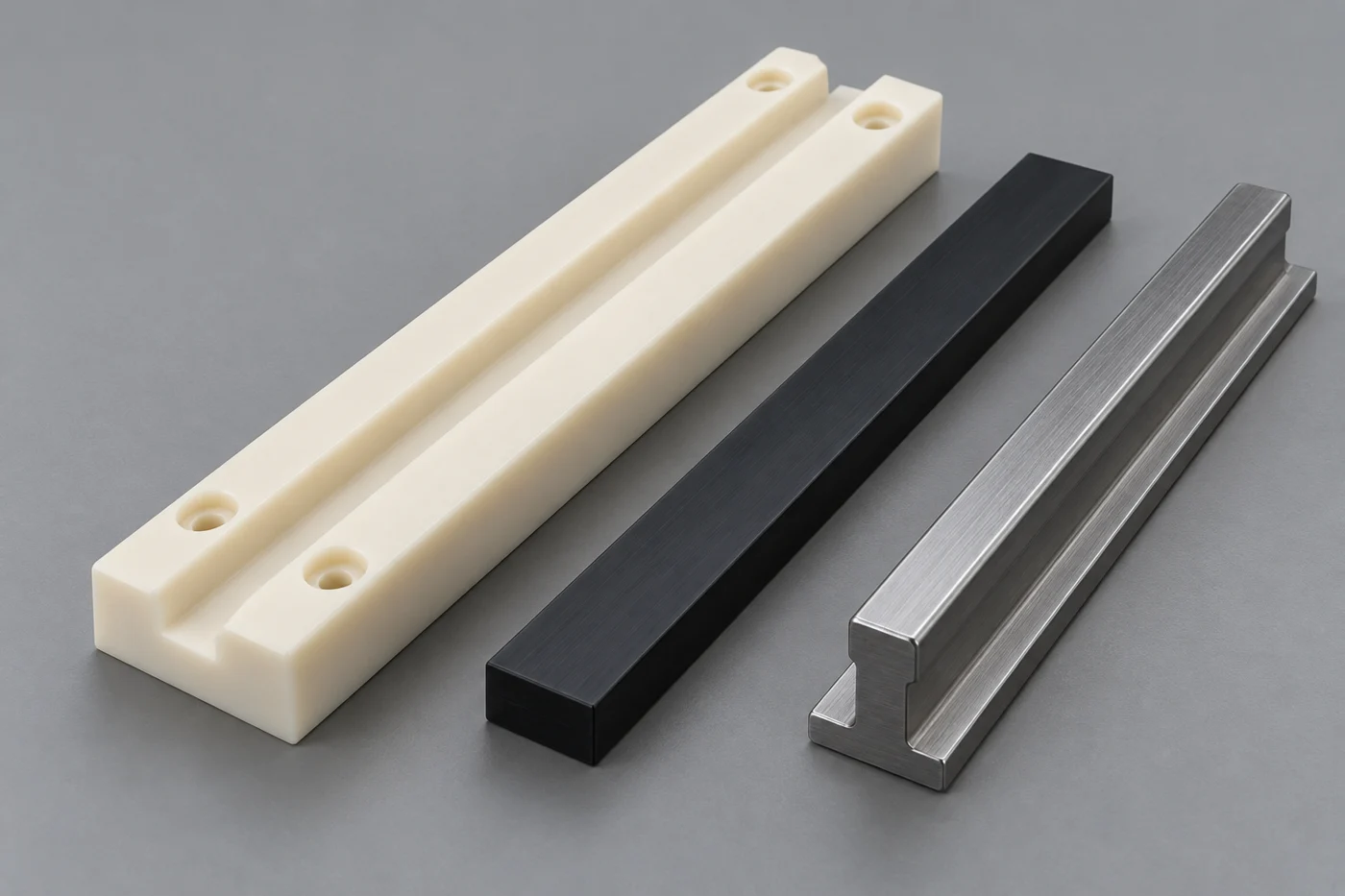
First, define the channel position relative to the mounting datums. Separate the locating face from clearance faces. Record carriage material, contact finish, travel, duty cycle and the cleaning sequence. Identify whether wear debris could affect the product or mechanism.
Then request trial parts in one identified PET grade and one identified POM grade. Keep their geometry and inspection conditions consistent. Check free dimensions, mounted alignment, drive force and wear after a representative cycle sequence. Inspect again after the specified cleaning exposure.
If one candidate binds, investigate mounting constraint and local contact before blaming the polymer. If another wears acceptably but cannot meet the cleaning requirement, a favorable dry trial is insufficient. The selected combination must satisfy the complete operating sequence.
The result might favor either candidate, or show that the geometry needs revision. This is a decision method, not a customer case or a claimed TOPS performance result. Record why the selected grade passed so future substitutions can be evaluated against the same evidence.
Before releasing the trial order, decide who owns each acceptance decision. Engineering should define function, purchasing should confirm the supplied grade and quality staff should agree the inspection record. Keep a retained sample or a documented dimensional baseline when useful. This makes a later replacement order easier to compare with the tested configuration and reduces uncertainty when a supplier proposes another stock product.
Compare Total Accepted-Part Cost
Stock price is only one line in the purchase decision. Include available stock dimensions, material yield, machining operations, inspection effort, documentation and qualification work. A cheaper blank may be poor value if its available form creates unnecessary waste or additional setups.
Ask for separate explanations when quotes differ. One supplier may include material traceability and first article reporting while another prices only the machined component. Compare like scopes before concluding that the price difference comes from PET versus POM.
For repeat orders, specify the approved grade and how changes will be communicated. A substitution that appears minor to purchasing can invalidate a wear trial or compliance review. Agree which changes require a new sample, document review or functional check.
What To Send With Your RFQ
Send a drawing and model, quantity, part number and destination country. Add the functional context where it affects selection: mating material, movement, temperature range, cleaning exposure and the consequences of failure. Mark the dimensions that determine fit or alignment.
If the material is undecided, request a comparison rather than writing an unrestricted equivalent allowance. State the baseline grade, the reason an alternative is being considered and the evidence needed for acceptance. This gives suppliers a useful decision boundary without implying that all acetals or polyesters are interchangeable.
Include the required inspection state and any documentation you need. For a repeat part, provide the drawing revision and relevant trial findings. A concise, complete RFQ is more valuable than a long list of unrelated property requirements.
Frequently Asked Questions
Is PET Always More Dimensionally Stable Than POM?
No universal ranking establishes the behavior of your finished part. Compare identified stock grades under matching conditions, then evaluate the geometry and mounting. Supplier dimensional stability descriptions help with screening, but do not replace an installed fit requirement.
Can I Replace Delrin With PET Without Changing The Drawing?
Treat that as a material change requiring review. Check fit, wear, chemical exposure, documentation and manufacturing route. A trial may show that the geometry works, but the drawing should identify the approved material and any acceptance changes before repeat production.
Which Material Is Better For A Gear?
Start with tooth geometry, transmitted load, speed, lubrication and the mating gear. Compare candidate grades against those conditions and inspect the relevant failure modes. A general statement about machinability does not establish tooth fatigue or wear life.
Does A Bearing Grade Remove The Need For Lubrication?
Do not assume it does. Review the manufacturer's grade guidance and the complete contact system. Where dry operation is required, test the actual counterface and duty cycle without introducing a lubricant that will be absent in service.
Can White PET And White POM Be Identified Visually?
Appearance is insufficient for reliable purchasing control. Keep the supplier grade designation and material records linked to the batch. If material identity is uncertain, resolve it through an appropriate verification process before using the part in a critical assembly.
Should I Specify The Tightest Possible Tolerance?
Specify the tolerance needed for function and agree how it will be verified. Unnecessary tight limits can increase manufacturing and inspection effort without improving the assembly. Evaluate the installed fit before narrowing a free component dimension.
Request A PET Or POM Drawing Review
Send TOPS Plastics your drawing, quantity and application conditions through our contact page. Identify whether PET, POM-C, POM-H or a named grade is required, or ask for candidate review. Include the critical fit and exposure details so the quotation discussion can address the component you actually need.