
Machining reinforced plastics requires a review of the exact material product, stock form and functional surfaces. A glass-filled or carbon-filled designation does not automatically establish a finished part’s strength, wear behavior or dimensional capability. The useful specification connects the offered grade to the component’s loading, manufacturing route and acceptance requirements.
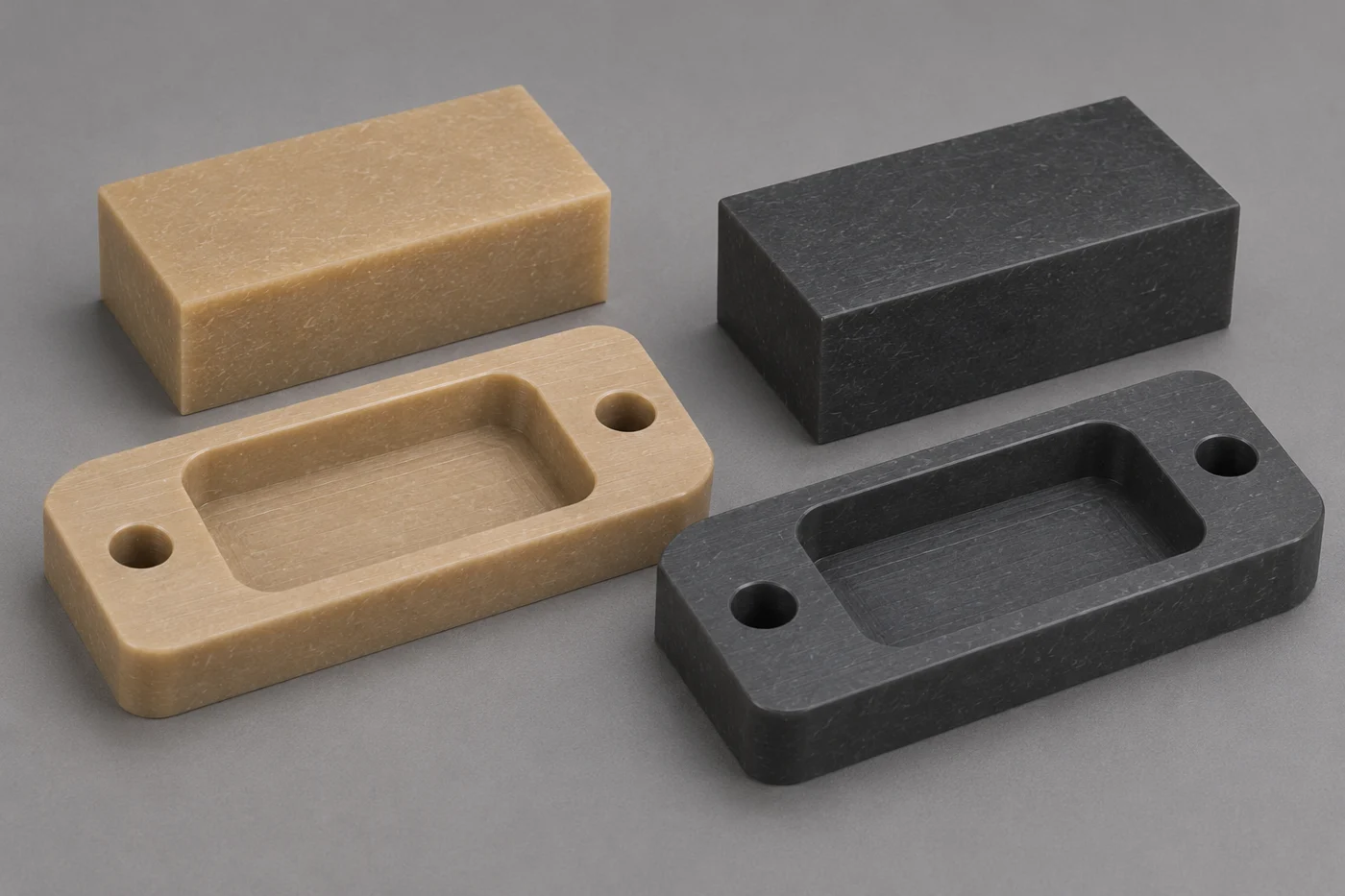
For a buyer, reinforcement should solve an identified application problem rather than serve as a general quality upgrade. This guide explains what to discuss before ordering a machined bracket, support, sleeve or insulating component from reinforced engineering-plastic stock. It focuses on practical design and purchasing decisions without prescribing universal cutting parameters.
Establish Why Reinforcement Is Being Considered
Start with the function that an unfilled candidate does not adequately address. The concern may involve stiffness, sustained loading, thermal movement or another property. Define the allowed displacement and operating conditions before assuming a reinforced formulation is the appropriate response.
A component can fail through an unsuitable fit, concentrated assembly load or inadequate support even when its material has favorable published strength. Examine the geometry and load path alongside material selection. A formulation change should not conceal a design issue that would remain with the new stock.
Identify all functions carried by the part. A structural support may also insulate, slide against another surface or contact a process medium. Improving one property can introduce questions elsewhere. The approval decision should cover the complete application rather than the single value that first attracted attention.
Use the engineering plastic selection guide to organize the requirements. A useful shortlist is based on what the component must do and which evidence is available for each identified candidate.
Specify The Product And Its Stock Form
Record the manufacturer designation, polymer matrix and reinforcement type. State the content where it forms part of the approved specification. A phrase such as carbon-filled plastic leaves the supplier to choose both the base polymer and formulation unless the supporting documents resolve those choices.
Stock form and manufacturing route also deserve attention. A machined component from rod or plate should not automatically inherit every assumption associated with a molded specimen or a continuous-fiber laminate. Check that the information being compared concerns the product and form proposed for the order.
Ensinger lists different glass-reinforced material forms, including composite architectures. This illustrates why reinforced plastics should not be treated as one material category. A short-fiber stock product and a fabric-reinforced sheet need their own relevant review.
Keep the drawing, quotation and purchase order consistent. Resolve differences in grade, source or form before material is cut. The material traceability guide explains how to connect the approved description to delivered components and supporting records.
Review Direction And Property Evidence
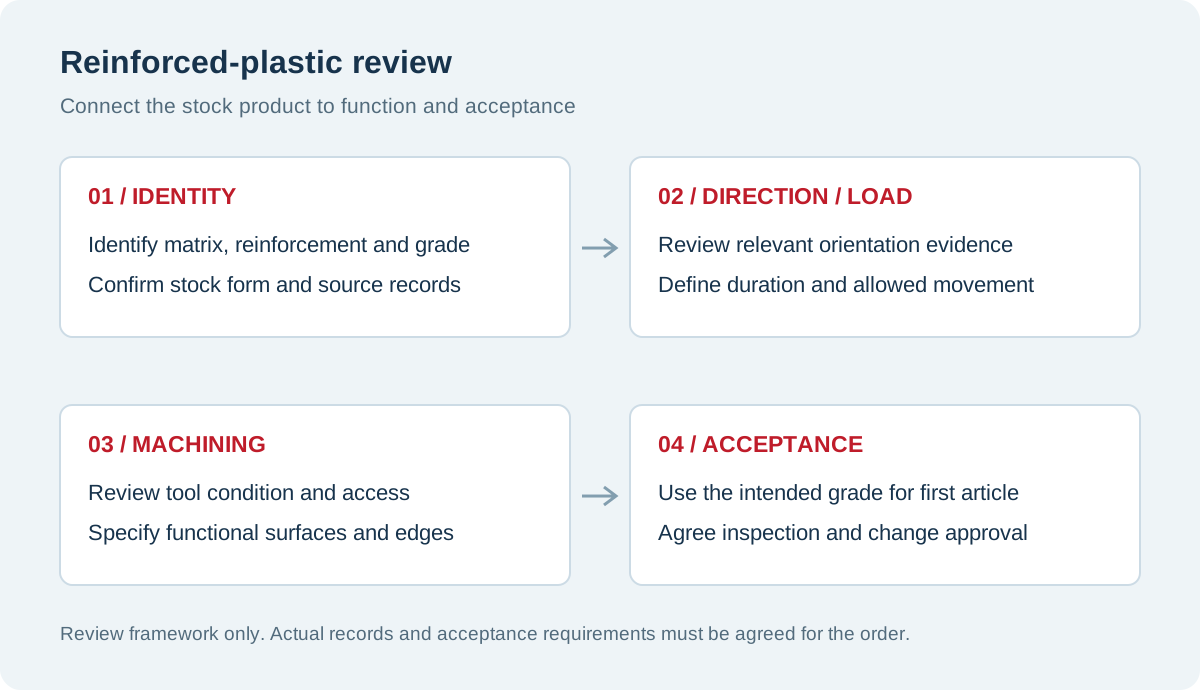
Ask whether direction-dependent properties are relevant to the selected product. The relationship between material processing direction, reinforcement arrangement and the component’s load can matter. The responsible engineer should evaluate the available product information rather than assuming identical behavior in every direction.
Keep test conditions visible when comparing data. A value from one specimen orientation or method is not directly interchangeable with a result obtained differently. Record the method, temperature and any stated limitations before using the figures in a design calculation or material comparison.
If the intended orientation within stock is important, discuss how it will be specified and retained through cutting. A model alone may not communicate that requirement. Agree what the supplier must identify and what evidence the buyer needs to review it.
Do not invent a directional correction where the necessary data are unavailable. Identify the information gap and determine whether supplier clarification, analysis or representative testing is needed. A clear limitation supports a better decision than a precise-looking assumption without a valid basis.
Compare Stiffness With Long-Term Loading
Higher stiffness can reduce displacement under a given set of conditions, but it does not answer every time-dependent question. Define load duration, temperature and permitted movement. A continuously loaded spacer has a different evaluation problem from a lightly loaded cover used only for protection.
Ensinger describes TECAPEEK GF30 natural through increased rigidity and improved creep-related characteristics compared with its unfilled reference. Keep that comparison attached to the named product. It is not evidence that every glass-filled polymer will satisfy an unspecified structural requirement.
The plastic creep guide explains why short-term strength alone is insufficient for sustained loading. Obtain relevant information for the identified grade and evaluate the component’s contact areas and support arrangement.
Review assembly forces as well as service loads. Fasteners, interference fits and localized clamping can create conditions different from the nominal operating load. A material upgrade should be assessed within that assembly rather than approved only from a broad family-level property comparison.
Plan For Tool Wear And Process Consistency
Reinforcement changes the machining discussion. Tool material, edge condition and the planned inspection interval should suit the actual product and operation. A process proven on an unfilled grade should not be assumed to transfer unchanged to a filled formulation.
Mitsubishi Chemical Group’s machining toolkit discusses tooling choices for reinforced and filled materials. Use the manufacturer guidance to support a grade-specific process review. It does not establish one tool type, cutting speed or tool life for every reinforced-plastic feature.
A worn edge can alter surface quality and dimensional results. Ask how the supplier intends to maintain an acceptable process through the requested quantity. The useful evidence concerns repeatability of the agreed result rather than an unsupported statement that the material machines easily.
Machining conditions should also provide appropriate chip removal and heat control. Deep pockets and interrupted cuts may deserve additional review. If a process fluid is proposed, use the coolant compatibility guide to collect the relevant material and exposure information.
Define Functional Surface Requirements
A reinforced stock product can present different surface considerations from an unfilled candidate. Identify sealing lands, sliding contacts, electrical surfaces and cosmetic areas. Discuss the permitted condition after machining rather than assuming a smooth appearance establishes every functional requirement.
Surface requirements should be specific enough to inspect. A generic note calling for a perfect finish can leave the supplier and buyer with different expectations. Define the relevant area, inspection approach and any approved reference needed to make the acceptance decision reproducible.
The component illustration shows separate support and sleeve concepts beside a metal shaft. It illustrates why a surface may serve different jobs. The image does not identify a tested grade, prove a surface condition or establish suitability for a particular mating arrangement.
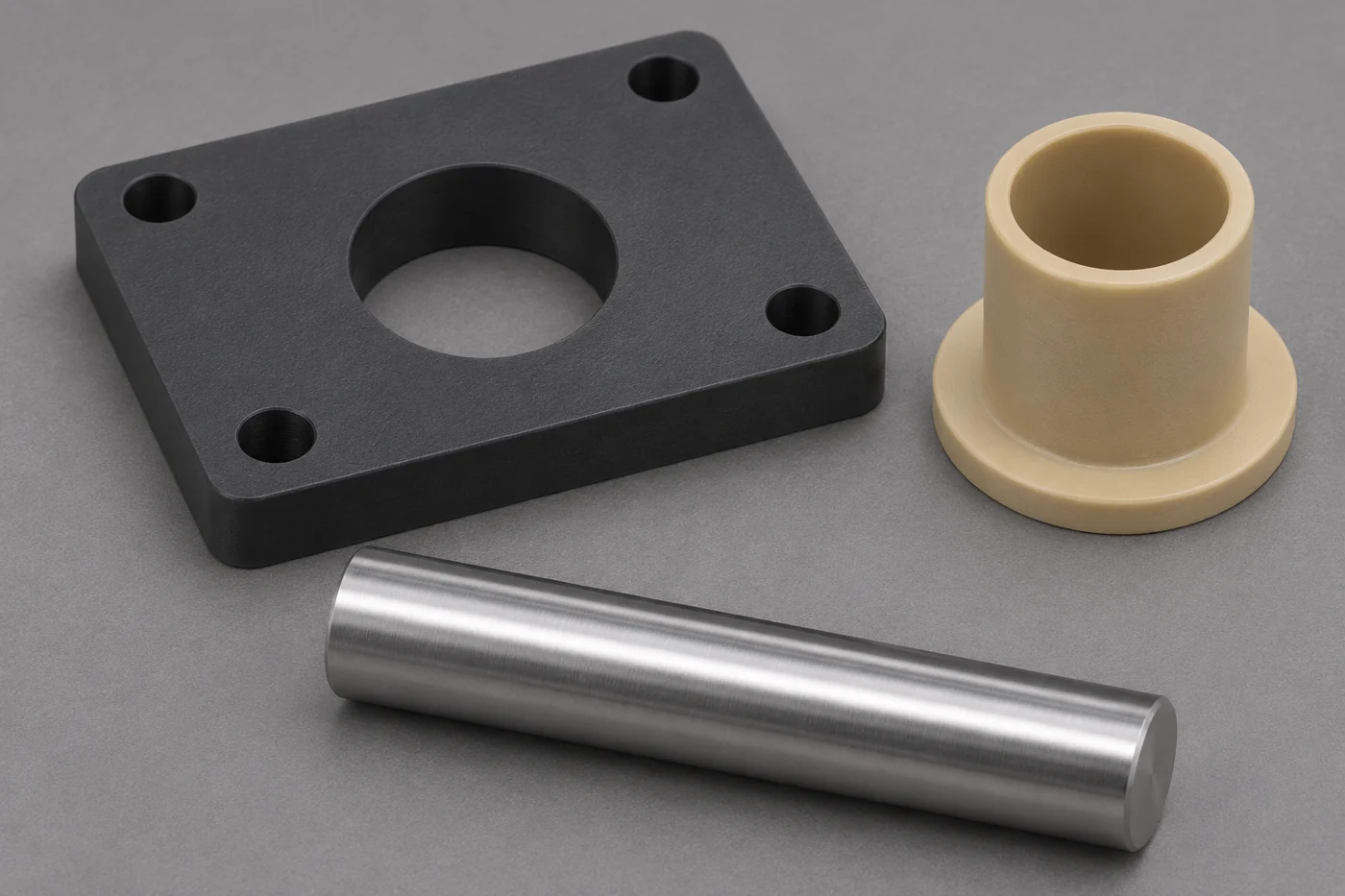
For edge conditions, agree what constitutes acceptable deburring without changing a critical feature. The deburring guide provides a framework for that discussion. Narrow lips and small intersecting holes may need a different review from a substantial exterior edge.
Check The Mating Surface For Sliding Parts
A material chosen for rigidity may not be the best candidate for a bearing contact. Describe the counterface material, finish, lubrication, load and motion. These conditions help establish whether the formulation is appropriate for the contact system.
Ensinger cautions on its TECAPEEK GF30 product page that glass reinforcement can affect mating surfaces in bearing or wear applications. This is a product-specific reason to review the counterface. It should not become a universal claim that all reinforced materials are unsuitable for sliding service.
Ask whether a dedicated bearing formulation or another geometry deserves evaluation. The answer depends on the actual application and available evidence. A supplier should identify the proposed grade rather than substituting a different filled material because both appear dark or contain a similar percentage of reinforcement.
The plastic bushing clearance guide addresses another part of the same system. Material selection, mounting and installed clearance need to be reviewed together when a sleeve or bearing arrangement is involved.
| Review area | Information to establish | Decision supported |
|---|---|---|
| Product identity | Matrix, reinforcement, manufacturer and stock form | Which technical information applies |
| Load direction | Functional loading and relevant material orientation | Whether directional evidence is needed |
| Sustained service | Duration, temperature and allowed movement | Which long-term evaluation is relevant |
| Machining route | Access, tool condition and process control | Whether the geometry can be produced consistently |
| Functional surfaces | Sliding, sealing, electrical and edge requirements | Which finish and inspection controls matter |
| Delivery evidence | Drawing revision, stock records and first article | Whether the order can be released confidently |
Keep Electrical And Chemical Requirements Separate
Do not infer electrical function from color or reinforcement type alone. A component may need insulation, controlled dissipation or another defined behavior. Check the named product under relevant conditions and specify the evidence required for acceptance.
The electrical insulating plastics guide helps organize that review. A material selected for stiffness still needs approval for its electrical role. Modifiers that improve one performance area can change assumptions elsewhere in the assembly.
For chemical exposure, evaluate the complete formulation and service conditions. Include cleaning and maintenance agents as well as process media. The chemical resistance guide explains why concentration, temperature, stress and exposure duration need to accompany the chemical name.
If an application requires specific declarations, identify the exact product and document scope. The responsible team should review that evidence before production. A polymer-family statement should not silently replace the order’s requirement for a particular grade or finished component.
Review Geometry Before Promising Tight Tolerances
Reinforcement does not remove tool-access or support limitations. Examine pocket depth, small internal corners and remaining walls. A substantial stock property cannot compensate automatically for a geometry that is difficult to hold or measure consistently.
The pocket-design guide explains why corner radii and depth should be considered together. If changes are possible, ask the supplier to identify improvements with their functional consequences. The design authority should approve the selected revision.
Consider material removal and the released component condition. A heavily pocketed part can respond differently from its original blank. The warpage guide provides background for reviewing restraint, stock history and removal sequence.
Define which relationships truly need tight control. Apply precision to the features that determine function and agree how they will be measured. A blanket demanding tolerance on every surface can add cost without resolving the important assembly question.
Use A Representative First Article
The first article should use the actual proposed grade, stock form and approved geometry. If orientation or source identity matters, retain that information with the sample. A trial using another formulation cannot establish the same basis for production acceptance without review.
Agree the dimensional, surface and functional checks in advance. A good-looking sample may still leave a critical property untested. Identify what the evaluation must decide and what evidence is needed before releasing the remaining quantity.
Record the measurement state and support arrangement. A flexible feature can respond to contact force even in a reinforced material. The quality and inspection page is a starting point for defining checks tied to the actual drawing and function.
Document limits of the evaluation. A short trial under one condition does not establish every service outcome. If the sample geometry or operating exposure differs from the intended application, describe that difference when interpreting the result.
A Hypothetical Support-Bracket Review
Imagine a buyer considering a reinforced polymer bracket because an unfilled candidate shows more displacement than the design allows. This is a hypothetical example, not a TOPS customer case or a claim about an existing component.
The review establishes load duration, temperature, direction and permissible movement. It also checks the mounting arrangement, nearby electrical function and contact surfaces. Candidate products are then compared using relevant evidence rather than a single stiffness figure.
The approved result may involve a reinforced grade, a geometry change or another material route. Record the decision and the basis for first-article acceptance. The useful outcome is a controlled specification that future sourcing can reproduce.
What To Include In Your RFQ
Send the current drawing and model, quantity and exact material designation. Include stock-form or orientation requirements already established by engineering. Mark functional surfaces, critical relationships and any design changes open to discussion.
List required material records and inspection evidence. Ask the supplier to identify unavailable information and proposed exceptions before production. Compare quotations against the same grade, revision and acceptance scope so a lower price does not simply reflect an omitted requirement.
Frequently Asked Questions
Is A Reinforced Grade Always Better Than An Unfilled Grade?
No. Evaluate the whole application. Stiffness or load-related advantages do not automatically establish wear, electrical, chemical or surface suitability. Compare identified products against the actual requirements.
Can Glass-Filled And Carbon-Filled Products Be Interchanged?
Not without review. The matrix, formulation and stock route matter as well as reinforcement type. Approve substitutions against the component specification and relevant product evidence.
Does Reinforcement Guarantee Tighter Machining Tolerances?
No. Geometry, tool condition, material state, workholding and inspection influence the accepted result. Favorable material characteristics support a process review but do not establish a universal capability.
Should The First Article Use The Production Grade?
Yes, when it is intended to validate that route. Any difference in formulation, stock form or approved orientation should be identified and reviewed before the result is used to release production.
Discuss Your Reinforced-Plastic Component
Send TOPS Plastics your drawing and application requirements. Include quantity, proposed grade, functional surfaces and the evidence needed for release. Those details support a practical discussion of machining and acceptance before production.