
Annealing can be useful when residual stress threatens the dimensional stability of a machined plastic component. It should be selected for a defined material, geometry and acceptance requirement. Adding a heat treatment note to every drawing does not automatically improve the part, and an unspecified cycle can create another source of variation.
Start by asking what problem the treatment must solve. Is the concern movement after heavy roughing, a critical flat surface, or a specified material processing requirement? Establish the approved route and inspection state before ordering. A finished part must meet the drawing after the agreed processing sequence, not only before it enters a thermal cycle.
What Annealing Can And Cannot Establish
Plastic annealing uses a controlled thermal cycle to address material behavior, commonly including residual stress. It is a process with defined conditions, not simply leaving a component in a warm oven. The appropriate route depends on the exact polymer product and the component being processed.
The MCG engineering plastics design guide discusses intermediate annealing for selected precision parts and distinguishes that need from routine machining. Its guidance supports a conditional decision. It does not justify requiring an additional cycle for every component made from an engineering plastic.
Annealing does not certify that a bore will retain its fit under every service condition. It also does not establish a load rating, chemical compatibility or a completed assembly qualification. Those questions still require the relevant design information and acceptance evidence.
Treat a proposed cycle as one element of the manufacturing plan. Material selection, machining support, stock removal and inspection remain part of that plan. A supplier should be able to explain why the step is included and what result will be checked afterward.
Separate Three Different Points In The Process
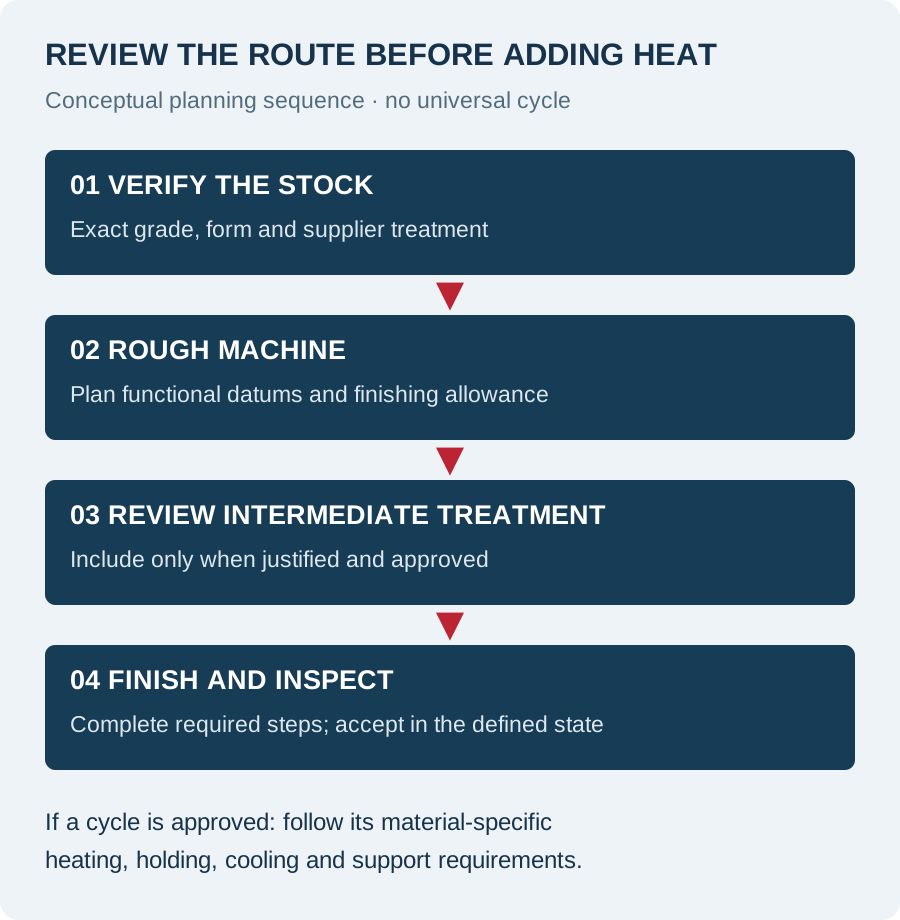
Stock treatment, intermediate treatment and treatment after final machining answer different questions. A purchase order that says annealed without identifying the stage leaves room for misunderstanding. Clarify whether the requirement refers to the supplied blank or to an additional operation on your component.
Ensinger's machining FAQ describes stress relieving of its stock products and discusses intermediate annealing after substantial or asymmetric material removal. It also notes leaving an allowance before final machining. These are supplier specific process considerations, not evidence that an unidentified blank has already received an acceptable treatment.
| Process stage | Question to resolve | Evidence to request |
|---|---|---|
| Supplied stock | What material and processing condition is being purchased? | Exact grade, stock form and relevant supplier documentation |
| After rough machining | Is additional stabilization justified before critical finishing? | Approved route, remaining allowance and evaluation plan |
| After final machining | Why is treatment required at this stage? | Applicable material guidance and final acceptance after treatment |
| Before shipment | In what state will the component be accepted? | Defined support, conditioning and dimensional report |
Do not count the same operation twice in a quote comparison. One supplier may describe the stock manufacturer's treatment, while another includes an additional component operation. Ask both to identify the actual scope before comparing prices or lead times.
Identify The Reason For Considering An Extra Cycle
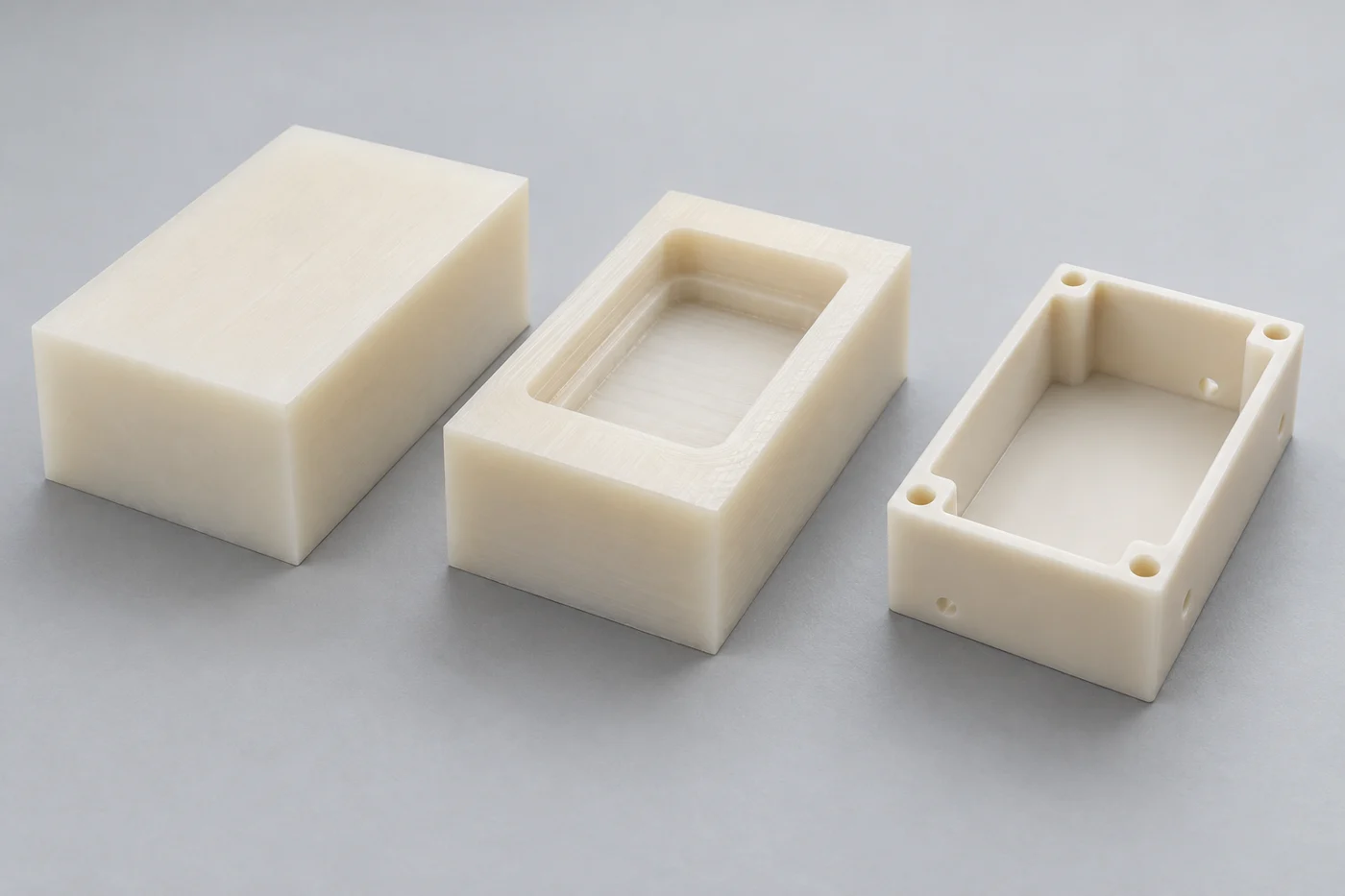
A large pocket cut into one side of a block is a useful review trigger. So is a thin frame with a tightly controlled mounting surface. These features deserve discussion because the finished geometry differs substantially from the starting stock. They do not, by themselves, prove that annealing is mandatory.
Describe the functional consequence of movement. A cosmetic bow in a loose cover and loss of alignment in a locating frame may require different responses. The drawing should make that distinction visible through functional dimensions, datums and realistic acceptance limits.
If earlier parts have moved, provide the measurement history. Record when the change appeared, which features changed and how the component was supported. A photograph alone may show shape, but it rarely explains the conditions needed to reproduce or evaluate the problem.
Our plastic machining warpage guide addresses the broader investigation. Use the annealing discussion to evaluate a specific proposed treatment within that investigation, rather than assuming every dimensional change has the same cause.
Do Not Confuse Annealing With Other Treatments
Drying, moisture conditioning, stress relieving and curing are different process objectives. Some may involve heat, but that does not make their instructions interchangeable. State the intended outcome and use the material manufacturer's terminology when defining a required operation.
Drying addresses moisture removal under specified conditions. Conditioning establishes a defined state for use or measurement. Neither label alone proves that a stress relieving cycle has been performed. A receiving inspection should not interpret a generic dried note as an annealing record.
Certain PAI products have an additional curing requirement or recommendation. The MCG machinist toolkit treats additional PAI cure separately from the general annealing discussion. Keep grade specific instructions attached to the exact product; do not transfer a PAI procedure to PEEK, acetal or another polymer.
Likewise, a service temperature exposure test is not automatically a production treatment specification. If a design requires both manufacturing treatment and subsequent environmental evaluation, identify them separately. This keeps the process record from implying that one step has satisfied two unrelated requirements.
Specify A Grade Specific Procedure
A useful process requirement identifies the material, the procedure reference and who approves changes. A generic note such as anneal as necessary gives little control over repeat orders. It can also produce quotations that include materially different work.
Avoid choosing a cycle by polymer abbreviation alone. Confirm the stock product, fillers or reinforcement, section geometry and applicable supplier guidance. A familiar material family can contain grades with different processing instructions or restrictions.
Ensinger's discussion of annealing and machinability explains how material removal can redistribute stresses originating earlier in production. This is a reason to consider the complete material history. It is not proof that a particular oven setting will produce an acceptable component.
The responsible process owner should establish heating, holding, cooling and support requirements using applicable guidance. Keep those instructions in a controlled procedure when detailed manufacturing information does not belong on the customer drawing. The purchase order can reference the approved procedure and reporting scope.
Plan Finishing Allowance Before Treatment
If an intermediate cycle is proposed, decide what material remains for finishing. Leave enough to complete the functional faces and bores through the approved route. Do not assume that a part already at its minimum allowable size can undergo another operation without affecting acceptance.
Identify which surfaces locate the component during subsequent machining. A temporary roughing datum may no longer represent the final assembly datum. Agree how the part will be re-established so the finishing sequence preserves the intended feature relationships.
This is particularly relevant to open frames, stepped sections and components with several large pockets. Review access to every critical face before accepting the route. An allowance that works on the outside may be unusable inside a narrow feature with restricted tool access.
Ask the supplier to explain the sequence rather than specify an arbitrary allowance on all surfaces. The route should connect roughing, any approved treatment, cooling, finishing and inspection. Our CNC plastic milling page provides a starting point for discussing pocketed and multi-face components.
Support And Measurement Need Their Own Decisions
A thermal processing support arrangement and an inspection setup serve different purposes. Record both where they influence acceptance. Do not describe a component as flat without explaining whether it is free, supported at defined points or restrained in an assembly fixture.
An illustrative frame supported on separate pads helps show this distinction. Such an arrangement is a concept, not a universal inspection prescription. The appropriate support positions depend on the actual part and the requirement being evaluated.
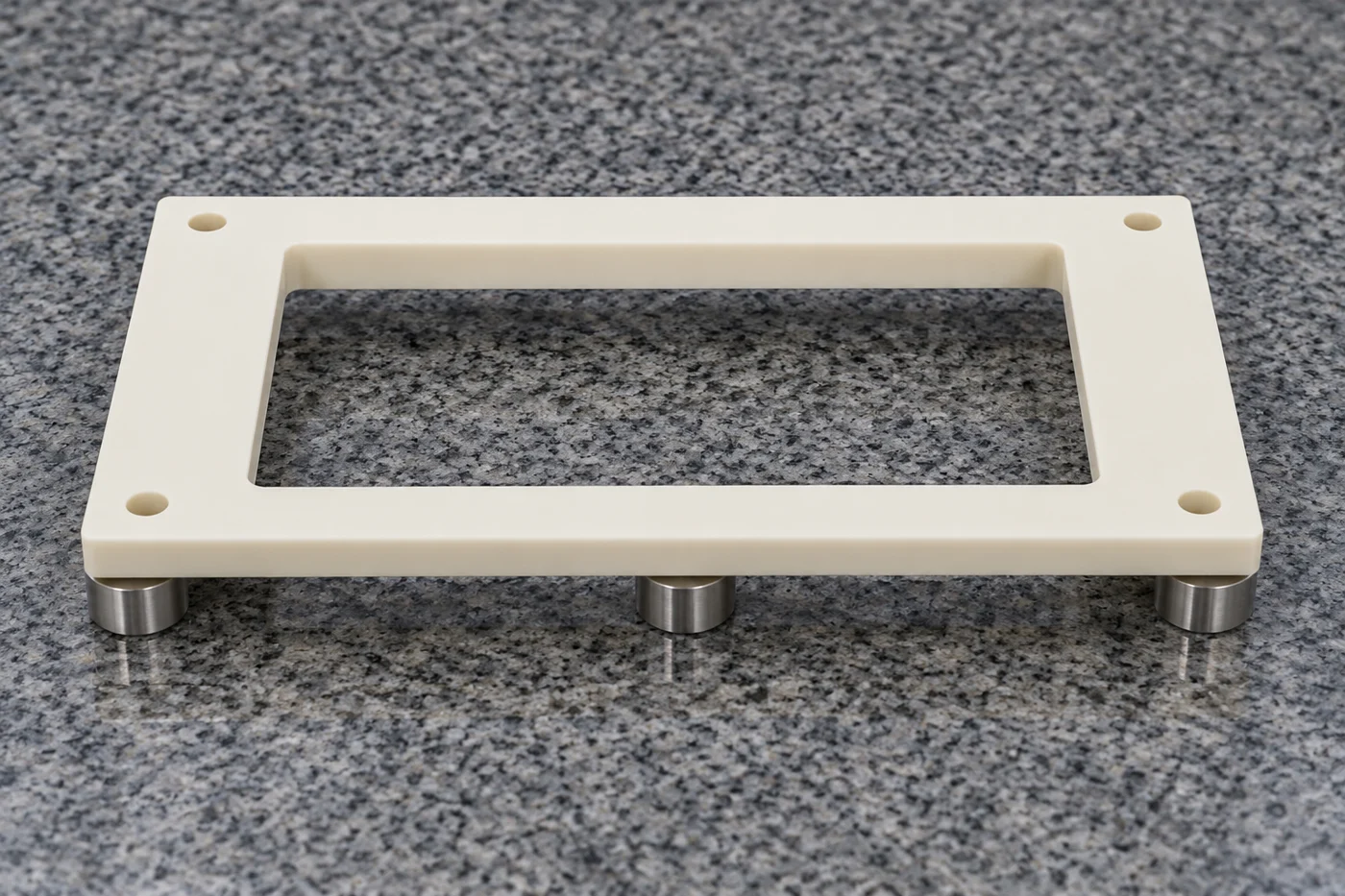
If flatness is controlled, agree the evaluation method and support condition. If a mounting assembly intentionally constrains the component, distinguish that installed requirement from free-state geometry. Forcing a part onto a surface during measurement can conceal the behavior that the customer wanted to evaluate.
Also define the relevant temperature and conditioning state. Keep this consistent when comparing before and after results. The plastic thermal expansion guide explains why measurements taken at different temperatures should not be treated as directly equivalent.
Validate A Proposed Route With A Representative Part
Consider a hypothetical machined locating frame made from a thick plastic plate. The frame has a large central opening, a mounting surface and several locating bores. The customer is concerned about changes after roughing. This is a process review example, not a reported customer result.
Begin with the functional requirements. Identify the mounting datum, bore relationships and permitted free-state shape. Ask whether the current drawing measures the part in the same condition in which it needs to function. Resolve that before choosing an additional treatment.
Next, document the starting material and the proposed sequence. If intermediate annealing is being evaluated, identify its position before critical finishing. Decide which measurements will be recorded at each stage and which results determine final acceptance.
Use a representative geometry and material grade for the trial. Record deviations from the intended production route so they are not accidentally treated as approved practice. A small solid coupon may help answer a material question, but it does not reproduce every feature of a thin, open frame.
After the trial, review the complete evidence. Did the finished component meet the drawing in the agreed state? Were critical bores and datums inspected? Was additional rework required? Do not define success solely as a smaller visible bow before the final machining and inspection steps.
What A Useful Process Record Contains
The record should connect the treated items to the approved instruction. Identify part number, revision, material grade and batch or other agreed traceability. Include the procedure revision, treatment date and relevant equipment or process record reference where required by the purchasing scope.
Agree whether actual cycle records are needed, or whether a certificate referencing the approved process is sufficient. These are different deliverables. Requesting one during quotation is clearer than discovering at shipment that the customer expected the other.
Record any accepted deviation and its approval. A changed stock form, support arrangement or additional treatment may deserve review even if the final part name stays the same. Keep the record useful for the next order rather than treating it only as paperwork for the current shipment.
For dimensional evidence, identify the measurement stage and conditions. A report made before the final required operation should not be presented as final acceptance. Our Quality and Inspection page outlines the information to discuss when agreeing an inspection scope.
Evaluate Cost Without Assuming More Processing Is Better
An additional controlled operation can affect scheduling, handling, fixturing and inspection. Compare those items against the problem it is intended to address. A justified step can be valuable, while an undefined requirement can add cost without establishing a measurable improvement.
Ask suppliers to separate the baseline route from an optional treatment proposal. Request the reason for the proposal and the acceptance evidence included. That makes the commercial comparison clearer than a single price containing unexplained process differences.
Before repeat production, record the selected route and change approval expectations. If the initial trial supports a route without extra treatment, preserve that decision too. Consistent control means following the approved evidence, not automatically adding another operation to every subsequent order.
Frequently Asked Questions
Must Every Machined Plastic Part Be Annealed Again?
No. Evaluate the exact material, geometry and acceptance requirement. Stock may already have received supplier treatment, and an additional component cycle needs its own justification. Establish the intended process stage before making it a purchase requirement.
Can Annealing Repair A Part That Is Already Undersize?
Do not assume that it can. Treatment is not a substitute for an approved dimensional repair. If a finished component is outside its limits, assess disposition against the drawing and approved rework rules rather than expecting heat to restore missing material.
Is There One Cycle For All PEEK Or POM Parts?
Do not use a family name as the complete procedure. Confirm the exact stock product and applicable manufacturer guidance, then review the component section and processing history. A generic schedule copied from another job may not describe the approved route.
Should Inspection Occur Before Or After Treatment?
Final acceptance should follow all required operations in the defined state. Intermediate measurements can support process evaluation, but they do not replace the final report. Identify measurement stages clearly so results are not compared out of context.
Does Annealing Remove Service Temperature Movement?
It does not eliminate the need to evaluate thermal expansion and mounting constraint. A treated component still has material properties that affect installed fit. Separate manufacturing stabilization from the assembly's operating temperature requirement.
What Should I Send For A Treatment Review?
Provide the drawing, exact grade, quantity and known processing requirement. Describe the observed or anticipated problem and the inspection state. If a previous part moved, include dated measurements and support conditions so the supplier can review useful evidence.
Request A Machining And Process Review
Send TOPS Plastics your drawing and application details through the contact page. Identify the critical dimensions, exact material and whether annealing is mandatory or under consideration. Ask for the proposed machining route and any treatment scope to be clarified before ordering, so production and inspection address the same requirements.