Choosing a plastic for CNC machining starts with your operating conditions, not the material price. POM, nylon, PTFE and PEEK solve different problems. This guide explains how to compare them, define your requirements and validate a material before purchasing custom parts.
Which Plastic Should You Consider First?
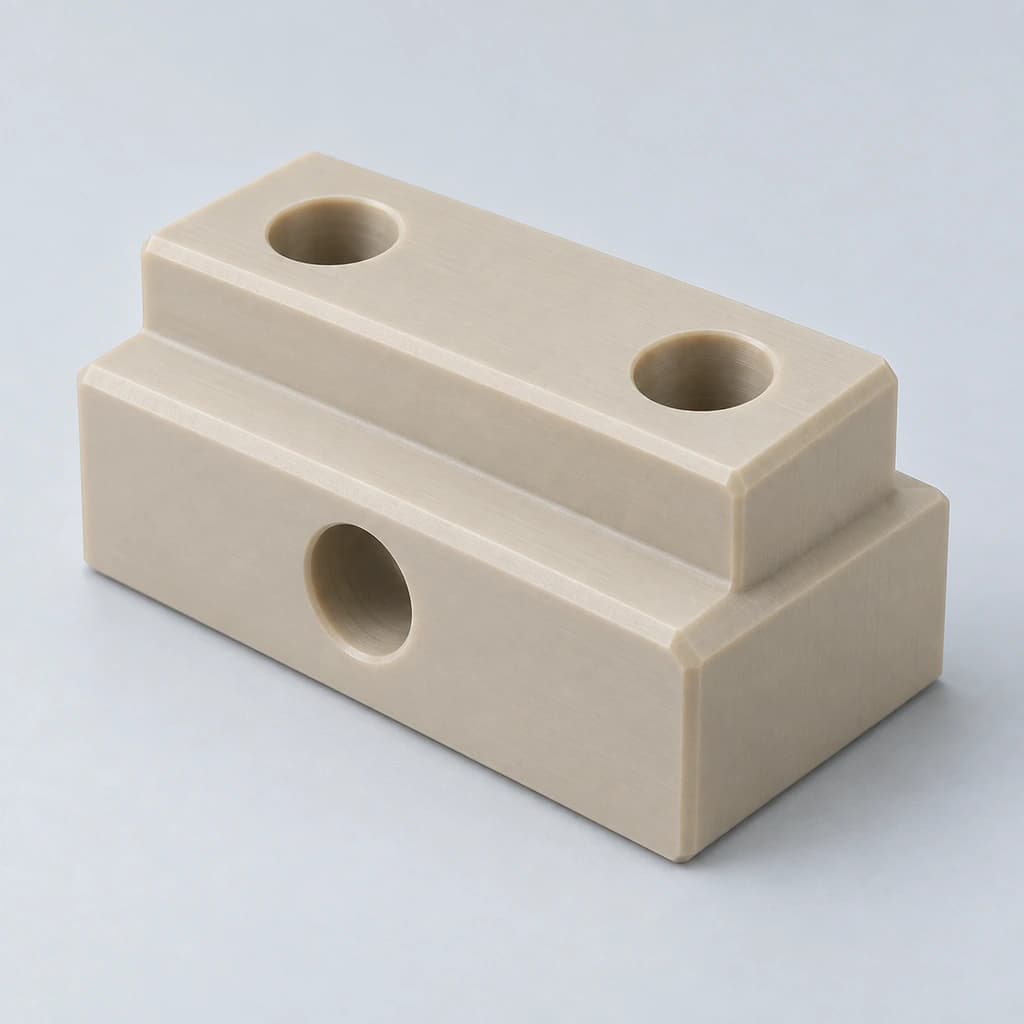
Start with the function that controls your component's performance, then shortlist materials for testing.
POM is often a practical starting point for rigid mechanical parts. Nylon deserves consideration for tough wear components. PTFE is worth evaluating when chemical exposure or sliding behavior dominates. PEEK becomes relevant when demanding temperature, mechanical or chemical requirements justify its higher cost.
These are screening directions, not final approvals. A material family contains multiple grades with different properties. Your application may also require a material outside this shortlist.
| Material | Useful Starting Applications | Main Question Before Selection |
|---|---|---|
| POM / acetal | Gears, spacers, rollers and mechanical housings | Will the selected grade maintain the required fit in your environment? |
| Nylon / PA | Bushings, guides and wear components | How will moisture conditioning affect dimensions and performance? |
| PTFE | Chemical-contact components and selected sliding parts | Can the design manage deformation under sustained load? |
| PEEK | Demanding insulators, fixtures and mechanical components | Which grade meets the operating conditions without unnecessary cost? |
Avoid ranking these materials from universally best to worst. A successful selection matches a specific grade to a defined duty.
Define The Application Before Comparing Datasheets
A useful material specification describes what the part experiences throughout its service life.
Start with the mating components. Identify the shaft, housing, fastener or surface that contacts your plastic part. Record the required clearance and allowable movement.
Next, describe loading. A spacer carrying a steady clamp load behaves differently from a guide experiencing repeated impacts. A rotating bushing introduces sliding speed, contact pressure and frictional heating.
Include normal operating temperature, short excursions and shutdown conditions. Specify where temperature is measured. Ambient air temperature may differ from the temperature at a sliding interface.
List chemicals by identity and concentration. Include lubricants, cleaning agents and fluids used during maintenance. Record exposure duration and whether the component remains mechanically loaded.
For outdoor equipment, include sunlight, water, dust and temperature cycling. For indoor equipment, do not assume a permanently dry environment. Cleaning, condensation and transport can introduce moisture.
Finally, define failure. Is the unacceptable outcome leakage, binding, excessive wear, electrical failure or cosmetic damage? Clear acceptance criteria make testing useful.
Separate Essential Requirements From Preferences
Essential requirements determine whether the part works. Preferences influence cost, appearance or convenience.
For example, an exact color may be a preference. Electrical insulation under a specified environment may be essential. A supplier should understand that difference before proposing alternatives.
Use three labels in your request: mandatory, preferred and open to review. This reduces unnecessary substitutions and unnecessary expense.
When Does POM Make Sense?
POM is a useful candidate when you need a machinable engineering plastic for mechanical components.
Acetal stock can suit parts with bores, pockets and repeated features. Evaluate it for gears, spacers, rollers and fixture components. Check the actual load, temperature and chemical exposure before approving the material.
Delrin is a brand of acetal homopolymer, rather than a name for every POM grade. Acetal copolymers are another option. Your purchase specification should identify the required grade or allow an approved equivalent.
A drawing that says only "Delrin or similar" leaves important decisions unresolved. Clarify whether brand identity, homopolymer chemistry or functional performance controls acceptance.
POM should not be treated as dimensionally unaffected by its environment. Delrin's design guidance discusses moisture and temperature effects. It also directs readers toward current grade-specific technical data. Delrin Design Guide
For a precision bore, compare the assembly clearance against expected dimensional changes. For a clamped component, consider sustained loading. For a sliding component, test the actual counterface and lubrication conditions.
What Should A POM Purchase Specification Include?
Identify the material family, grade, stock form and permitted substitution process. State the inspection condition for critical dimensions.
If a particular brand is mandatory, say so explicitly. If equivalents are acceptable, explain the evidence needed for approval. That evidence could include a datasheet, traceability information and a functional sample.
When Should You Consider Nylon?
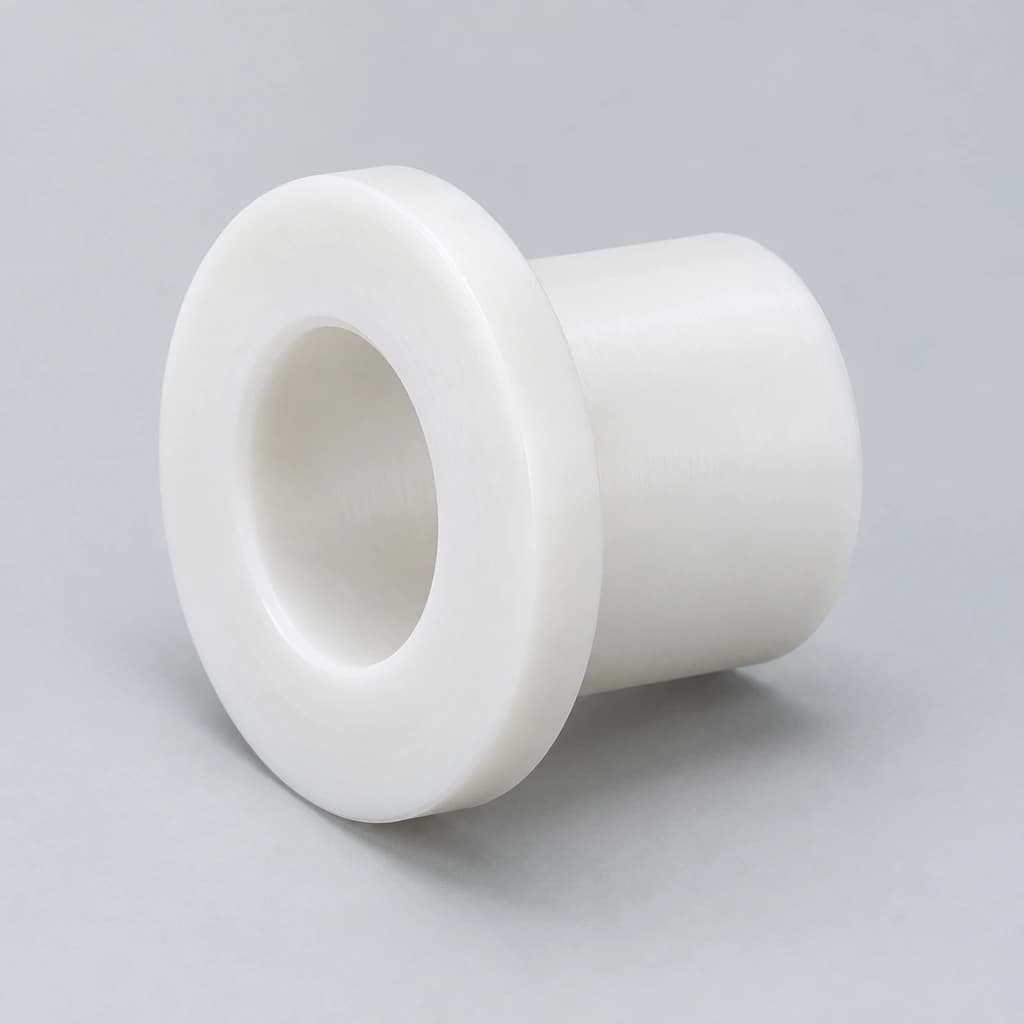
Nylon is worth evaluating for tough mechanical and wear applications, provided you account for moisture behavior.
The word nylon covers several polyamides and manufacturing forms. PA6, PA66 and cast nylon should not be treated as interchangeable. Filled and lubricant-modified grades introduce additional differences.
A dry nylon component can behave differently after exposure to humidity or water. This matters for close-fitting bushings, long guides and thin sections. Ensinger identifies moisture absorption as an important influence on dimensional stability. Dimensionally Stable Plastics
Specify whether acceptance applies in a dry, conditioned or agreed service-representative state. Also define how long the part should stabilize before measurement. The correct conditioning procedure depends on the grade and application.
Do not solve moisture uncertainty by demanding a tighter machining tolerance. A tighter initial dimension does not remove later dimensional movement.
For a nylon guide, review clearance along the complete length. For a bushing, review bore clearance after installation. For a gear, consider tooth engagement and operating conditions.
How Can You Validate Nylon For A Wet Application?
Compare samples before and after exposure that represents the intended use. Record dimensions, assembly behavior and functional performance.
Choose an exposure period appropriate to the part thickness and service conditions. A brief surface wetting test may not represent long-term moisture uptake.
Document the results and agree which condition defines acceptance. This creates a repeatable basis for subsequent orders.
Where Does PTFE Fit?
PTFE deserves consideration when chemical resistance or low-friction behavior is central to the application.
However, chemical suitability and mechanical suitability are separate decisions. A material may resist a fluid while deforming too much under load.
For a PTFE component, review clamp loads, sealing geometry, support and installation conditions. Consider the effect of time on deformation. A successful installation test does not establish long-term dimensional performance. Chemours includes deformation-under-load data when comparing PTFE resin options. Teflon NXT Granular Resins
Different fillers can change wear, stiffness and other characteristics. They can also change suitability for electrical or contamination-sensitive applications. Request the exact compound rather than accepting a generic "filled PTFE" description.
Machining is another consideration. Ensinger notes that PTFE's softness complicates machining compared with stiffer engineering plastics. Plastics For Machining
An inspection method should avoid distorting a soft part. Discuss measurement force, support and the condition of the component during inspection.
What Should You Ask About A PTFE Alternative?
Ask which failure mode the alternative addresses. Is the goal lower wear, reduced deformation or different chemical performance?
Then compare evidence under your conditions. Do not approve a substitution solely because both materials are white or share similar catalog descriptions.
When Is PEEK Worth Its Cost?
PEEK is worth evaluating when demanding operating conditions exceed the practical limits of your lower-cost shortlist.
Its value should come from a requirement, rather than its reputation. Explain the thermal exposure, mechanical load, chemicals and service duration that motivate selection.
Victrex emphasizes grade selection according to mechanical, thermal and chemical needs. Its product guidance also distinguishes reinforced and unfilled options. Victrex PEEK Polymers
Do not apply a material family's advertised temperature figure to every assembled component. The relevant limit depends on grade, stress, exposure and required performance.
Unfilled PEEK and reinforced PEEK are not automatic substitutes. Reinforcement can affect stiffness, dimensional behavior, machining and contact surfaces. Electrical requirements need particular attention when considering conductive fillers.
For an expensive component, evaluate stock utilization and geometry early. Excessive material removal can affect both cost and manufacturing strategy.
How Do You Avoid Over-Specifying PEEK?
Compare candidates against the same acceptance test. If POM or nylon meets every essential requirement, PEEK may add little value.
Conversely, a lower initial material cost can be misleading if the part requires frequent replacement. Compare replacement labor, downtime and maintenance access alongside purchase price.
The decision should remain evidence-based. Do not assume either the cheapest or the most expensive polymer provides the lowest lifecycle cost.
Why The Exact Grade Matters More Than The Color
The grade defines material behavior more reliably than appearance or a broad polymer name.
Two black components may contain different polymers, fillers or additives. Two natural-colored components may have different manufacturing histories.
Request the material designation used for purchasing stock. If traceability matters, specify what records should accompany the shipment. Clarify whether a stock supplier certificate, resin declaration or another document is required.
Regulated applications require additional review. A generic polymer name does not establish food-contact, medical or aerospace suitability. Identify the applicable requirements and obtain evidence for the specific material and intended use.
Also ask whether the chosen grade is available in the required stock size. Availability can affect waste, lead time and the feasibility of producing a large part.
Match Datasheet Test Conditions
Compare properties measured under compatible conditions. Temperature, specimen state and test method can change the meaning of a value.
A short-term strength result does not describe sustained-load deformation. A wear result measured against one surface may not describe your counterface.
Build a short comparison sheet containing the exact grades and relevant test conditions. Leave unverified fields blank instead of filling them with generic family values.
How Does Material Choice Affect CNC Machining?

Material choice affects workholding, heat management, burr control and dimensional stability.
Your supplier should review the drawing as a plastic component, rather than copying a metal machining approach. Features that look straightforward can become difficult when the material flexes or responds to heat.
Thin walls, long unsupported sections and deep pockets deserve early discussion. Ask which dimensions should be checked after machining and stabilization.
Stock history also matters. Removing material from a block can expose or redistribute internal stress. Discuss whether the proposed process needs roughing, stabilization or other material-specific steps.
You do not need to prescribe spindle settings without process evidence. Instead, specify the outcome: dimensional acceptance, surface condition, cleanliness and functional behavior.
For assembly preparation, explain which surfaces contact seals, shafts or sensitive equipment. "Good finish" is less useful than a clear description of function.
Review Your Material Shortlist
Unsure whether POM, nylon, PTFE or PEEK fits your application? Send your drawing and operating conditions to TOPS Plastics. Include temperature, chemicals, loading and critical fits for a material-focused discussion.
How Should You Test Before Approving Production?
Use a staged validation plan that connects material evidence, component inspection and application testing.
First, confirm that the sample uses the intended grade. Record drawing revision and material identity before testing.
Next, inspect the features that determine assembly. Measure critical bores, interfaces and locating surfaces in the agreed condition. Record the method as well as the result.
Then test the component in a representative assembly. Check installation force, clearance, movement and contact with mating parts. Avoid forcing a failed fit into place without recording the problem.
For wear applications, define speed, load, lubrication and test duration. Track useful outcomes such as clearance growth, temperature change and visible damage.
For chemical exposure, define fluid identity, concentration, temperature and duration. Test the loaded component when loading is part of the intended use.
Finally, inspect again. A part that fits before testing may change afterward. Record dimensional change and functional observations separately.
This is a suggested validation framework, not a claim that TOPS has performed a particular test. Agree project-specific factory testing before placing the order.
What Does A Practical Selection Example Look Like?

A useful selection example compares risks rather than presenting a material as an automatic winner.
Consider an illustrative conveyor guide exposed to repeated cleaning. The buyer needs low wear and consistent clearance. The guide also contacts a moving metal surface.
The first step is documenting the cleaning fluid and temperature. Next, define loading, sliding speed and acceptable wear. Then compare suitable grades and sample assemblies.
Nylon may deserve evaluation for toughness, but moisture behavior needs attention. POM may simplify dimensional planning, but chemical compatibility still needs verification. PTFE or PEEK may become relevant if the operating requirements support them.
The final choice comes from test results and cost evaluation. This scenario is not a TOPS customer case or a verified material recommendation.
What Should You Include In A Material Selection RFQ?
Include enough information for your supplier to evaluate the material and the finished component together.
Provide a drawing, model and revision reference. State sample quantity, repeat-order expectations and required delivery destination.
Describe function, mating parts, temperature, fluids and loading. Mark dimensions that control assembly or performance.
Identify mandatory material requirements and acceptable alternatives. Specify the evidence needed before a substitution can be approved.
Add inspection, testing and shipment inspection requirements. State which surfaces need protection during packing. For sensitive components, explain acceptable cleanliness and handling.
If information is unknown, say so. An identified uncertainty can be discussed; an unstated assumption can become a production problem.
Browse the engineering materials overview to organize your initial shortlist.
Frequently Asked Questions
What Is The Best Plastic For CNC Machining?
There is no universally best plastic. Choose a grade that meets your load, temperature, chemical exposure and dimensional requirements. Machinability matters, but finished-part performance determines suitability.
Is Delrin The Same As POM?
Delrin is an acetal homopolymer brand within the POM family. POM also includes other grades and copolymers. Specify the required grade or a documented substitution process.
Is Nylon Suitable For Precision Bushings?
It can be, depending on grade, clearance and environment. Moisture conditioning and installation conditions need review. Validate the assembled fit under representative operating conditions.
Is PTFE Always Better For Chemical Applications?
No. Review the specific fluid, exposure and mechanical duty. Chemical resistance alone does not establish dimensional or structural suitability.
Should I Upgrade Every Critical Part To PEEK?
No. Establish which requirement needs PEEK and compare suitable grades. A lower-cost material may meet the same acceptance criteria.
Can The Supplier Choose An Equivalent Material?
Yes, if your purchasing specification permits it. Require the proposed grade, supporting data and approval before production. Do not rely on color or a generic material description.
Conclusion
Choose your CNC machining plastic by function, environment and verification evidence. Specify the exact grade and critical acceptance conditions. A clear application brief helps you compare materials without paying for unnecessary performance or accepting avoidable risk.
Discuss Your Custom Plastic Component
Send TOPS Plastics your drawing, material shortlist, quantity and application requirements. Identify unresolved selection questions and critical dimensions. Request a project-specific review before approving production.