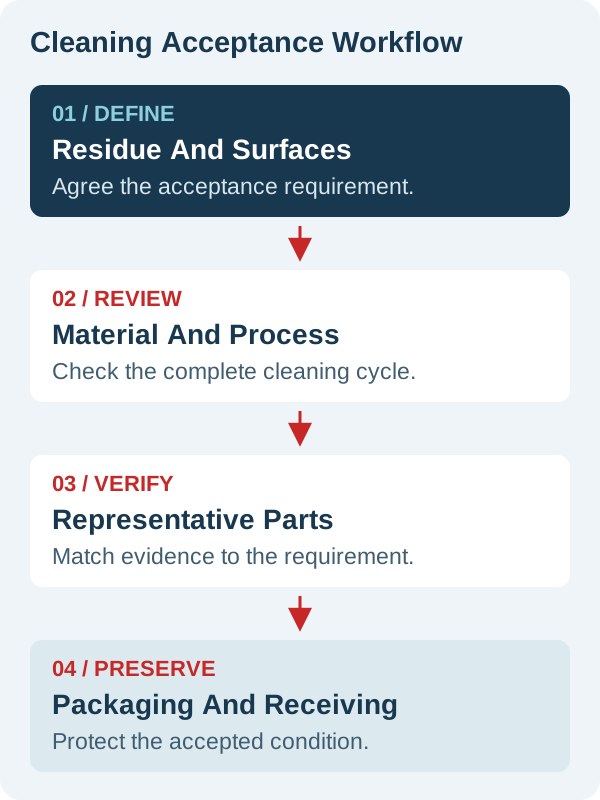
Cleaning machined plastic parts starts with defining the unwanted residue, the compatible process and the acceptance method. You also need packaging that preserves the result. Specify these requirements before quotation, rather than asking your supplier to deliver parts that simply look clean.
Define What Clean Means For Your Component
You need a cleanliness requirement tied to the part's function, rather than a universal label.
A conveyor guide, a bonding surface and a fluid passage can require different evidence. Start with the failure you want to prevent. Could a loose chip obstruct a port? Could an invisible film interfere with adhesive bonding? Could handling mark a transparent cover?
Write the affected surfaces into your drawing or purchase specification. Distinguish functional bores from external cosmetic faces. Identify surfaces that will receive additional cleaning after delivery. This prevents unnecessary processing while protecting the areas that matter.
Separate three requirements: contamination removal, acceptable material condition and preservation during shipment. Passing one does not demonstrate the others. An apparently clean part may still have damaged surfaces or unsuitable packaging.
Decide who approves the requirement before requesting production quotations. Purchasing can compare supplier scope, but engineering must define the functional consequence. Quality should confirm how incoming acceptance will work.
Build A Clear Acceptance Note
Use a structured requirement that your engineering and quality teams can complete. For example, identify internal passages as controlled surfaces. Identify loose machining debris as one contamination concern. Then name the approved inspection instruction and required evidence.
Keep missing decisions visible during quotation. If the test method remains unresolved, mark it as pending approval. Do not replace that decision with a supplier's general promise of cleanliness.
Your note should answer these practical questions:
- Which drawing revision and material grade does the requirement cover?
- Which surfaces receive the final cleaning operation?
- Which residue categories are included, and which require separate treatment?
- Which inspection instruction defines sampling and acceptance?
- Which packaging instruction preserves the accepted condition?
- Which organization performs any final application-specific processing?
Treat this as a specification framework, not a completed acceptance standard. You must supply the functional limits and approve the evidence. Where no quantitative requirement exists, describe the agreed visual condition honestly.
Check that the purchase order references the same documents as the supplier quotation. Attach controlled revisions where your purchasing system permits. When documents conflict, resolve the discrepancy before the supplier starts production. This avoids discovering different expectations only after a batch reaches your receiving area.
Separate Particles, Films And Biological Requirements
You should specify each contamination category separately because one inspection cannot establish every kind of cleanliness.
| Contamination Concern | Where To Look | Requirement To Agree |
|---|---|---|
| Loose machining chips | Bores, threads and intersecting passages | Removal method and accessible inspection areas |
| Fine particles or fibers | Functional surfaces and internal channels | Measurement method, sampling and reporting basis |
| Oil, coolant or polishing film | Sealing faces, bond areas and contact surfaces | Relevant residue test and acceptance criteria |
| Handling contamination | Exposed finished surfaces | Handling rules and final packaging sequence |
| Biological contamination | Application-specific surfaces | Separate requirements established by the responsible specialist |
Do not use a particle inspection report as evidence that oily films are absent. Likewise, a satisfactory visual inspection cannot establish a quantitative particle limit.
Keep industrial cleaning separate from sterilization claims. The FDA reprocessing overview distinguishes cleaning, disinfection and sterilization. Its healthcare context does not establish an industrial supplier's capabilities. For regulated applications, obtain an application-specific specification from your responsible quality team.
Check The Actual Polymer And Cleaning Chemistry
You should approve cleaning chemistry against the exact material and finished component conditions.
Record the polymer designation, grade, fillers and any inserts or bonded materials. Ask for the proposed cleaner's identity and current technical documentation. Review concentration, temperature, exposure duration and the intended rinse. A product described as suitable for plastics is not automatically suitable for your part.
Ensinger's engineering plastics guidance highlights moisture-related dimensional concerns for nylon. It also identifies stress-cracking concerns with amorphous materials such as polycarbonate and polysulfones. These are reasons to evaluate the complete cleaning cycle, rather than transferring a metal-parts washing recipe.
Supplier instructions can also be narrowly conditional. Röhm's PLEXIGLAS cleaning brochure permits brief isopropanol contact followed by a damp wipe. That instruction concerns its specified acrylic products. It does not authorize prolonged immersion of every machined acrylic component.
For broader screening, use the plastic chemical resistance selection guide. Then confirm the actual cleaner and process with the relevant suppliers.
Choose A Process Around Geometry And Residue
You should choose cleaning methods by access, contamination and material risk, rather than equipment name alone.
| Proposed Route | Decision It Must Answer | Trial Checks |
|---|---|---|
| Controlled wiping or brushing | Can the process reach each specified surface? | Scratches, fibers and missed recesses |
| Aqueous washing and rinsing | Can the chemistry remove the identified residue? | Compatibility, rinse effectiveness and retained liquid |
| Approved solvent cleaning | Is the complete formulation suitable for the component? | Exposure conditions and surface changes |
| Ultrasonic cleaning | Does the proposed cycle suit the material and geometry? | Part support, cleaning access and damage |
| Specialist cleaning | Is a defined requirement beyond routine processing? | Provider scope, validation and preservation |
Ultrasonic cleaning is a process option, not an acceptance standard. Elma's ultrasonic cleaning explanation connects results with chemistry, temperature, time and frequency. Equipment ownership alone cannot demonstrate that your particular part will meet its requirement.
Ask whether parts are processed individually or in batches. Confirm which surfaces touch baskets, fixtures or neighboring components. Include that contact condition in your trial.
Design Access For Cleaning And Drying
You can reduce cleaning uncertainty by identifying inaccessible features during drawing review.
Mark intersecting bores, blind pockets, narrow slots and internal threads. Ask how the proposed process reaches each feature. A long passage needs a different inspection plan from an open plate. Request a section view when the internal geometry is difficult to understand.
Consider access before approving permanent plugs, press fits or bonded joints. If the design permits, discuss cleaning before assembly. Define how cleanliness will be preserved through the remaining operations. Otherwise, later machining or handling may undo the earlier result.
Review features that can retain liquid in the proposed processing orientation. Ask how parts drain and how dryness is checked. Do not change functional geometry solely for cleaning convenience without engineering approval.
For internal channels, review the related plastic manifold design guidance. Cleaning access should be part of that discussion, alongside ports, seals and inspection.
Qualify The Sequence On Representative Parts
You should evaluate cleaning as a complete sequence, including handling and packaging.
Use representative parts with the intended material, manufacturing route and challenging features. A simple flat coupon can support compatibility screening. It cannot demonstrate cleaning access inside a different component.
Agree a trial plan before releasing the production order:
- Record incoming part condition and the contamination being targeted.
- Identify the proposed equipment, chemistry and processing conditions.
- Apply the planned cleaning, rinsing and drying sequence.
- Inspect the specified surfaces and check relevant dimensions.
- Package parts using the proposed materials and handling sequence.
- Assess samples after unpacking under the agreed receiving conditions.
Keep trial results with the drawing revision and cleaning instruction. Record deviations and unresolved questions. If a requirement remains unverified, identify it explicitly in the quotation.
Use the trial to define what changes require review. A replacement cleaner, new packaging film or revised internal passage may affect the agreed result. Establish the notification rule before repeat orders begin.
Match Inspection Evidence To The Requirement
You need an inspection method that measures the contamination you have actually specified.
For visual acceptance, agree lighting, viewing distance, accessible surfaces and the reporting format. Use photographs to clarify cosmetic examples. Do not describe this as a quantitative cleanliness measurement unless a suitable measurement method is defined.
For particle-sensitive applications, agree extraction, analysis, sampling and reporting with a competent specialist. Define whether the result applies per part, batch or inspected area. Record the actual sample basis, rather than presenting selected samples as proof about every component.
ISO 16232:2018 addresses particulate cleanliness inspection for functionally relevant road-vehicle components and systems. It excludes filmy contamination and nonquantitative visual or cloth-wipe methods. It also supplies no universal component cleanliness limits. Referencing its number therefore cannot replace a component-specific requirement.
For film-related concerns, ask which method addresses the relevant residue. Have the responsible laboratory explain the method's limitations. Agree acceptance criteria before testing, rather than interpreting results against an unspecified idea of cleanliness.
Check Dimensions After The Relevant Conditioning
You should define when dimensional acceptance occurs relative to cleaning, drying and conditioning.
Record whether measurements concern parts before washing, immediately after drying or after an agreed conditioning period. This matters when your material and process can change the part's condition. Avoid comparing incoming measurements against supplier results taken under different conditions.
For nylon, coordinate the cleaning sequence with your moisture and dimensional control plan. Do not demand dryness while separately assuming an unspecified moisture equilibrium. Define the condition relevant to installation and inspection.
Inspect functional surfaces after the planned process, where required. Review appearance, sealing areas and features that contact the cleaning fixture. If your trial reveals changes, investigate the cause before simply widening tolerances.
Keep dimensional and cleanliness reports distinct. Together, they should describe the same identifiable parts or samples. A good dimensional report cannot substitute for missing cleanliness evidence.
If receiving inspection finds a discrepancy, retain the packaging and identify the affected batch. Record how the package was opened. Compare observations against the agreed method before assigning a cause. Ask whether the result indicates a processing issue, handling damage or a specification mismatch. Avoid reworking parts before the responsible teams agree a disposition.
Preserve The Result Through Packaging And Receiving
You should specify packaging as part of cleanliness acceptance, rather than treating it as a separate shipping detail.
Start with the surfaces requiring protection. Decide whether parts need individual separation, protective caps or a defined contact material. Review whether the packaging can introduce particles, residue or abrasion. A rigid outer container can prevent damage while still requiring a suitable inner arrangement.
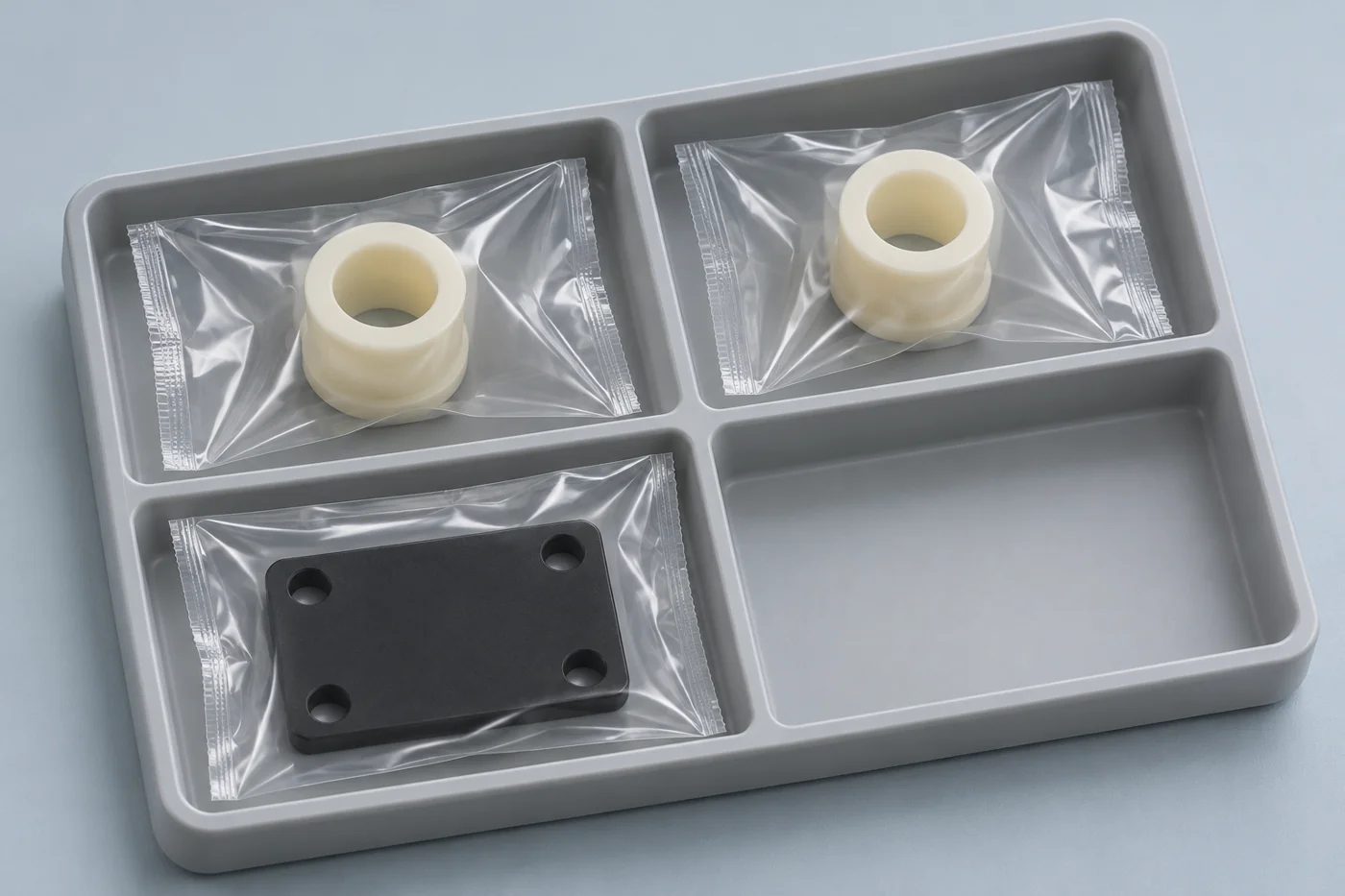
The packaging illustration shows separated components in plain individual pouches. It presents a discussion example, not a validated packaging specification. A sealed pouch does not establish sterility or a guaranteed storage life.
Agree which labels remain outside the immediate part-contact area. Preserve the part number, revision, quantity and batch identification. Describe how receiving personnel should open packages without defeating the agreed protection.
Consider partial deliveries and leftover stock. Decide whether opened packages can be resealed, and who controls subsequent handling. Packaging acceptance should cover the condition you actually receive, not only a photograph taken before shipment.
Compare Supplier Scope Before Comparing Price
You should compare quotations against the same cleaning, inspection and preservation scope.
Separate routine chip removal from documented precision cleaning. Ask whether specialist testing or external processing is included. Confirm sample quantities, reports, packaging and any approval hold points. Otherwise, two quotations may describe substantially different deliverables.
Cost depends on cleaning access, material compatibility, processing sequence, inspection effort and packaging complexity. Repeated handling and additional documentation can also affect the quoted scope. Request separate clarification of trial costs and recurring production costs. Avoid assuming a universal cleaning surcharge.
TOPS Plastics provides a route to discuss custom CNC plastic machining against your drawing. Request confirmation of the proposed cleaning and inspection scope for your particular order. This article does not claim certified cleanroom processing, validated sterilization or a guaranteed residue limit.
If your requirement exceeds the proposed scope, resolve the gap before ordering. A specialist provider or customer-controlled final cleaning stage may be necessary.
Cleaning Machined Plastic Parts FAQ
You can clarify most purchasing questions by separating the cleaning process from the evidence required for acceptance.
Does Dry Machining Eliminate The Need For Cleaning?
No. You still need to address chips, handling and packaging contamination. Define the required final condition independently of the machining route.
Can You Use Isopropanol On Every Engineering Plastic?
No. Check the exact grade, cleaner formulation and exposure conditions. A limited supplier instruction should not become a universal solvent rule.
Does Ultrasonic Cleaning Prove A Part Is Clean?
No. It describes a process. You still need agreed inspection criteria and evidence from the actual component and cycle.
Can A Visual Check Establish A Particle Limit?
No. Use visual inspection for its agreed purpose. Quantitative particle requirements need an appropriate measurement and reporting method.
Should You Clean Before Or After Assembly?
Choose the sequence during drawing review. Consider cleaning access, assembly contamination and how the final condition will be verified.
Does A Sealed Bag Mean Sterile Packaging?
No. Separation and preservation do not establish a validated sterile barrier. Specify any regulated packaging requirements through the responsible specialist.
Can One Cleaning Instruction Cover Every Part Number?
Only when its defined scope supports those parts. Review differences in material, geometry, contamination, processing and acceptance requirements.
What Should You Include In A Cleaning RFQ?
Send the drawing, material grade, contamination concern, acceptance method, quantity and packaging requirements. Identify any customer-controlled final processing.
Request A Cleaning And Packaging Review
Define the residue, approve a compatible sequence and agree evidence that survives delivery. Contact us with your drawing, material grade, quantities, functional surfaces and acceptance requirements. Request confirmation of the proposed scope before ordering.