
Cast nylon vs extruded nylon is a stock-selection decision, not a universal ranking of material quality. You must compare polymer chemistry, exact grade, available blank geometry and accepted moisture condition. This guide explains how to choose a machining route and purchase nylon parts against a clear specification.
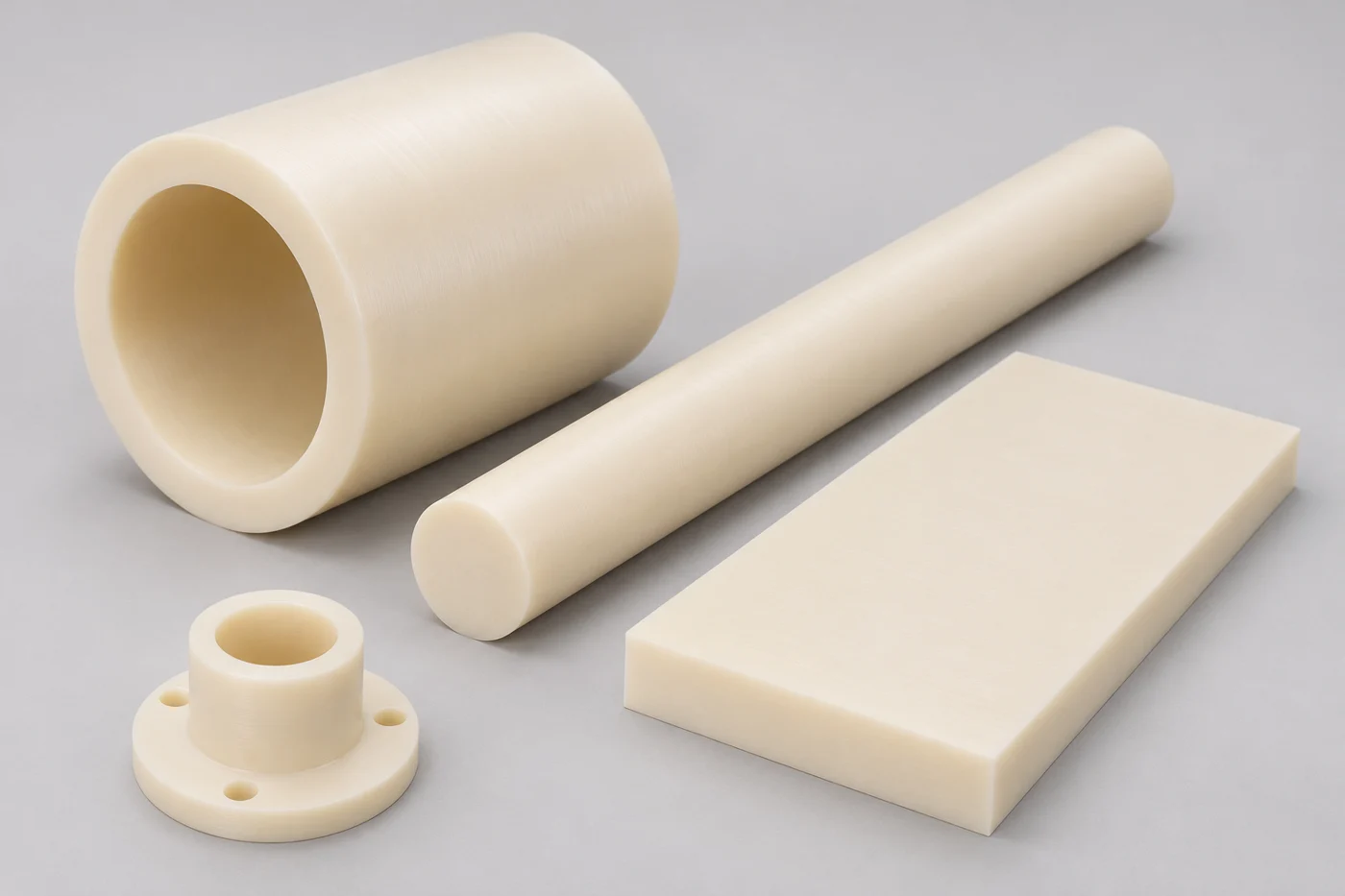
Separate The Manufacturing Route From The Polymer Type
You should identify both the nylon chemistry and stock-making route before comparing properties or quotations.
Cast nylon commonly means cast polyamide 6, also described as PA6 C. Extruded nylon is a broader category. It can include PA6, PA66 and other polyamides, so the word extruded does not establish one chemical composition.
If you compare cast PA6 with extruded PA66, you change chemistry and manufacturing route together. A difference in performance cannot automatically be attributed to casting alone. Begin your comparison with the full grade designation on each technical datasheet.
Ensinger's extruded nylon overview lists several polyamide families and modified grades. It demonstrates why a purchase order stating only extruded nylon leaves important choices unresolved.
Specify the intended component and production quantity early. A large roller, thin guide and small turned spacer can favor different stock options. Tight feature tolerances, inspection evidence and acceptable substitutions also influence which option makes commercial sense.
Understand What Casting And Extrusion Actually Change
The stock-making route affects how a blank is produced, but your finished-part decision still requires grade-specific evidence.
In cast PA6 production, caprolactam polymerizes through a controlled reaction in a mold. Extruded stock is formed by processing polymer through a die into a continuous shape. Both routes can supply material that later requires CNC machining.
Ensinger's cast nylon description explains the casting reaction and identifies modified formulations. It also describes rods, tubes and plates. Those options should prompt a stock review rather than an assumption that every required size is available locally.
Do not confuse casting the stock with molding your finished component. A cast tube can still need boring, turning, grooves and mounting features. Likewise, an extruded rod is not a finished precision shaft simply because its cross-section looks suitable.
Treat descriptions such as higher crystallinity or low internal stress as material context. They do not independently establish your finished tolerance, service life or inspection result. You still need an appropriate geometry, machining plan and acceptance condition.
Compare Cast Nylon Vs Extruded Nylon On Equal Terms
A useful comparison holds the application requirements constant and makes every material difference explicit.
| Comparison Item | Cast Nylon Review | Extruded Nylon Review |
|---|---|---|
| Polymer Identity | Confirm PA6 C and exact formulation | Identify PA6, PA66 or another specified polyamide |
| Stock Geometry | Check suitable cast rod, tube or plate | Check available rod, tube or plate dimensions |
| Modification | Identify lubricants, fillers or stabilizers | Identify the same formulation details |
| Property Evidence | Use data for the proposed cast grade | Use data for the proposed extruded grade |
| Acceptance State | Define moisture and temperature conditions | Define equivalent inspection conditions |
| Commercial Scope | Include blank supply and machining | Include the same finished-part requirements |
Ask whether published values describe dry material, conditioned material or a particular test specimen. Compare the same property, method and units. A dry tensile result and a conditioned result do not isolate the influence of manufacturing route.
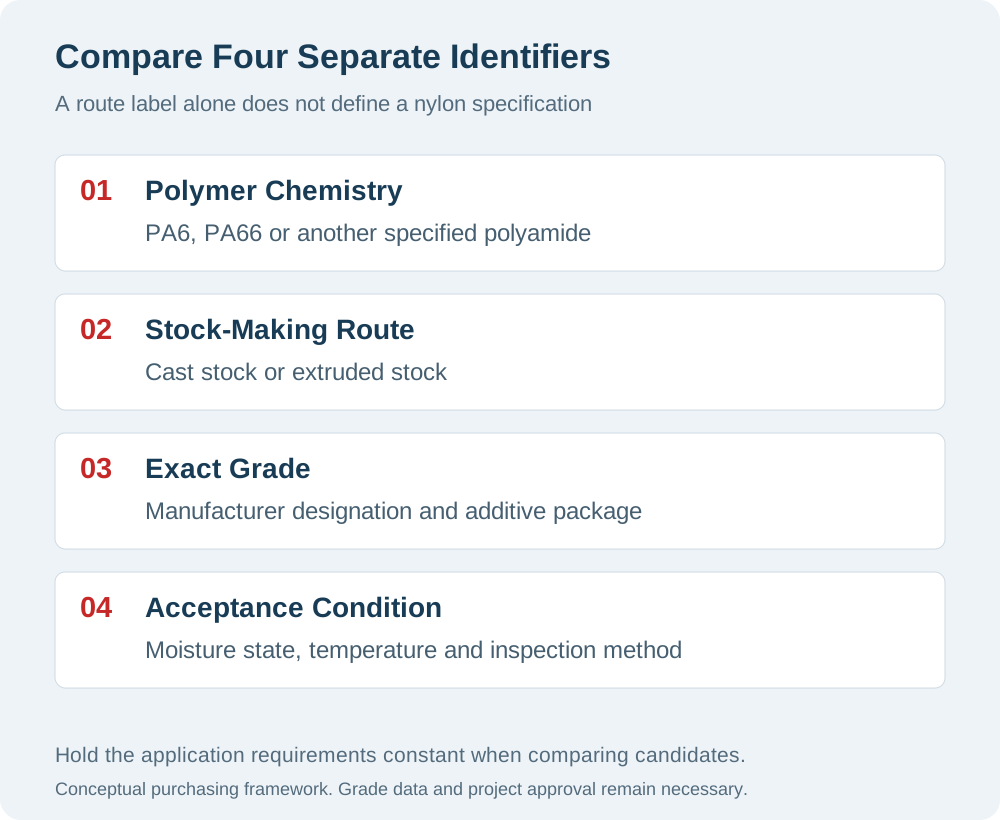
Mitsubishi Chemical Group's Nylamid portfolio description includes both cast and extruded nylon 6. This is another example of route and chemistry being separate identifiers. It does not establish availability of that regional brand for your order.
Keep your comparison focused on the property that limits the design. A higher headline strength value may not solve a clearance problem. A favorable sliding result may not address sustained structural loading or environmental exposure.
Match The Blank To The Finished Geometry
You should choose the stock form that accommodates the finished part while allowing practical machining and workholding.
Review the component envelope before requesting a material price. Include flange diameter, finished length, central bore and any projecting features. Your supplier needs enough information to select a blank without excluding essential machining allowance.
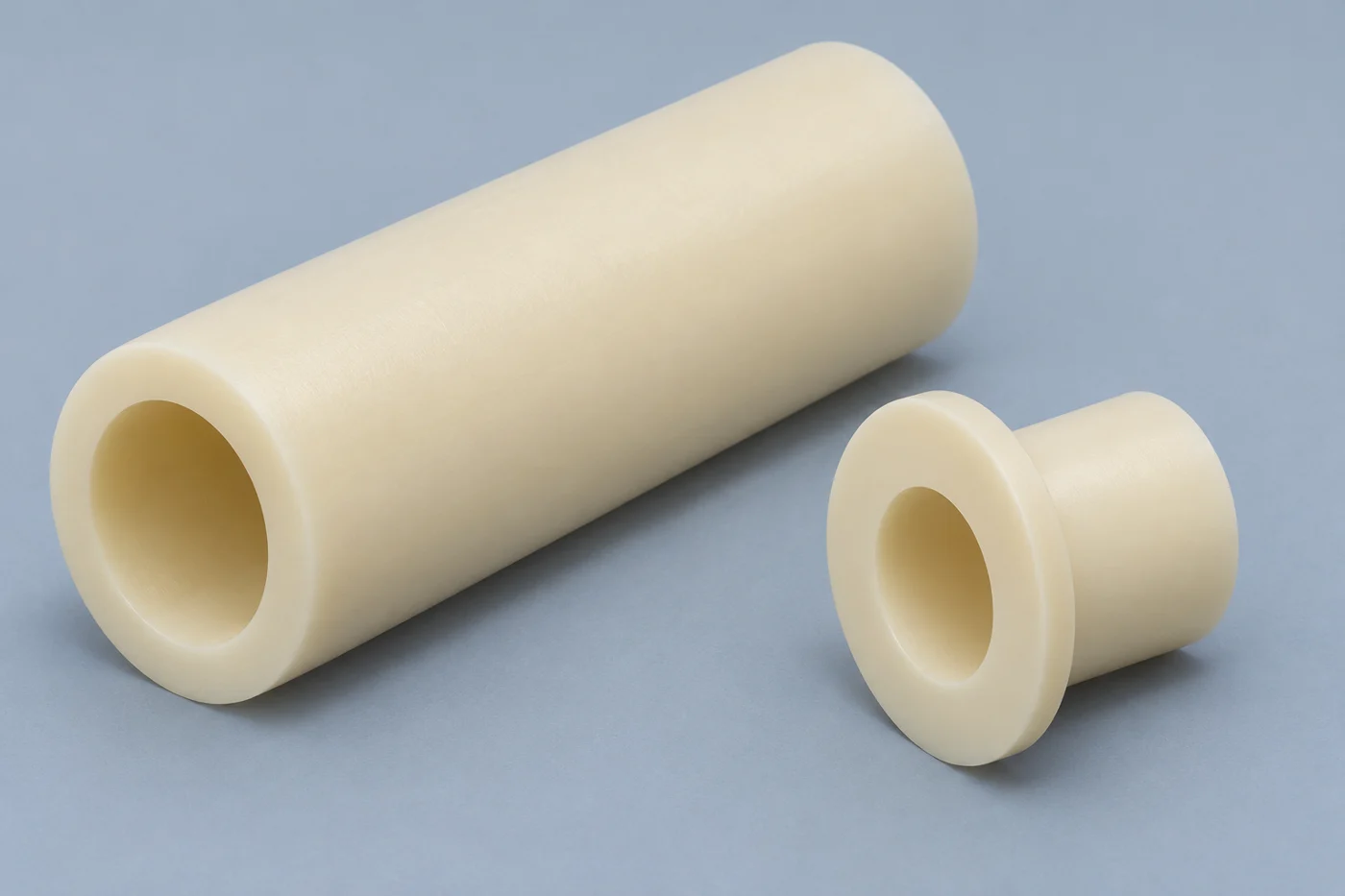
For a thick ring or sleeve, investigate a suitable tube rather than automatically starting from solid rod. A hollow blank may reduce material removal when its dimensions and grade are appropriate. It can also limit the available bore or wall geometry, so check the actual stock dimensions.
The stock illustration shows a tube blank beside a finished flanged bushing. It explains the relationship between blank selection and machining. Appearance cannot verify whether a real nylon blank was cast or extruded.
For plate components, review nesting, thickness and support during machining. A large sheet may accommodate several parts, while a smaller available blank might avoid unnecessary purchasing volume. Compare usable material yield rather than price per kilogram alone.
Do not infer a universal size boundary between cast and extruded nylon. Availability depends on manufacturer, grade, stock form and supply location. Ask your supplier to identify the proposed blank and disclose any supply constraint before design approval.
Define Moisture Condition Before Setting Fits
Neither casting nor extrusion removes the need to account for moisture-related changes in nylon components.
Record the environment during storage, inspection, assembly and operation. A part accepted after dry storage may behave differently after exposure to humid conditions. The relevant change depends on grade, geometry, exposure and time.
Separate dimensional acceptance from service suitability. Your drawing might define a controlled receiving condition while the machine experiences a wider operating range. Both conditions belong in the engineering review, even when only one appears on the inspection report.
Use the nylon moisture absorption guide when defining those conditions. Do not instruct a supplier to condition a thick part using an unspecified soak or a universal schedule. Agree on the purpose, method and evidence first.
For a bushing, review the bore after installation as well as the released component dimensions. Housing restraint and environmental movement can interact. For a guide, assess changes in mounting relationships and running clearance instead of copying a shaft-fit tolerance.
If the required dimensional behavior cannot be supported, reconsider the grade or material family. Choosing cast nylon solely because it sounds more stable does not resolve an undefined moisture specification.
Check Performance Against The Actual Application
You should select a nylon grade using relevant mechanical and environmental evidence rather than a general cast-versus-extruded preference.
Define load duration, motion, temperature and chemical exposure. Include reversals, impact events and periods without movement. A component can face different limiting mechanisms during startup, steady operation and shutdown.
For sliding or rolling parts, identify the mating surface and lubrication arrangement. A modified nylon may deserve evaluation, but modification does not guarantee compatibility with every counterface. Compare the manufacturer's relevant data and validate representative assemblies where necessary.
| Application | Selection Question | Evidence To Request |
|---|---|---|
| Machined Bushing | Will the installed clearance remain acceptable? | Grade data, inspection state and fit validation |
| Roller Or Wheel | What limits the running surface or hub? | Load cases, mating details and operating trials |
| Guide Or Wear Part | What controls friction and replacement? | Counterface, contamination and wear criteria |
| Structural Bracket | Will time-dependent movement matter? | Load duration, temperature and allowable deflection |
Treat reinforced or lubricated grades as separate candidates. A filler may change machining behavior, surface condition or the behavior of mating components. Do not substitute a modified stock merely because its color resembles an approved sample.
Where a datasheet does not address your limiting condition, identify the evidence gap. Ask for relevant testing or consider a different candidate. Neither manufacturing route substitutes for a design assessment.
Plan Machining Around The Proposed Stock
Your machining plan should address heat, restraint and material removal for the actual blank rather than a generic nylon label.
Show functional datums and the relationships that matter after machining. A bore, flange face and outside diameter may need coordinated control. Small mounting holes may require different attention from an exposed nonfunctional surface.
The Mitsubishi Chemical machining toolkit discusses processing considerations for engineering plastics. Use its guidance to frame tooling, cooling and tolerance discussions. It does not guarantee that a particular nylon stock will meet every drawing requirement.
Review heavy stock removal, thin sections and asymmetric features during DFM. Consider how clamping and release affect the measured part. If additional stabilization or staged machining is proposed, agree on its purpose and acceptance implications before production.
Use this sequence to connect material selection with the manufacturing order:
- Confirm chemistry, exact grade, stock route and documentation.
- Review the blank against finished geometry and workholding needs.
- Agree on material condition during machining and final inspection.
- Identify critical dimensions and practical machining access.
- Review any proposed stabilization or conditioning operation.
- Approve the first article before authorizing repeat production where required.
Do not add a universal annealing instruction without grade-specific review. An uncontrolled thermal treatment can create another source of variation. Responsibility for the proposed process and its verification should be clear.
Specify Acceptance Beyond A Visual Material Check
Your receiving plan should verify material identity and functional dimensions under an agreed measurement condition.
Natural, blue or black appearance does not establish casting route, polymer type or additive package. Require the identification and documentation appropriate to your purchase specification. Link delivered components to the approved material and drawing revision.
Decide what evidence each critical feature needs. A dimensional report can establish specified geometry but cannot independently prove long-term wear performance. A material certificate can identify a supplied grade without establishing correct assembly clearance.
Record temperature, conditioning state, support and any relevant measurement-force controls. A flexible part can respond to the inspection setup. Compare receiving measurements with supplier results only when the methods represent equivalent conditions.
The material traceability guide explains how records connect stock, machining and delivery. Request the required records before ordering. Retrospective document recovery may leave gaps that a visual check cannot resolve.
If you approve a stock substitution, revise the acceptance plan where necessary. Changing route, chemistry or formulation can affect the evidence required. Preserve the approval alongside the original purchase requirements.
Control A Trial Substitution
When evaluating a replacement stock, retain the approved part as your baseline. Record its material identity, dimensions and operating history. Define what improvement the trial must demonstrate before ordering the alternative.
Keep other variables consistent where practical. Changing the housing, lubricant and nylon grade together makes the result harder to interpret. Record any unavoidable differences rather than attributing every outcome to the stock route.
After the trial, review dimensional behavior and service observations separately. A part can pass receiving inspection without meeting its operating objective. Approval should identify the tested configuration and any conditions that remain unresolved.
Compare Finished-Part Cost And Supplier Scope
You should compare quotations for the same approved part, not different nylon descriptions with similar prices.
Include blank cost, material yield, machining time, inspection and documentation. Unavailable stock sizes or a special blank can influence lead time. Order quantity and repeat demand may change the preferred purchasing arrangement.
Ask suppliers to identify deviations explicitly. One quote might use cast PA6 while another assumes extruded PA66. Another might omit conditioning or required records. Those offers do not represent the same scope until the differences are reviewed.
TOPS describes drawing-based review of PA6, PA66, cast nylon and specified filled grades on its nylon machining page. Grade availability and suitability require project confirmation. This does not imply that TOPS manufactures the original cast or extruded stock.
Retain the approved grade designation on repeat orders. Allow substitutions only through a documented review. A purchasing description shortened to nylon during reordering can undo the technical work behind the first approval.
Cast Nylon Vs Extruded Nylon FAQ
These answers address common questions when specifying nylon stock for custom machined components.
Is Cast Nylon Always Stronger Than Extruded Nylon?
No. Compare exact grades under equivalent test conditions. Chemistry, formulation and moisture condition can influence the result.
Is Extruded Nylon Always PA66?
No. Extruded stock can include PA6, PA66 and other polyamides. State the chemistry and grade explicitly.
Is Cast Nylon The Same As Injection-Molded Nylon?
No. They describe different manufacturing routes. A cast stock blank may still require substantial machining before becoming your component.
Can You Identify The Stock Route By Color?
No. Color does not verify polymer chemistry, manufacturing route or additives. Use the supplier's grade identification and required documentation.
Does Cast Nylon Avoid Moisture Absorption?
No. Define the relevant environmental and inspection conditions for the selected grade. Validate dimensions and installed fit where necessary.
Will A Tube Blank Always Cost Less Than Solid Rod?
No. Compare actual stock availability, material yield and machining requirements. A suitable tube can help, but it is not automatically cheaper.
Can You Substitute Cast PA6 For Extruded PA66?
Only after engineering review. Chemistry and route both change, so confirm property requirements, fit, documentation and validation implications.
What Should You Send With An RFQ?
Provide drawings, exact grade, acceptable stock route, quantities and operating conditions. Include critical fits, inspection condition and documentation requirements.
Request A Nylon Stock And Drawing Review
Choose cast or extruded nylon through grade evidence, suitable stock and defined acceptance conditions. Send your drawing, quantities and operating requirements. Contact us to confirm material availability, machining feasibility and quotation scope.