
Food-contact machined plastic parts need a defined grade, documented use conditions, controlled processing and agreed acceptance evidence. A polymer name alone cannot establish suitability. You should connect the material documents to the finished component before ordering replacements or approving production quantities.
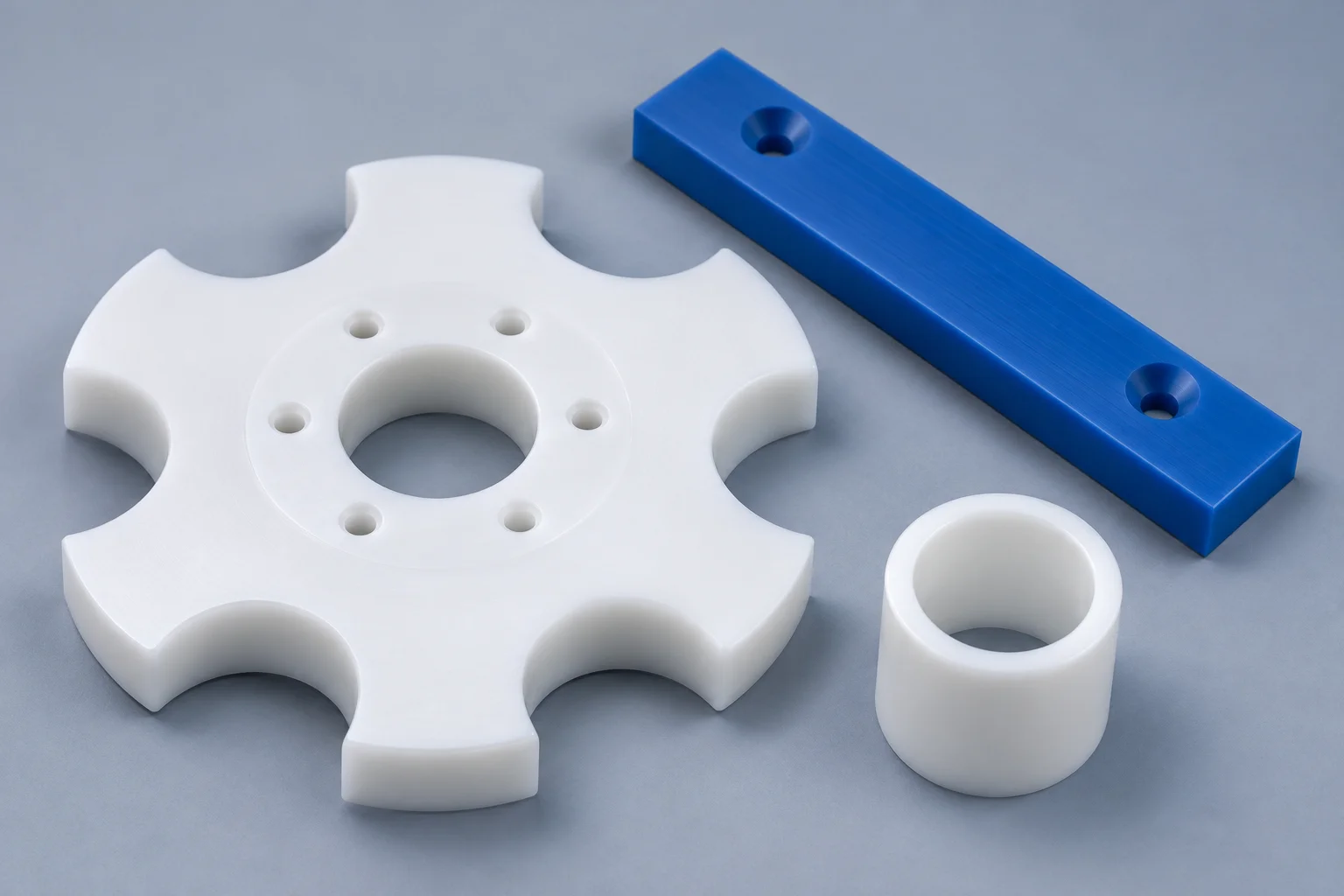
Define The Actual Food Contact Before Selecting Plastic
You need a contact profile before you can judge whether a material declaration covers your component.
Start with the destination market and the equipment location. Identify surfaces touching food directly and surfaces where transfer remains reasonably foreseeable. A guide above an open conveyor deserves different consideration from an isolated external handle.
Describe the food rather than writing only “food processing.” Include whether it is aqueous, acidic, fatty or dry. Record the hottest contact condition and the longest contact period. Separate production contact from cleaning, storage and accidental exposure.
For repeated use, describe the expected cycle and replacement policy. Your normal production temperature might differ substantially from the cleaning temperature. Both matter when you review the grade and the component design.
Ask your equipment owner to approve this profile. Purchasing should not infer the operating conditions from a worn sample. Otherwise, your supplier may evaluate a different application from the one receiving the part.
Treat Food-Contact Compliance As A Documented Use Decision
You should evaluate the stated regulatory basis and restrictions instead of accepting an unrestricted “food-grade” label.
The European Commission's legislation overview identifies the framework, plastics rules, good manufacturing practice and compliance documentation. Its guidance links migration assessment to representative food uses and contact conditions. Check current amendments when reviewing a declaration.
For US applications, the FDA's regulatory-status guidance explains how component authorizations support an intended use. FDA also explains the legal basis for a manufacturer's letter of guaranty. Avoid replacing that evaluation with a general claim that FDA approves every finished plastic component.
EU and US documentation address different regulatory systems. Neither automatically establishes compliance in every destination market. Have your responsible compliance specialist confirm the applicable route, document scope and any testing requirements.
This article provides a purchasing workflow, not a declaration for your particular part. Your actual material, application and supply chain determine the evidence needed.
Specify The Full Grade And Supplied Stock
You should identify the manufacturer, grade, color and stock form rather than specifying the polymer family alone.
“Acetal” leaves room for different formulations and suppliers. Blue stock may contain different additives from natural stock. Filled, lubricated or detectable grades require their own review. A document for one formulation cannot simply represent another.
Record the stock supplier and the relevant designation on your purchasing specification. Define whether substitutions require written approval. A replacement with similar mechanical properties might have different food-contact restrictions or documentation availability.
Separate a product datasheet from an order-related declaration. The datasheet helps you compare engineering properties. The declaration addresses stated compliance conditions. Your lot records connect the supplied material to the particular order.
Keep that connection through cutting and machining. Once a large sheet becomes many small components, the original stock label may disappear. Your supplier needs an agreed identification method that survives the manufacturing sequence.
Compare Candidates Against The Same Application Profile
You should compare candidate grades against contact conditions, mechanical demands and cleaning exposure together.
The table identifies review questions rather than approving whole polymer families. Each candidate still needs grade-specific documentation. Your engineering team must also evaluate wear, deflection and installed fit.
| Component | Candidate Families To Review | Manufacturing Route | Questions Before Release |
|---|---|---|---|
| Conveyor wear guide | UHMW-PE or POM | Milling and drilling | What wear debris and cleaning exposure occur? |
| Indexing star wheel | POM or PET | Profile milling | Does tooth geometry preserve handling and cleanability? |
| Support bushing | POM or selected PA | Turning and boring | How do moisture and clearance affect operation? |
| Hot process spacer | Selected PEEK | Turning or milling | Do the documented contact conditions cover this duty? |
| Sliding scraper | Selected PE or other evaluated grade | Profile machining | Can edges remain functional without unacceptable shedding? |
Use your food-processing application review to organize the component discussion. Avoid choosing a premium resin before you understand the actual failure mechanism. A stronger material may still be unsuitable for the cleaning chemistry or required documentation.
Review Declarations Before Committing To Production
You should compare each declaration's identity and conditions against the drawing and approved contact profile.
Check the issuer, product identification, issue date and stated regulatory basis. Review limitations on food types, temperature, duration and repeated use. Ask how the declaration relates to the supplied order and stock batch.
A broad product brochure is useful during selection. It cannot resolve a missing grade identity on the purchase order. Likewise, an old certificate may need review after formulation, regulatory or supplier changes.
Ask which supporting information can be provided and under what conditions. Some formulation information may remain confidential. Your reviewer still needs enough evidence to determine whether the declared scope fits the intended use.
Record any unanswered questions before machining begins. If additional assessment or testing is required, agree who commissions it. Include timing and acceptance responsibility in the order rather than discovering those requirements after delivery.
Keep Material Evidence Connected To Finished Parts
You should maintain a traceable connection between incoming stock, machining records and the delivered component batch.
Create an order identifier that follows the parts through workholding, finishing and packaging. Where multiple stock lots are used, define whether mixing is permitted. Your delivery record should show the relationship clearly.
Decide where identification belongs. Direct marking may be inappropriate on a food-contact or sliding surface. Packaging labels or controlled batch containers can provide an alternative, depending on your traceability requirements.
For a practical records structure, see material traceability for machined plastic parts. Keep the drawing revision alongside the material reference. Retain the approved contact profile with those records. This gives replacement buyers a clear basis for comparing subsequent offers. Otherwise, the correct material may accompany the wrong component configuration.
Your receiving team should know how to retrieve these records. Documentation that cannot be matched to the delivered batch creates avoidable investigation work during maintenance or replacement planning.
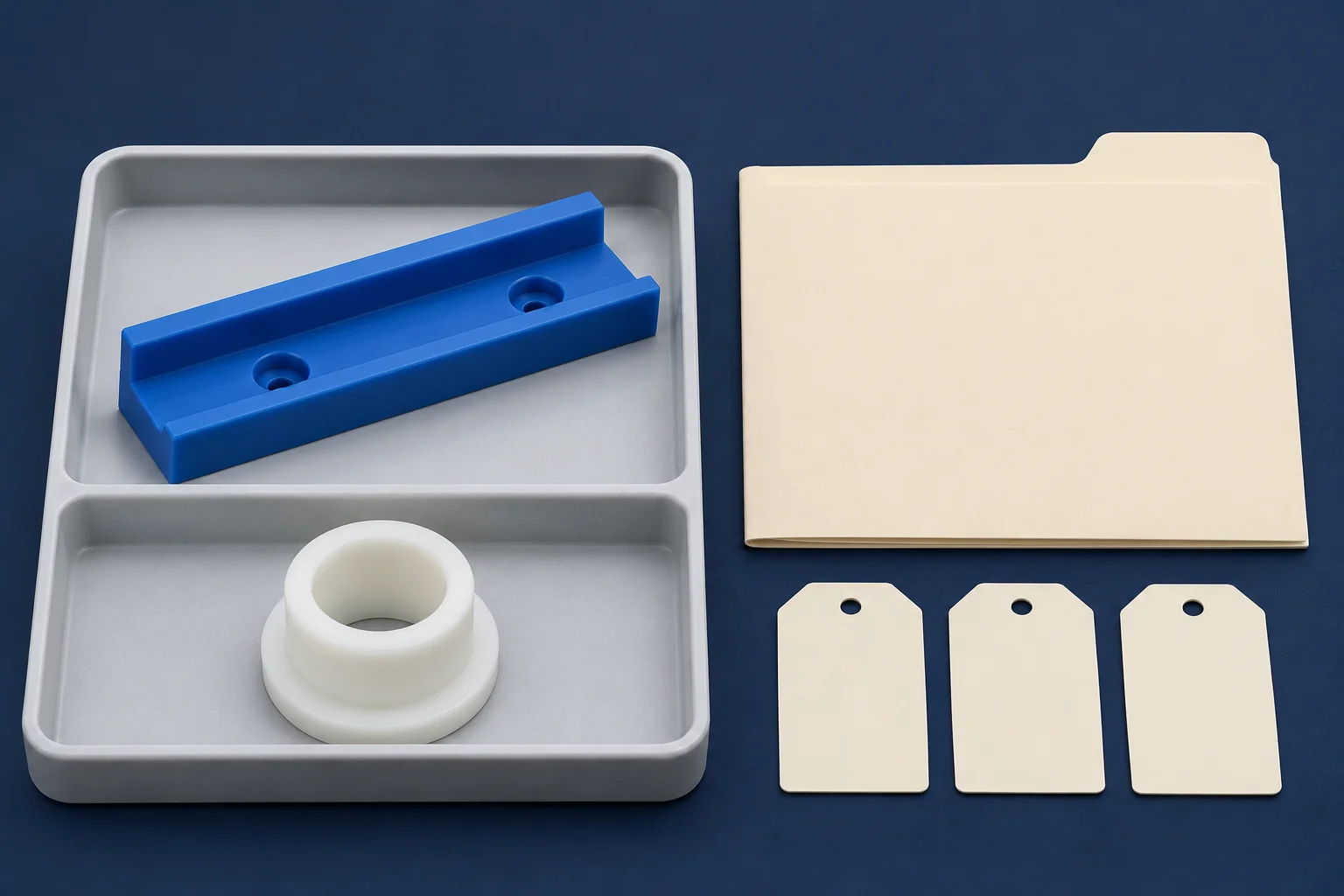
Control The Machining And Finishing Sequence
You should review processing inputs because suitable starting stock does not describe every exposure during machining.
Discuss machining fluids, handling aids, marking materials and any secondary processing. Identify which substances can remain on the part. Agree the cleaning sequence and how its suitability will be assessed.
Keep chips and burrs separate from chemical residues. Removing a visible burr does not demonstrate removal of an invisible processing film. Both may require acceptance checks, but their methods and criteria differ.
Your CNC plastic machining review should address geometry, workholding and inspection as well as material selection. Specify critical surfaces before manufacturing planning. This helps your supplier avoid unnecessary contact or marking in those areas.
Where the application requires dedicated handling or additional segregation, request evidence for that arrangement. Do not assume every general machining process includes a validated food-contact production system.
Design Surfaces For Cleaning And Maintenance
You should design the component so required cleaning and inspection can reach the relevant surfaces.
Review blind cavities, narrow gaps and recessed fasteners with your equipment team. These features can complicate access or drainage. A smooth external face does not compensate for an inaccessible joint behind it.
Specify edge requirements by function. A scraper edge and an operator-accessible edge need different treatment. Avoid vague instructions that could remove necessary geometry or leave unacceptable burrs.
Agree surface finish only where it serves a defined requirement. A single roughness value cannot establish overall hygienic suitability. Geometry, assembly, wear and cleaning access also influence the installed result.
Plan replacement access early. Your maintenance team should be able to remove the component without damaging adjacent contact surfaces. Include an agreed inspection point for deterioration during service, particularly around heavily loaded or sliding features.
Separate Compliance, Cleanliness And Mechanical Inspection
You should create separate acceptance criteria for material evidence, surface condition and dimensional conformity.
Each check answers a different question. A dimensional report cannot establish food-contact compliance. An apparently clean surface cannot establish a material's formulation. A declaration cannot prove that your installed bushing has adequate clearance.
| Acceptance Area | Evidence To Agree | What It Cannot Establish Alone |
|---|---|---|
| Material identity | Grade reference and batch linkage | Suitability for every food or temperature |
| Declared use | Applicable declaration and restrictions | Finished geometry or cleaning effectiveness |
| Dimensions | Drawing-based inspection results | Chemical suitability of the grade |
| Surface condition | Defined burr and cleanliness checks | Universal migration compliance |
| Delivery protection | Agreed packaging and identification | Sterility or indefinite storage suitability |
Your quality and inspection discussion should identify which records belong with each shipment. Confirm the actual page requirements and requested evidence during quotation. Additional application-specific testing needs a separately defined method and responsible reviewer.
Use A Controlled Sample Approval Sequence
You should approve a representative sample and its evidence package before releasing an unfamiliar replacement into routine service.
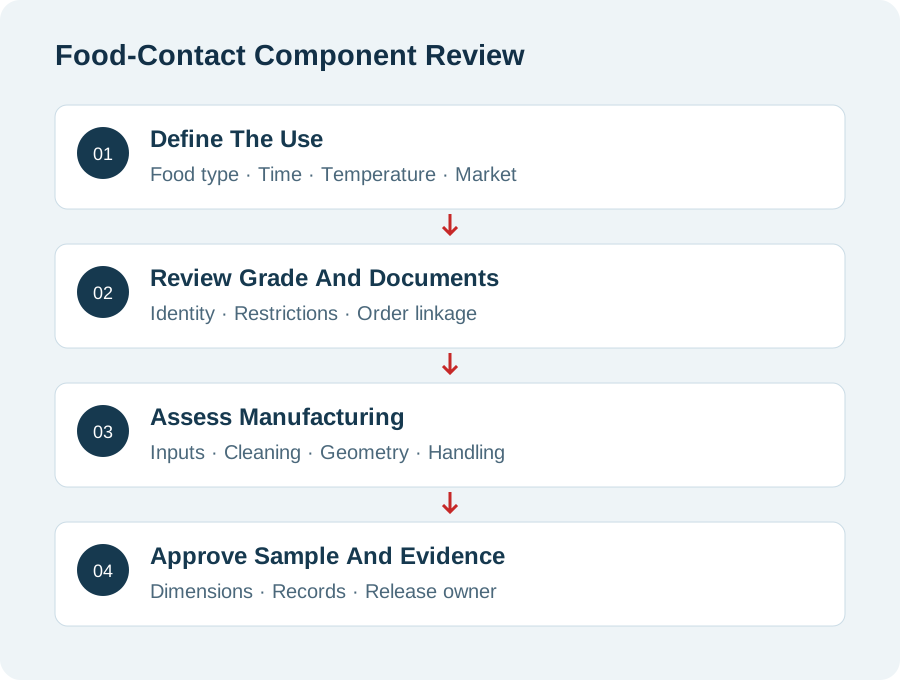
Begin with the drawing and contact profile. Review the proposed grade and available documentation. Then assess manufacturing inputs, finished geometry and cleaning requirements together.
Inspect representative components against the agreed drawing. Review records against the actual delivered sample batch. Where equipment trials are needed, define the trial conditions and who authorizes release.
Define a response when a sample fails. Separate dimensional rework from unresolved material evidence. Reworking geometry cannot repair an unsupported formulation claim.
Record deviations rather than accepting them through informal conversation. A successful fit trial does not erase an unresolved material restriction. Likewise, complete paperwork does not justify a mechanically unsuitable replacement.
Freeze the approved configuration after review. Keep the material designation, drawing revision, processing requirements and acceptance package together. Future reorder reviews can then focus on changes instead of reconstructing the original decision.
Compare Quotes By Evidence And Accepted Service
You should compare quotations using the same material identity, documentation scope and acceptance requirements.
Stock availability, component size and machining complexity influence cost. Grade-specific documentation, batch segregation and additional assessment can also affect the purchasing route. Ask suppliers to identify these items separately where practical.
Review the replacement interval and consequences of failure without inventing a universal service life. A cheap component may require expensive downtime. Conversely, an unnecessarily restrictive specification can add cost without improving the actual duty.
State prototype quantity, repeat quantity and expected annual demand. Ask whether the proposed stock source can support repeat orders. A supplier change during a maintenance emergency can reopen the material review.
Compare exclusions carefully. If one quotation omits required documents or cleaning steps, its lower price may represent a different deliverable. Resolve those differences before selecting the supplier.
Define What TOPS Must Confirm For Your Order
You should obtain order-specific confirmation before treating a proposed TOPS component as suitable for your food-contact application.
TOPS presents machining services and food-processing applications on this website. Those pages provide a starting point for discussing geometry and materials. They do not establish every grade's availability or every requested compliance arrangement.
Ask TOPS to confirm the proposed stock, document availability and manufacturing requirements against your application. Request confirmation of any special inspection, segregation or testing expectations. Do not infer a certification or validated process from an illustrative product image.
No customer case or verified food-contact production result is claimed in this article. Your purchase decision should rest on the evidence available for your own order.
Food-Contact Machined Plastic Parts FAQ
You should resolve these recurring questions before approving a replacement or comparing suppliers.
Is Every POM Or UHMW Part Food-Contact Suitable?
No. You need the exact grade and its documented conditions of use. Polymer names alone leave formulation and application questions unresolved.
Does Blue Color Prove Compliance?
No. Color provides identification or contrast, depending on the application. It does not replace grade-specific evidence or establish detectability performance.
Can I Reuse A Declaration From Another Order?
Only after confirming that its product identity and scope apply. Preserve the connection to your supplied stock and finished batch.
Does Machining Automatically Cancel A Stock Declaration?
Not automatically. You must assess what the document covers and whether processing introduces additional issues. Confirm finished-article responsibilities with your reviewer.
Is A Food-Contact Part Automatically Clean Or Sterile?
No. Material suitability, cleanliness and sterility are different requirements. Specify the actual delivery condition rather than treating these terms as interchangeable.
Can Mechanical Testing Replace Compliance Documents?
No. Mechanical testing evaluates specified performance under selected conditions. It cannot independently establish the regulatory status of a material formulation.
Should Every Replacement Use The Same Drawing?
Use the approved drawing revision and material specification. Review changes deliberately, including substitutions made when the original stock is unavailable.
What Should I Send With An RFQ?
Send the drawing, full grade requirement, contact profile, destination market and quantities. Include documentation, cleaning, packaging and inspection expectations.
Request A Review Against Your Actual Conditions
You can reduce purchasing uncertainty by defining the use before selecting stock. Keep material identity, manufacturing controls and acceptance evidence connected. Resolve document restrictions before approving production or substituting replacement grades.
Contact us with your drawing, food-contact conditions, destination market and expected quantities. Include required declarations and acceptance records for an order-specific review.