
Choose virgin or filled PTFE by the component’s function and the evidence available for an identified material product. A filler can change properties that matter to loading, wear, dimensions or electrical behavior. It can also introduce requirements that an unfilled grade did not present. The word filled therefore starts a specification discussion rather than completing one.
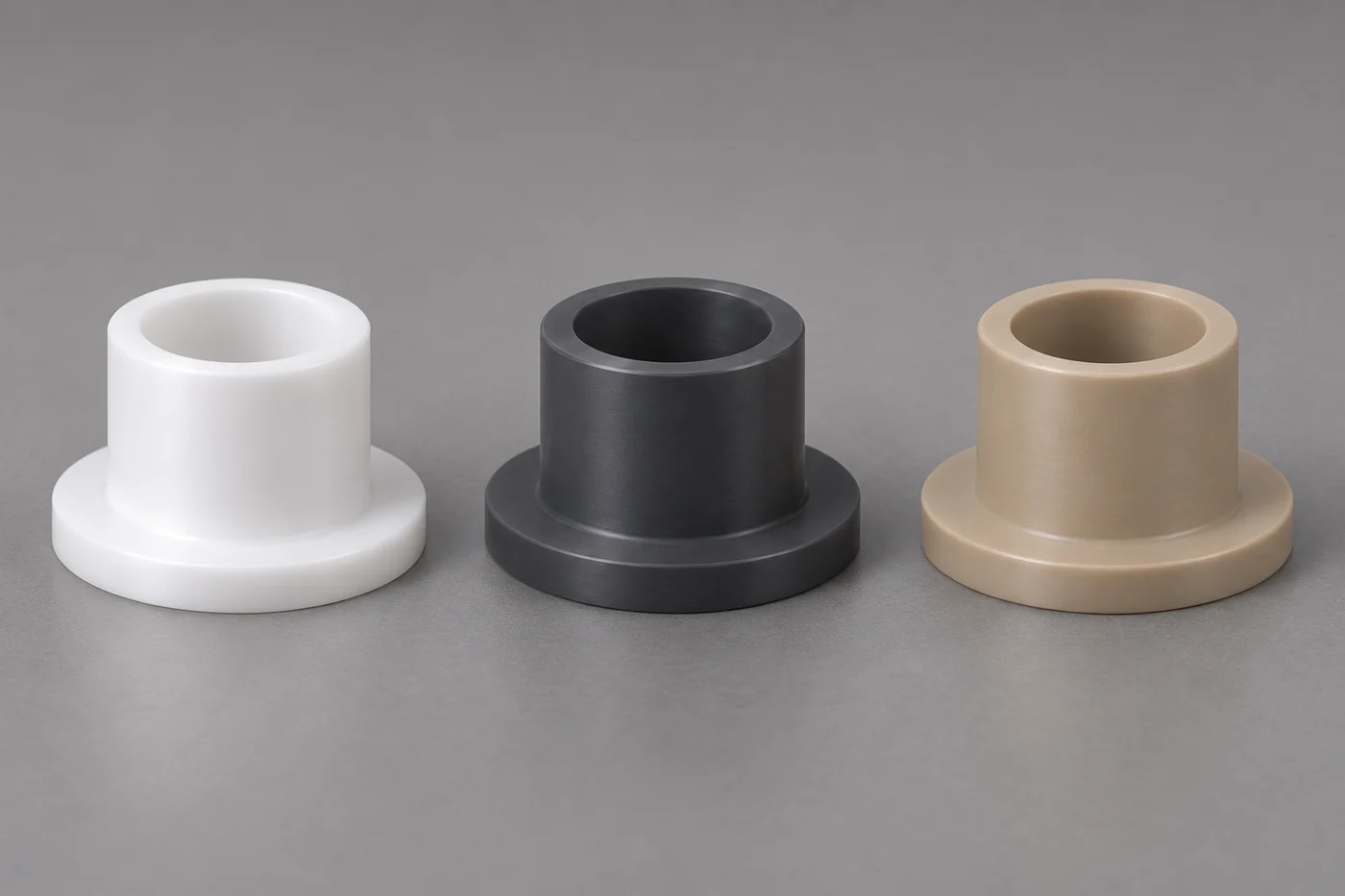
For a machined valve seat, bushing, spacer or insulator, compare the actual formulations against the same operating conditions and acceptance plan. Do not select by color or assume every filled grade is a stronger version of the same material. This guide explains the engineering and purchasing questions to settle before production.
Define The Component’s Main Job
Start with the failure condition that the material must prevent. A valve seat may need an agreed sealing result, a bushing may need acceptable sliding behavior and an insulator may need specified electrical evidence. These roles can lead to different material choices even when the parts share a similar ring shape.
Describe load, motion, temperature and chemical exposure together. Identify whether loading is continuous, intermittent or limited to assembly. State the permitted movement or change in clearance where it affects function. A family-level description of PTFE cannot establish the outcome of a specific loaded component.
Separate essential requirements from preferences. If an existing drawing specifies virgin PTFE, ask why before proposing a filled alternative. There may be a functional or documentation reason that is not visible in the model. Conversely, an old specification may deserve review when the application has changed.
Use the engineering plastic selection guide to organize the application information. A useful shortlist follows from the operating job rather than from a general ranking of material names.
Specify More Than Virgin Or Filled
Virgin PTFE normally describes an unfilled material, but the purchasing description still needs the relevant product identity and requirements. Clarify any restrictions concerning reprocessed content or approved stock sources. Do not rely on an informal grade label to communicate every supply expectation.
For a filled material, identify the manufacturer designation and formulation. Glass, carbon, graphite, bronze and other additions describe different possibilities, not one interchangeable product class. The amount and type of addition can matter, as can the way the stock product is manufactured.
Röchling’s PTFE parts and billets information describes several filler options for application-specific products. This supports asking for an exact formulation. It does not establish that each option has the same mechanical, chemical or electrical properties.
Keep the drawing, quotation and order consistent. If one document requests virgin material while another names a filled supplier product, resolve the difference before cutting. Record any approved alternative so repeat orders have a controlled reference.
Review Sustained Load And Deformation
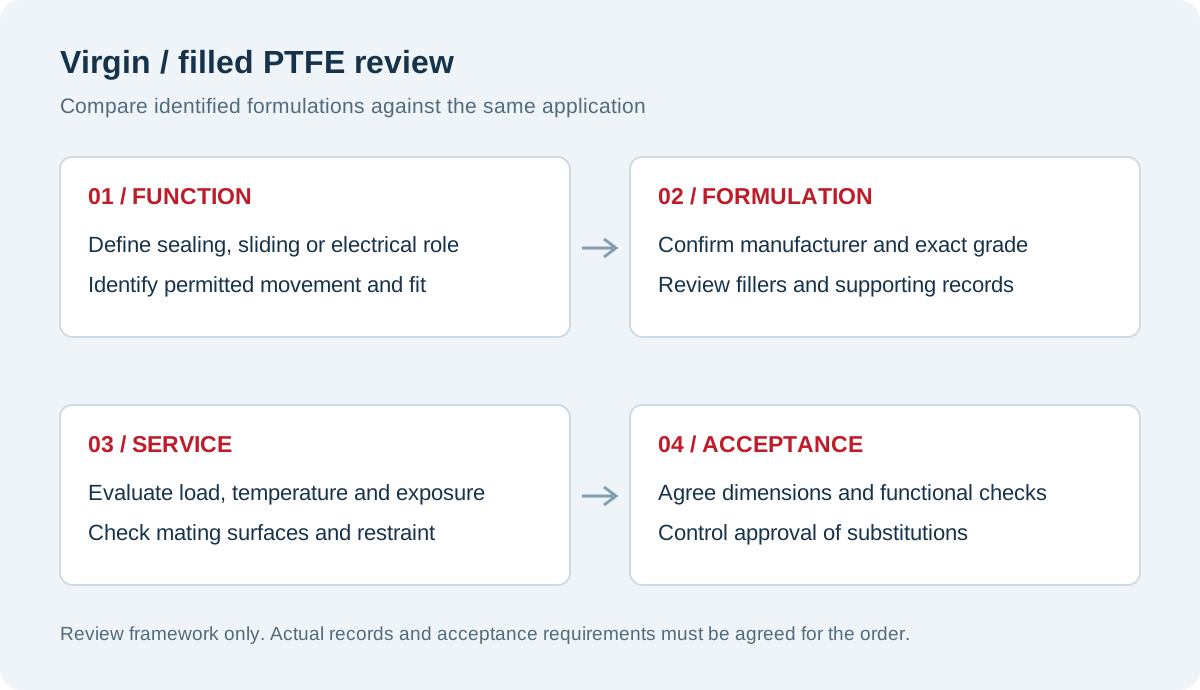
A material selected for a loaded component needs more than a short-term strength comparison. Review the duration of loading, operating temperature and permitted deformation. A part can meet its initial dimensions yet behave differently after sustained service or prolonged assembly restraint.
The plastic creep guide explains why time-dependent movement deserves separate attention. For PTFE-based candidates, obtain information relevant to the specific formulation and loading situation. Do not convert a general statement about improved load resistance into a component-level guarantee.
Mitsubishi Chemical Group describes Fluorosint 500 PTFE as a product developed for dimensional control and resistance to deformation under load. That is evidence about a particular commercial material. Its published comparisons should not be assigned to every material sold as filled PTFE.
Assembly design remains part of the decision. Contact area, support and the way force is introduced can change local conditions. If the design has a concentrated load or a narrow sealing land, evaluate that geometry instead of relying only on nominal bulk material properties.
Compare Sliding And Wear As A Contact System
For a bushing or wear ring, describe the mating surface, lubrication, motion and contamination conditions. The same polymer can behave differently against different counterfaces or under different loading patterns. A material comparison should therefore include the contact system rather than an isolated friction value.
A filler intended to improve one aspect of tribological behavior may change other properties or counterface requirements. Review the supplier’s information for the offered product. Do not assume that a formulation used successfully in one bearing arrangement will provide the same result in another machine.
The component illustration shows separate seat, sleeve and spacer concepts beside a metal shaft. It illustrates different functions that can drive material selection. It is not an assembled test arrangement or evidence of wear life for any PTFE grade.
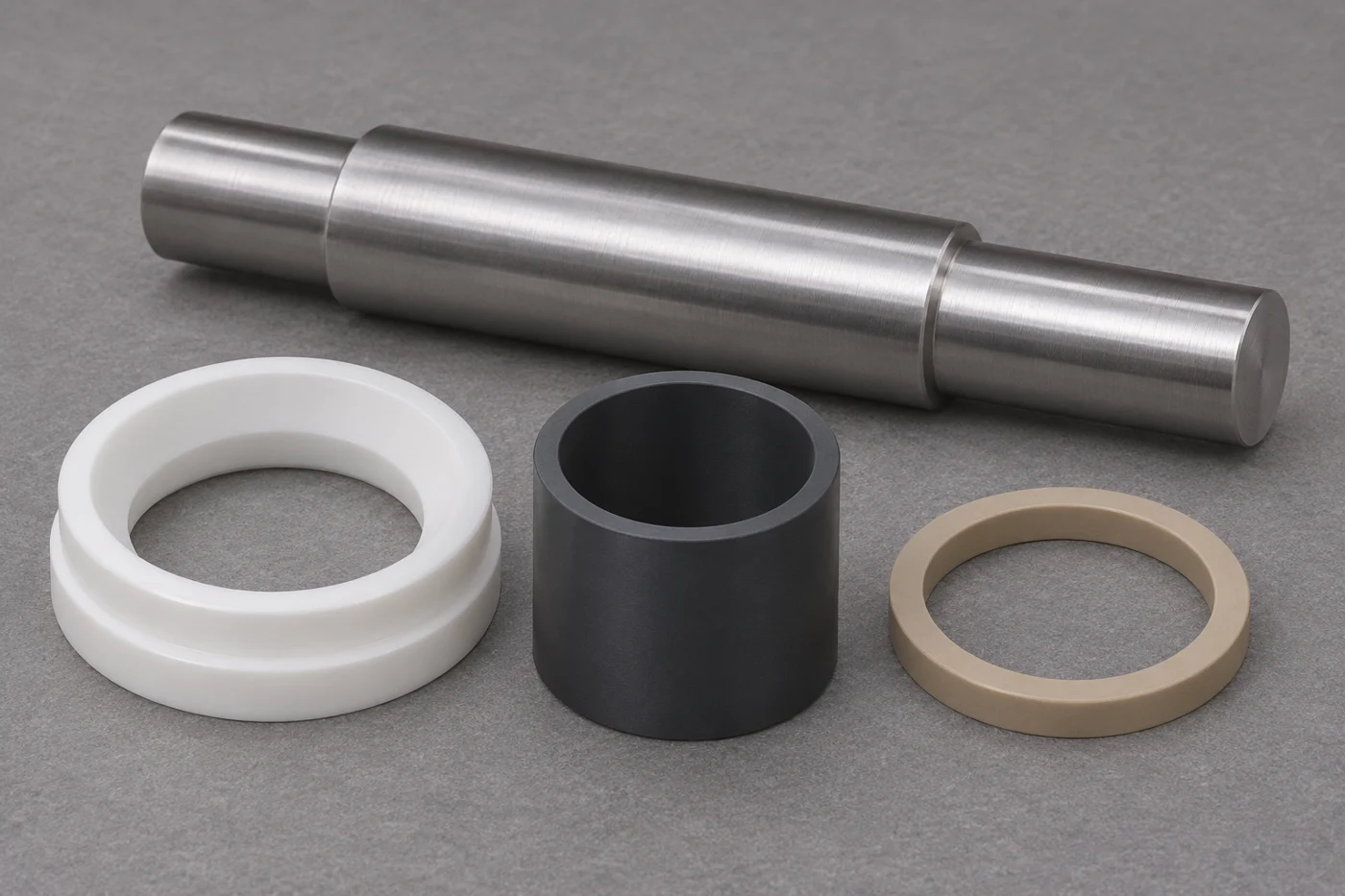
For an installed bushing, connect the material review to the clearance discussion. The housing, shaft and mounting method influence the functional fit. A material substitution can require review of that relationship even when nominal drawing dimensions stay the same.
Check Chemical Compatibility For The Whole Formulation
List the actual fluids, concentrations, temperature and exposure pattern. Include cleaning and maintenance agents. Broad chemical-resistance descriptions are useful for screening, but the finished formulation and the application conditions need to be considered together.
A filler should not automatically inherit every compatibility assumption made for unfilled PTFE. Ask whether the identified product is suitable for the specified exposure and whether available information covers the relevant conditions. Where the evidence is incomplete, define the evaluation needed before approving production.
The chemical resistance guide explains the information required for that review. Stress, temperature and exposure duration can matter as well as the chemical name. Keep those conditions visible in the material-selection record.
If the component has a specified contact or application approval requirement, identify the evidence needed for the exact product. Have the responsible technical or quality team review its scope. A generic declaration for a polymer family should not silently replace the documentation required by the order.
Keep Electrical Requirements Explicit
An electrical insulator and a dissipative component have different objectives. Fillers can alter electrical behavior, so neither color nor the PTFE family name establishes that the offered formulation meets the required function. Identify the property, conditions and evidence relevant to the application.
Do not assume that a dark grade is conductive or that a light grade is suitable for every insulation task. These visual shortcuts cannot identify composition or establish tested performance. Use the manufacturer designation and the appropriate product information.
The electrical insulating plastics guide provides a framework for discussing the environment and geometry. Where moisture, contamination or operating temperature affects the assembly, include it in the review instead of comparing only one room-temperature data-sheet value.
If a substitute is proposed, recheck the electrical requirement along with mechanical and chemical needs. A benefit in wear or load resistance does not automatically justify a change for a component that also serves an insulating role.
| Selection issue | Information to compare | Purchasing question |
|---|---|---|
| Material identity | Exact manufacturer designation and formulation | Is the offered product the approved grade? |
| Sustained loading | Temperature, duration and allowable movement | What evidence supports the loaded component? |
| Sliding contact | Counterface, motion, lubrication and debris | Is the formulation suitable for this contact system? |
| Chemical exposure | Medium, concentration and service conditions | Does the evidence cover the whole product? |
| Electrical function | Required behavior and test conditions | Is insulation or dissipation actually specified? |
| Acceptance | Dimensions, inspection state and documents | Are quotations based on the same deliverable? |
Review Thermal Movement And Inspection State
Material selection does not remove the need to define dimensional acceptance. Identify the temperature basis, support and measurement condition for critical features. A soft ring or slender sleeve can respond to contact forces during inspection, complicating comparison between inspectors.
Review operating clearance with the surrounding assembly. The thermal expansion article explains why the mating materials and temperature history matter. Do not assume a filled formulation matches another material’s expansion behavior without checking the identified product and conditions.
Specify whether a dimension applies to the free component or a defined restrained state. If assembly restraint is used for acceptance, document the arrangement. An improvised clamp that changes a ring’s shape is not a reproducible inspection method merely because the resulting number is convenient.
Agree how sensitive features will be measured. The quality and inspection page is a starting point for discussing the required evidence. Concentrate the plan on functional relationships and the drawing revision rather than requesting a generic statement of dimensional compliance.
Discuss Machining And Edge Conditions
The selected formulation affects the machining review. Tool condition, cutting approach and workholding should suit the actual stock product and geometry. A process established for one PTFE grade should not be assumed to transfer unchanged to another formulation.
Ensinger’s machining FAQ discusses material-specific considerations for machining engineering plastics and reinforced materials. Use supplier guidance to support the process discussion. It does not establish a universal cutting recipe or tolerance capability for every PTFE component.
Identify sealing lands, functional edges and surfaces that must remain free from clamp damage. A thin lip or narrow wall may need a different support strategy from a substantial spacer. Review these details before accepting a quotation based only on overall diameter and length.
Use the PTFE machining page for a drawing-based inquiry. Include the exact formulation and operating function so the conversation can address stock, machining and inspection together.
Evaluate A Representative First Article
A first article should use the intended grade and a representative manufacturing route. If the material is still being selected, identify which candidate each sample represents and what the comparison must decide. Keep the source records connected to the sample throughout evaluation.
Agree the dimensional and functional checks before producing the parts. A sealing component may need an application-specific evaluation beyond dimensional inspection. A wear component may need a defined contact trial. The responsible team should establish the scope and acceptance basis.
Document the limits of the trial. A short test under one temperature or load does not demonstrate unrestricted service life. If the evaluation differs from the intended application, make the difference visible when interpreting the result.
Any change between the trial grade and production material needs approval. Replacing a supplier product with another material bearing the same filler description can change the basis of acceptance. Treat the proposed replacement as a controlled decision rather than a clerical purchasing adjustment.
Compare Total Accepted-Part Cost
Request quotations against the same grade, geometry, quantity and evidence package. Stock price is only one contributor. Availability, material yield, setup, inspection and any required evaluation can affect the practical cost of the accepted component.
Avoid a fixed cost ranking that assumes every filled formulation costs the same or always provides better value. Obtain current quotations for the identified products. A more expensive stock material can be justified only through the actual requirements, not a general claim that filled PTFE is superior.
Clarify whether documentation or first-article work is included. An offer that omits required evidence is not directly comparable with one that includes it. Review exceptions before the order is accepted so the release requirements remain realistic and explicit.
A Hypothetical Valve-Seat Decision
Imagine a buyer investigating movement in a machined valve-seat ring under sustained loading. The existing drawing says PTFE without a product designation. This is a hypothetical example, not a TOPS customer case or a claim about a particular valve design.
The review first establishes loading, temperature, fluid exposure and the permitted sealing change. The team then compares identified unfilled and modified candidates using relevant evidence. It also examines support geometry and assembly conditions rather than assuming the material alone explains the issue.
The result is an approved specification and a representative validation plan. The selected route may involve a new grade, a geometry revision or retaining the original material. The useful outcome is a decision tied to evidence and controlled requirements.
What To Include In Your RFQ
Send the current drawing and model, quantity and exact material designation. State the filler formulation where applicable and identify any approved alternatives. Describe the sealing, sliding, spacing or electrical function along with operating conditions that control selection.
List the material records, inspection evidence and application checks needed for release. Use the material traceability guide to define how the delivered parts connect to their stock. Ask for unavailable evidence or proposed exceptions to be identified before production.
Frequently Asked Questions
Is Filled PTFE Always Better Than Virgin PTFE?
No. A formulation must satisfy the whole application. Improvements in one property may introduce other considerations. Compare identified products against loading, exposure, electrical function and acceptance requirements.
Can Color Identify A PTFE Formulation?
No. Appearance cannot establish filler type, amount or source history. Use the approved manufacturer designation and supply records. The article’s different colors are illustrative only.
Can A Filled Grade Use The Same Drawing Without Review?
Not automatically. Recheck fit, operating behavior, surface needs and required documents. A change in material can alter assumptions even if nominal dimensions remain unchanged.
Does A Material Data Sheet Prove A Finished Seal Will Work?
No. Product data supports selection, but the component also depends on geometry, assembly and service conditions. Define any application evaluation needed before production release.
Discuss Your PTFE Component
Send TOPS Plastics your drawing and operating requirements. Include quantity, proposed formulation and critical acceptance conditions. Those details support a practical review of material, machining and evidence before production.