
Chemical resistance of plastics depends on the exact material and exposure conditions. A compatibility-chart rating can help you screen candidates, but it does not approve a finished component. This guide helps you define the exposure, compare evidence and prepare a useful validation plan before ordering machined plastic parts.
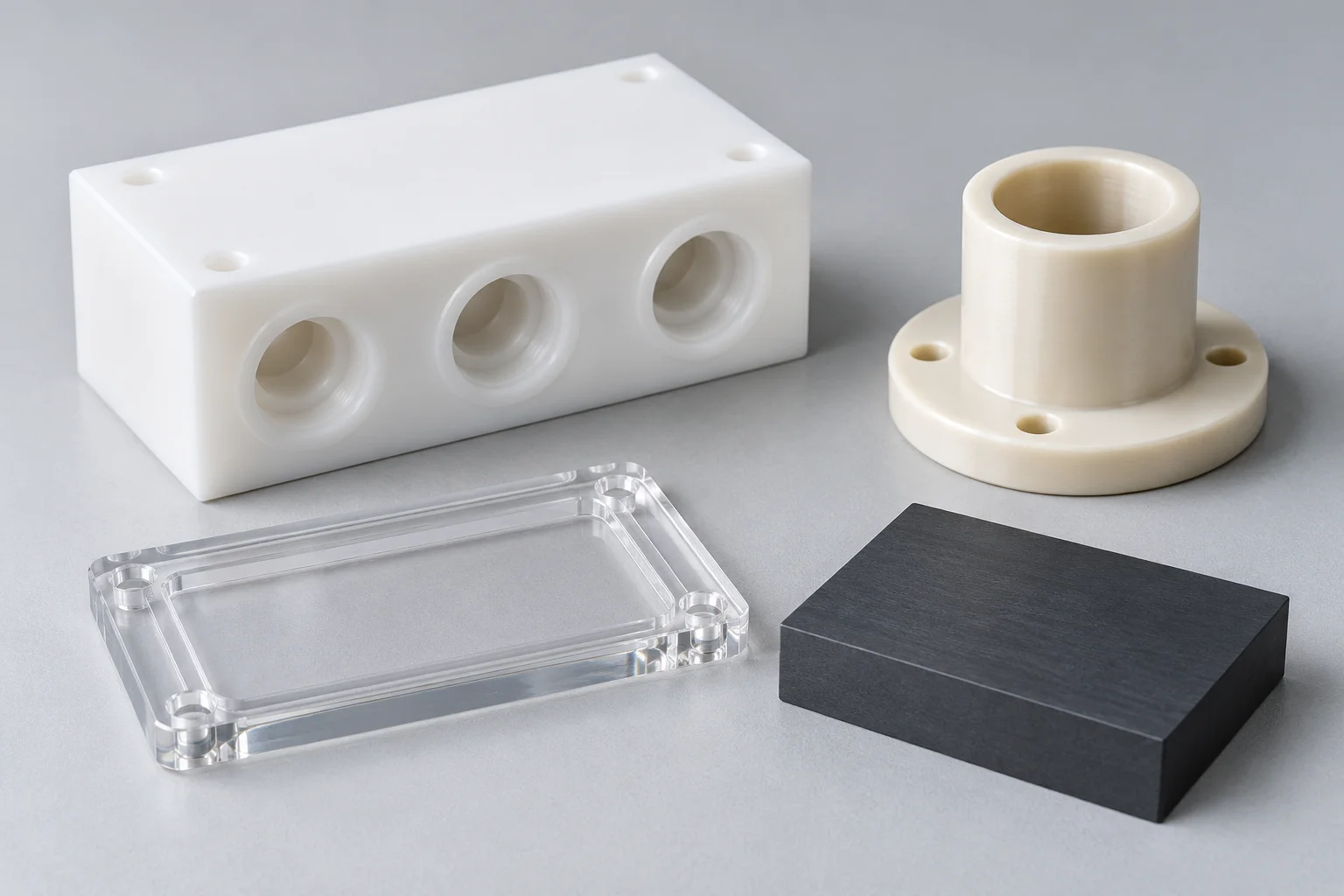
What Does Chemical Resistance Mean For Your Part?
Chemical resistance means retaining the properties your component needs during a specified chemical exposure.
Your acceptance requirement might concern dimensions, strength, appearance or sealing function. Define that requirement before asking which plastic is “best.”
A cover can remain intact yet become unsuitable if its viewing surface changes. A valve component can fail functionally without obvious discoloration.
Start by identifying what the part must continue doing. Then determine which measurements or checks can demonstrate that function after exposure.
Avoid treating “chemical resistant” as a complete material specification. It leaves the chemical, operating conditions and acceptable change undefined.
For custom plastic machining, provide these functional requirements with the drawing and exact material designation.
What Exposure Information Must You Collect First?
Collect the chemical identity, concentration, temperature, contact pattern and mechanical conditions before comparing materials.
Ensinger’s chemical-resistance guidance identifies temperature, concentration, exposure duration and mechanical loading as important evaluation factors.
A product’s trade name alone may not identify the exposure sufficiently. Obtain its current technical information from the manufacturer.
Where appropriate, provide the formulation or composition information available to your responsible engineering team. Clearly identify anything that remains unknown.
Use one exposure record for the supplier discussion. Conflicting descriptions across emails make evidence difficult to compare.
| Information | What To Record |
|---|---|
| Chemical identity | Chemical or commercial product name, supplier and relevant document revision |
| Concentration | Working concentration and any permitted variation |
| Temperature | Actual contact temperature and relevant operating range |
| Contact pattern | Immersion, splash, wipe, vapor or another defined condition |
| Duration | Continuous contact, individual contact time and expected repetition |
| Mechanical condition | Assembly constraint, applied loading and functional surfaces |
| Acceptance | Properties and functions that must remain within agreed limits |
If one field is unknown, flag it. Do not silently substitute room temperature or assume the product is used undiluted.
How Should You Read A Plastic Compatibility Chart?
Read the rating together with its stated material, test conditions and limitations.
Mitsubishi Chemical Group describes a screening tool that considers chemical, concentration and temperature. Those inputs matter when interpreting simplified ratings.
Check the legend before comparing symbols or letters. Different publishers may define their categories differently.
Confirm whether the entry concerns your exact grade or only a general polymer family. Record the source and document revision.
A blank entry should remain an evidence gap. It does not demonstrate either suitability or failure.
If the chart condition differs from your application, ask what further review is required. Do not promote a nearby entry into approval.
Keep the original evidence with the selection record. A copied rating without its context is difficult to audit later.
Why Do Concentration And Temperature Need Separate Records?
Concentration and temperature define the exposure being evaluated, so record both explicitly.
“Cleaning solution at operating temperature” is insufficient if different teams use different definitions. State the values and their permitted ranges.
Identify whether the component contacts a prepared working solution, a supplied concentrate or both. Include abnormal exposures only when your design must accommodate them.
Similarly, distinguish room conditions from the temperature at the component surface. Ask where and when the relevant value is determined.
Do not assume that one favorable result establishes every condition within a broad operating description. Define the envelope your evaluation must cover.
When conditions change, review the evidence again. An unchanged component drawing does not establish unchanged chemical exposure.
How Do Contact Time And Cleaning Cycles Change The Brief?
Describe the actual contact sequence instead of reducing every application to a single immersion label.
Continuous contact, occasional splashes and repeated wiping are different evaluation scenarios. Your test plan should reflect the intended use.
Write down the sequence: operation, draining, cleaning, rinsing, drying and storage, where applicable. Identify which steps contact the component.
For repeated cleaning, record cycle frequency and the relevant process instructions. Keep the cleaning-product revision with that record.
If several chemicals appear in sequence, identify the order. Do not assume separate compatibility entries establish the behavior of an unspecified mixture.
Your supplier needs this information to understand the request. It does not transfer responsibility for an unknown process to the machine shop.
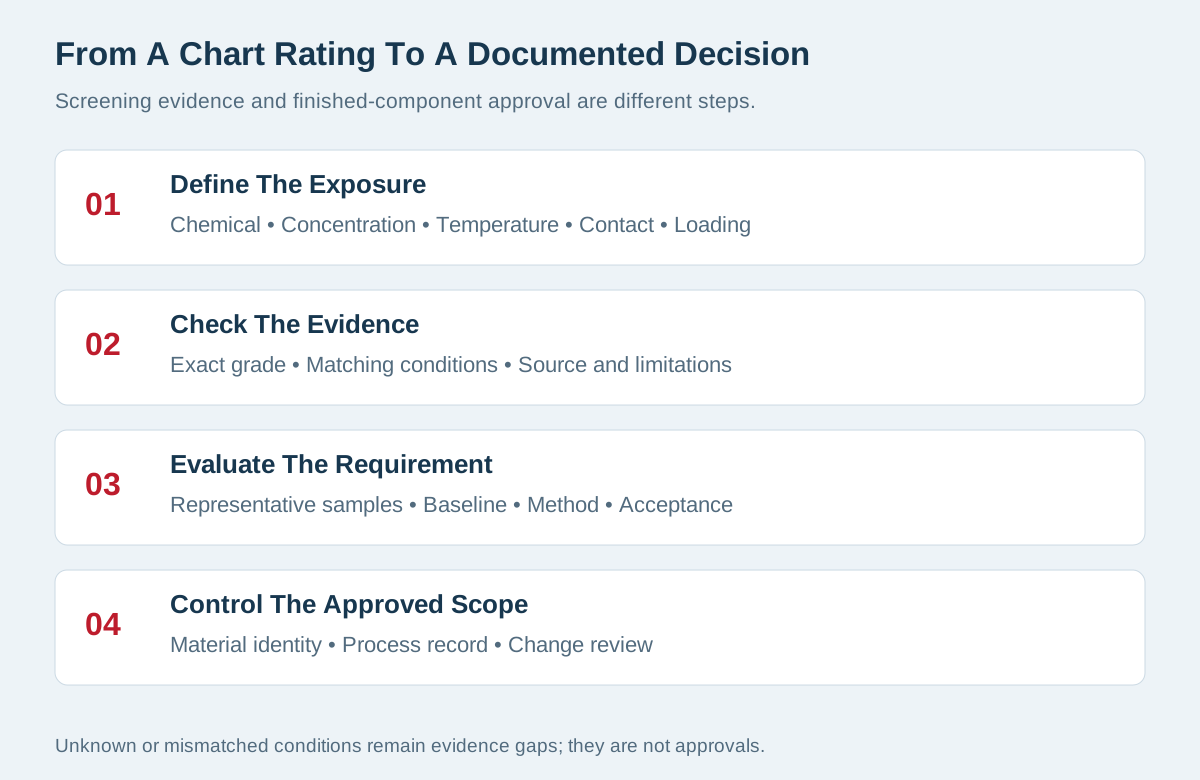
Why Must You Specify The Exact Polymer Grade?
Specify the grade because a family name does not identify every formulation or modification.
“PEEK,” “PTFE” or “Nylon” may describe a starting family rather than the exact stock required. Include supplier designations and approved substitutions.
For PTFE machining, distinguish the specified grade from a generic material request. Record any fillers or modifications identified by the material supplier.
For PVDF components, use the same discipline. A material name should lead to traceable procurement information.
Do not approve a substitute solely because the polymer abbreviation matches. Ask whether the existing evidence covers the proposed product.
For broader material selection, our engineering-plastic selection guide explains how functional requirements shape the shortlist.
How Can Stress And Geometry Affect The Evaluation?
Review the chemical exposure in the component’s assembled condition, including relevant loads and constraints.
ASTM D543’s published scope includes immersion evaluation and a practice combining mechanical stress with reagent exposure.
That distinction is useful when planning evidence. A loose sample and a constrained component do not represent identical conditions.
Identify press fits, fastener locations and other loaded interfaces on the assembly drawing. Explain which conditions your evaluation must represent.
Do not infer the cause of cracking from appearance alone. Preserve the failed component and its material and exposure records.
Our plastic machining warpage guide covers dimensional movement and machining-related review questions. Chemical suitability still needs its own assessment.
If the geometry changes, decide whether the existing evaluation remains representative. Document that decision rather than assuming a previous result transfers automatically.
Which Properties Should You Check After Exposure?
Choose measurements that reflect the part’s function, rather than relying only on visual appearance.
ASTM D543’s public description includes evaluating changes in dimensions, mass, appearance and relevant mechanical properties. Select the applicable checks with your responsible test team.
Do not claim compliance with a test standard merely because you adopted a few measurement ideas. Agree on the method and reporting scope.
| Component Function | Question For The Evaluation Plan |
|---|---|
| Viewing cover | Does the agreed optical or cosmetic condition remain acceptable? |
| Precision spacer | Do critical dimensions remain within the specified limits? |
| Fluid manifold | Are the required dimensional and functional checks satisfied? |
| Sliding component | Does the application-specific operating check remain acceptable? |
| Loaded bracket | Are the required mechanical and assembly criteria maintained? |
These are planning questions, not prescribed test procedures or material approvals. Each design needs explicit acceptance limits.
Record the component’s baseline condition before exposure. Without comparable starting information, the meaning of a later measurement may be unclear.
How Should You Plan A Representative Validation?
Agree on the test conditions, samples, controls and acceptance criteria before starting the evaluation.
ASTM notes that the relevance of results depends on similarity between test conditions and end use. Short screening tests have limitations.
Begin with a written objective. State whether you are eliminating unsuitable candidates or validating a defined component requirement.
Identify the exact materials, stock condition and component revisions. Explain how the samples represent the proposed production part.
Then agree on exposure conditions and the measurements to report. Use an appropriate qualified laboratory or responsible technical team for the work.
Keep controls and baseline results where the chosen method requires them. Report unexpected outcomes instead of removing them from the summary.
Distinguish a screening result from a production release. The responsible design authority should decide what evidence supports approval.
Separate Coupon Screening From Component Validation
Use coupons to answer the screening question they were designed to address. Do not silently treat them as complete assembly validation.
A simple sample may omit threads, joints, stress concentrations or functional surfaces. Identify those differences before interpreting the result.
For example, a flat material specimen does not reproduce every condition in a fastened transparent cover. An assembled trial may address additional questions.
This does not mean every project needs the same test sequence. Select the evidence needed for your actual risk and functional requirements.
How Would You Review A Cleaning-Exposed Manifold?
Review the operating fluid and cleaning sequence together before approving the manifold material.
Consider a hypothetical machined plastic manifold exposed to a process liquid and periodic cleaning. This is an illustrative example, not a customer case.
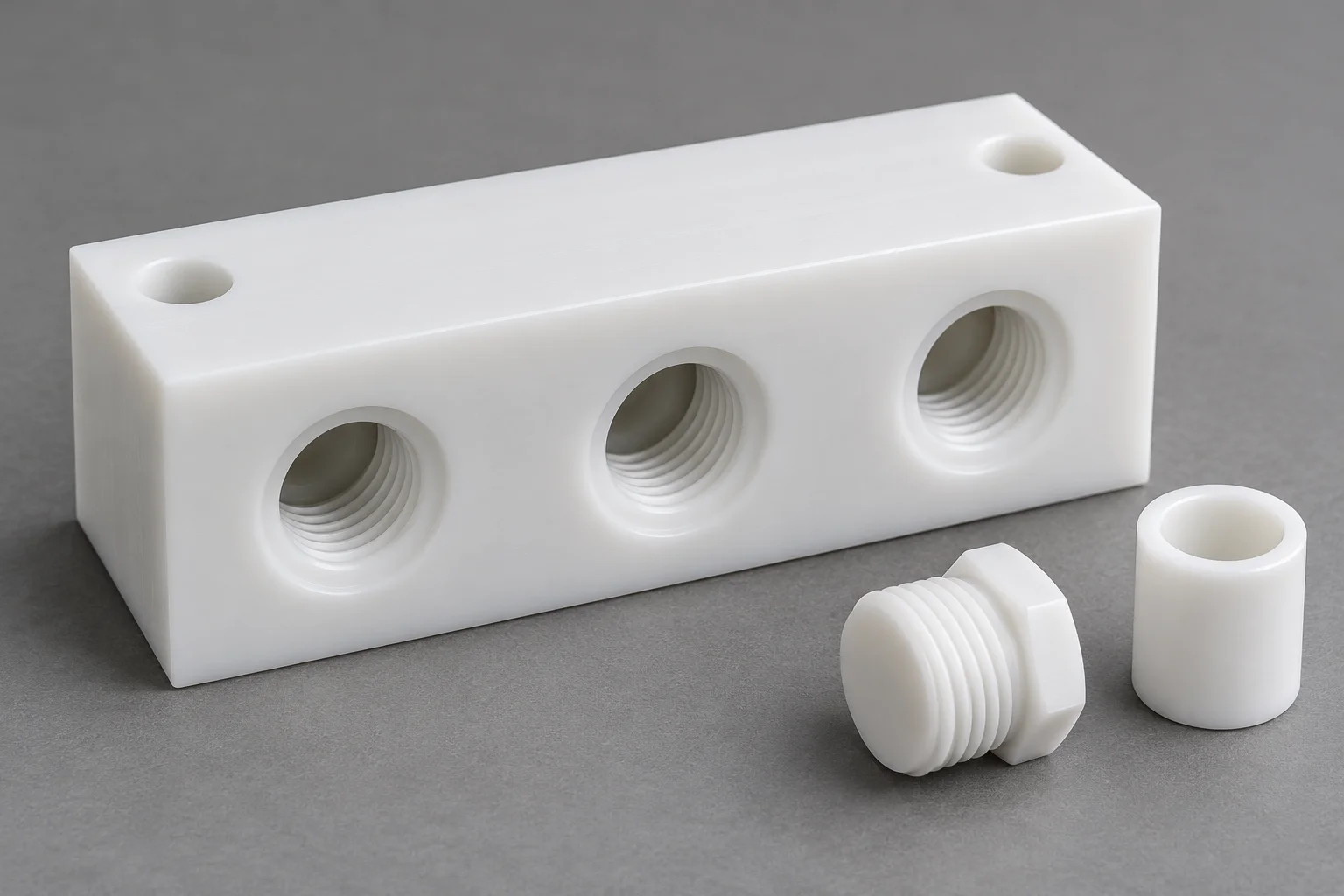
First, identify the process liquid and the cleaner’s current product information. Record the working concentration, contact temperatures and sequence.
Next, identify the manifold grade, drawing revision, plugs, seals and mating components. Clarify which items belong to the supplied assembly.
Ask whether the available compatibility evidence matches the operating and cleaning conditions. List gaps instead of selecting a convenient rating.
Then define the necessary dimensional and functional checks. If pressure testing is required, specify the agreed procedure and acceptance separately.
A material-chart rating does not certify a pressure-containing assembly. The complete design requires its own appropriate review and approval.
Finally, retain the approved exposure record with the production specification. A later cleaner change should trigger a documented compatibility review.
What If The Data Are Missing Or Contradictory?
Treat conflicting data as a question to resolve, rather than averaging ratings from unrelated sources.
Check whether the entries use different concentrations, temperatures, exposure periods or material grades. Those differences may explain the disagreement.
Ask the material manufacturer for clarification using your actual exposure record. Provide the original sources so the question is specific.
If evidence remains incomplete, define a suitable evaluation or keep the candidate unapproved. Do not convert uncertainty into a supplier guarantee.
Avoid approving by reputation alone. “Widely used in chemical equipment” does not establish suitability for your exact reagent and component.
Record the final decision and its limitations. Your purchasing team should be able to identify what was approved without reconstructing several conversations.
What Should The Drawing And RFQ Include?
Your RFQ should connect the machining specification with the exposure and acceptance requirements.
Send the drawing, CAD file, exact grade, quantity and part number. Identify critical dimensions and functional surfaces.
Attach the exposure record and relevant material evidence. State whether the requested supply covers a component, installed hardware or an assembly.
For plastic manifold machining, include mating features and any required inspection or test documentation.
Clarify who selects and approves the material. If a supplier recommendation is requested, provide the information needed for a meaningful review.
List any special conditioning, cleaning, traceability or reporting requirements. Ask for confirmation before assuming those operations are included.
Separate material documentation from component validation records. They serve different purposes and should not be described as interchangeable certificates.
How Does Compatibility Review Affect Total Cost?
Compare quotations against the same material, exposure assumptions and acceptance scope.
A quote for machining loose parts differs from one including special preparation, reports or agreed testing. Make those differences visible.
Ask suppliers to list exclusions and unresolved requirements. A low initial price is difficult to evaluate if material approval remains unsettled.
For a first order, define who supplies test samples and mating components. Identify how trial findings will affect the final specification.
Do not request every possible test without a purpose. Equally, do not omit a necessary evaluation simply to reduce the first quotation.
The useful comparison is the cost of meeting your agreed requirement. Avoid publishing a universal price premium for “chemical-resistant plastic.”
What Can TOPS Plastics Confirm For Your Project?
TOPS Plastics can review drawing-based machining requirements and confirm the proposed manufacturing scope in a quotation.
Provide the approved grade, quantity, CAD and critical dimensions. Include exposure information when it affects the material or acceptance discussion.
Use our quality and inspection page to organize project-specific documentation and inspection questions.
Special chemical testing, laboratory work, pressure testing or application certification requires separate confirmation. This guide does not claim those capabilities automatically.
Before production, resolve any material substitution, validation or approval responsibilities. Keep the agreed scope with the purchase specification.
Frequently Asked Questions
These answers clarify common compatibility decisions without assigning universal chemical-resistance ratings.
Does An Excellent Chart Rating Approve My Finished Part?
No. Check the exact grade and stated conditions, then determine what component or assembly validation your application needs.
Is The Most Expensive Plastic Always The Best Choice?
No. Select against the actual exposure, geometry and functional requirements. Price alone does not establish compatibility.
Can I Use A Room-Temperature Rating For A Heated Cleaning Cycle?
Do not assume it transfers. Review evidence covering the relevant temperature and other exposure conditions with the responsible technical team.
Does No Visible Damage Mean The Part Passed?
Only if appearance was the complete agreed requirement. Other applications may need dimensional, mechanical or functional checks.
Should A New Cleaning Product Trigger Another Review?
Yes, when it changes the approved exposure. Compare its relevant information with the existing record before relying on previous conclusions.
Define The Exposure Before Choosing The Material
Specify the chemical, concentration, temperature, contact pattern and functional acceptance. Use charts for screening, then approve suitable evidence. To discuss machining, contact us with your drawing, approved grade, quantity and exposure requirements.