Chemical resistance
Useful for many acids, halogens and compatible process fluids. Confirm the exact medium and concentration: broad resistance is not universal compatibility.

POLYVINYLIDENE FLUORIDE / PVDF
TOPS Plastics provides CNC machining of PVDF for custom components requiring chemical resistance, high-purity suitability, UV stability and controlled dimensions. We manufacture manifolds, valve parts, fittings, insulators, fixtures and fluid-handling components from customer CAD files and engineering drawings.
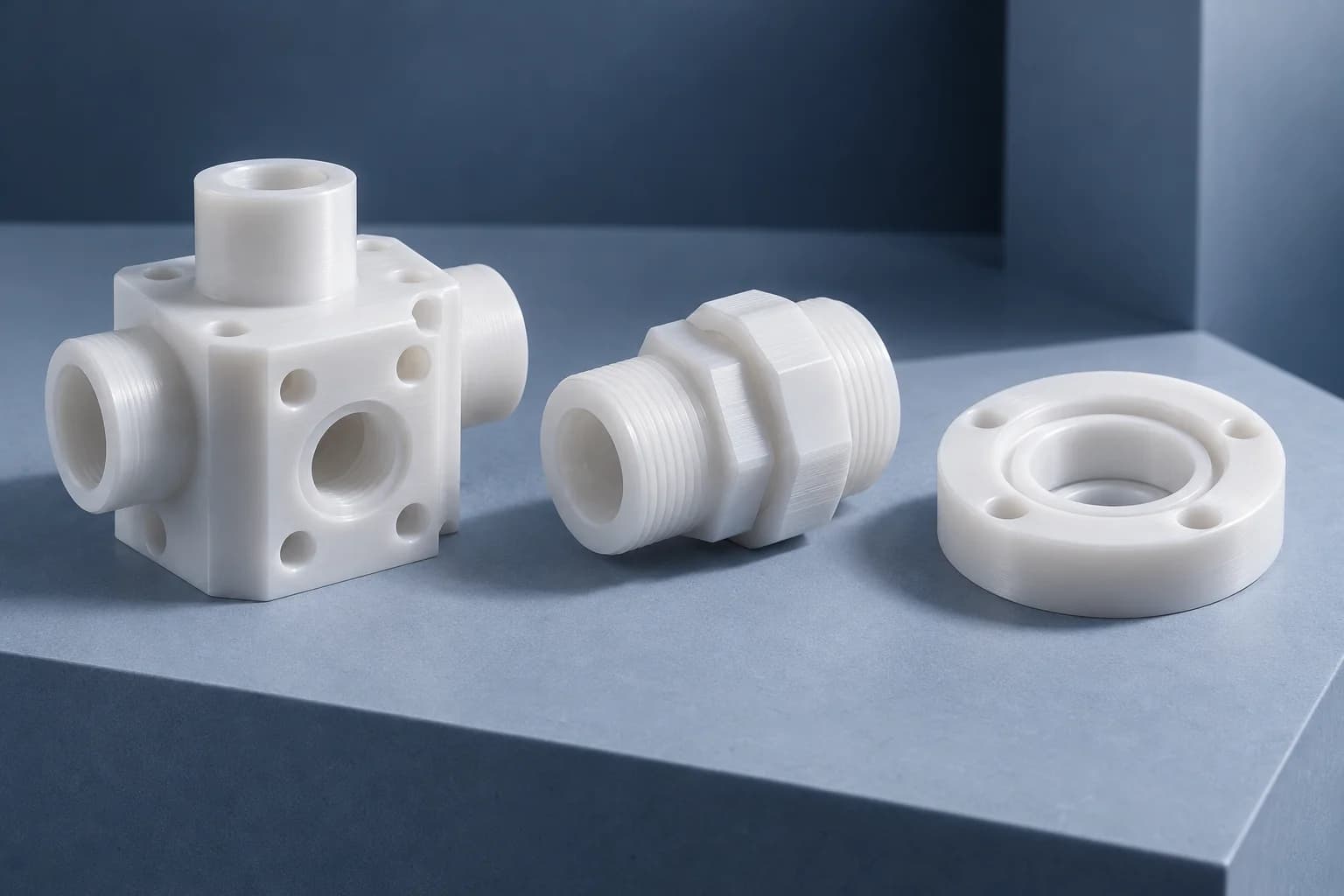
Fluid-contact geometry deserves a complete review: grade, ports, sealing surfaces, burrs, cleanliness and measurement conditions all influence acceptance.
Drawing-led manufacturing for fluid-contact components. Confirm the grade, stock form, documentation and acceptance criteria before production.
| Capability | TOPS Plastics project scope |
|---|---|
| Material | PVDF / polyvinylidene fluoride; exact supplier grade to be confirmed |
| Processes | CNC milling, turning, drilling, tapping and boring; multi-axis review where geometry requires it |
| Typical parts | Manifolds, fittings, valve components, insulators and fixtures |
| Production | Prototypes, low-volume batches and repeat production |
| Input | CAD files, engineering drawings and reference samples with agreed dimensions |
| Files | STEP, STP, IGES, X_T, DWG, DXF and PDF |
| Inspection | Dimensional and surface inspection to the approved drawing |
| Applications | Semiconductor, chemical processing, fluid handling and laboratory equipment |
PVDF, or polyvinylidene fluoride, is a semi-crystalline fluoropolymer used for chemical resistance, low moisture absorption, weatherability and electrical insulation.
For machined components, PVDF combines useful rigidity with chemical resistance. It is generally stiffer than unfilled PTFE, making it a candidate for structural fluid parts where a softer fluoropolymer would require more support. Exact behavior depends on grade, temperature, stress and stock history.
A white fluoropolymer is not automatically a semiconductor-grade material. High-purity acceptance depends on the specified grade and documented processing, cleaning and packaging. Evaluate chemical mixtures, concentration, temperature, exposure duration and mechanical load together.
Choose the material around service conditions, then qualify the finished component against functional requirements.
Useful for many acids, halogens and compatible process fluids. Confirm the exact medium and concentration: broad resistance is not universal compatibility.
Selected documented grades can support purity-sensitive fluid paths. Resin selection alone does not establish finished-part cleanliness.
PVDF generally offers greater rigidity than unfilled PTFE. Ports and mounting features still need adequate wall thickness and support.
PVDF is valued for outdoor durability. Confirm the exact grade, color and exposure requirements rather than adding an unspecified UV treatment.
A candidate for insulating interfaces and housings. Review dielectric requirements, geometry and environmental exposure for the actual grade.
Helps limit humidity-related dimensional changes. It does not remove thermal expansion, residual stress or load-dependent deformation.
Grade sourcing and documentation are reviewed for each RFQ; these categories are selection routes, not a claim that every grade is held in stock.
Unfilled natural stock for compatible chemical-resistant components. Specify supplier designation, stock form and traceability requirements.
Use a grade supported by appropriate supplier documentation. Define extractables, particle limits or other cleanliness acceptance criteria when applicable.
Specify the industrial grade and environmental performance needed. PVDF already has strong weatherability; any additional stabilization must be identified.
Filled, conductive, ESD-modified or other specialty compounds require availability and property review. Modified grades may alter purity and chemical behavior.
Kynar is an Arkema trademark. A request for Kynar machining should identify an exact grade; no branded substitution is assumed without approval.
Select processes around ports, bores, sealing lands and datum relationships rather than treating the material name as a machining specification.
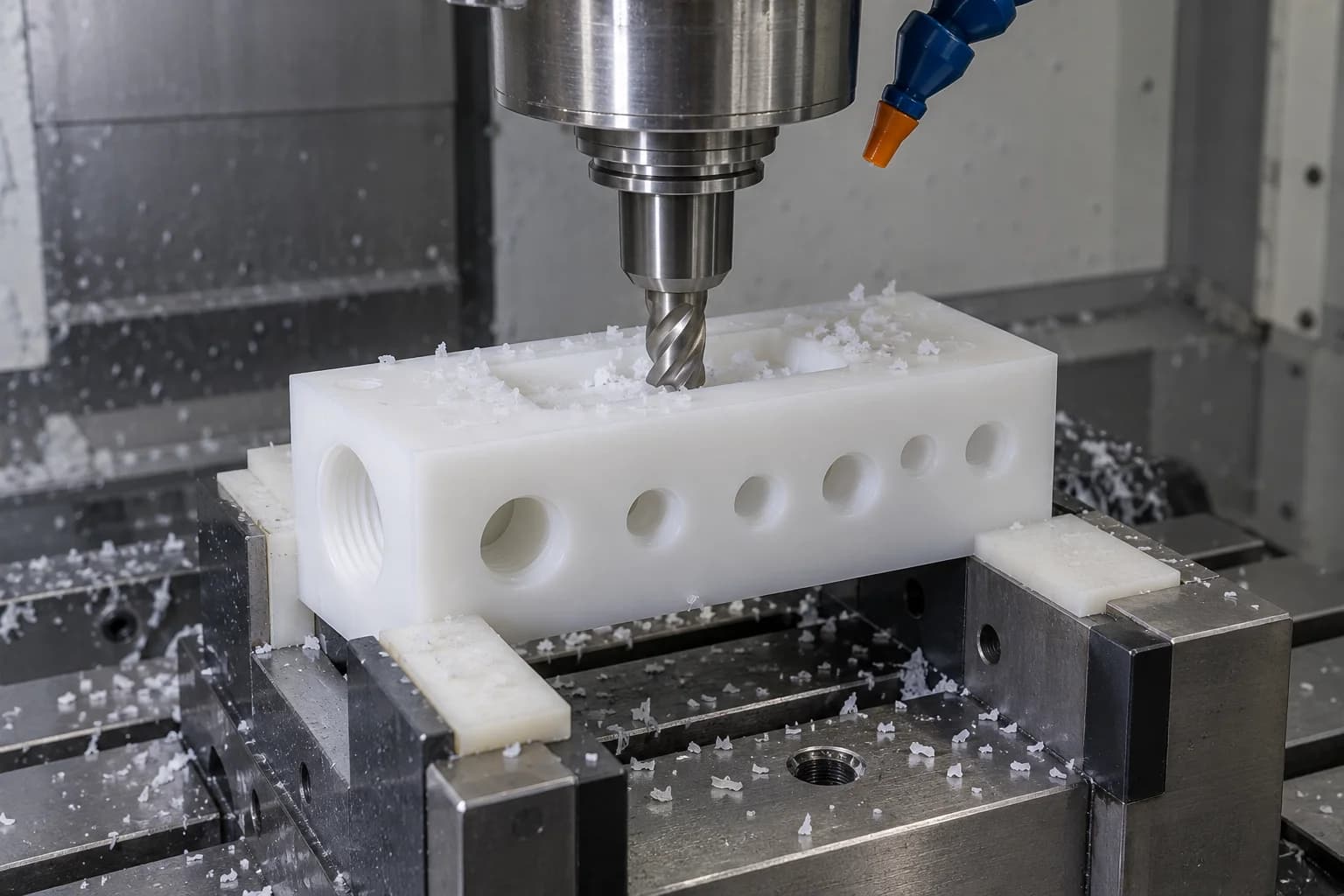
Machine manifold blocks, valve bodies, fixtures, sensor housings and semiconductor equipment interfaces. Plan pocket access and intersecting passages before selecting tools.
Explore the process →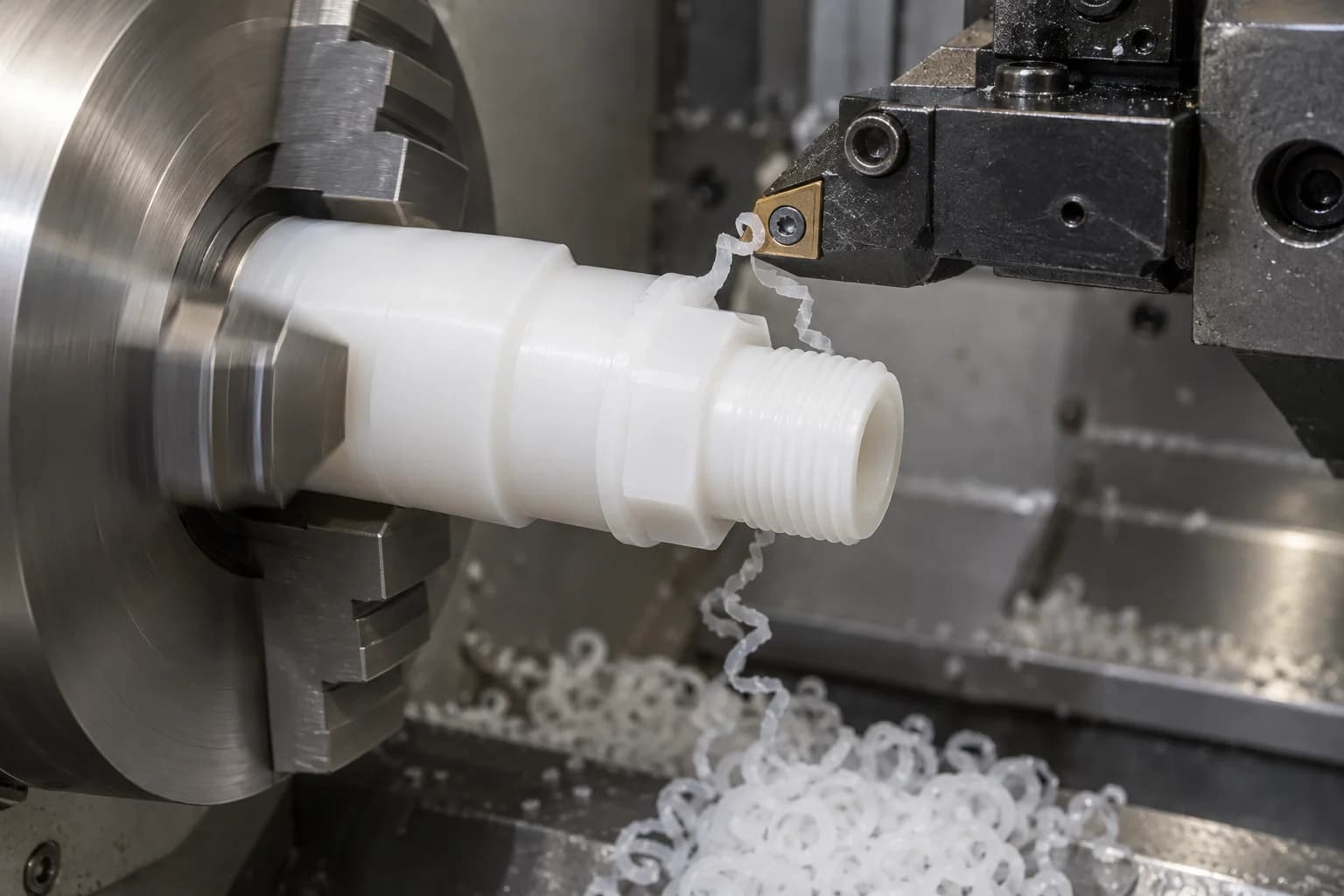
Produce fittings, sleeves, rings, washers, plugs and threaded connectors. Review bore roundness, sealing diameters and wall thickness after release from the chuck.
Explore the process →For multi-face components and compound-angle features, review tool reach, collision clearance and which datum relationships must stay in one setup.
Fluid ports, precision bores and intersecting passages need controlled entry, exit and thread details. Define thread form and sealing method instead of relying on a generic tapped-hole callout.
PVDF can machine well, but cutting heat, elastic response and workholding can influence the released part. A rigid-looking block can still move under load.
Low thermal conductivity limits heat removal through the part. Sharp tools, suitable chip formation and staged cutting help avoid smearing.
Thin walls and unsupported features may deflect away from a cutter. Review support and finishing strategy for the free-state geometry.
Excess fixture pressure can produce apparently correct dimensions while clamped. Check critical features after unloading.
Flexible burrs can remain at port exits, threads and intersecting passages. Identify an accessible removal and inspection route.
Dimensions respond to temperature more strongly than metal interfaces. Avoid accepting warm measurements as final stabilized dimensions.
Achievable tolerance depends on grade, geometry, wall thickness, size, stock condition, temperature, workholding and measurement method. We review critical dimensions individually rather than promise one tolerance for every part.
| Feature | Main consideration |
|---|---|
| Precision bore | Wall thickness, tool condition and free-state roundness |
| Fluid port | Location, breakout burrs and sealing quality |
| Thin wall | Support and clamping deformation |
| Long feature | Temperature and expansion across the full length |
| Flat surface | Residual stock stress, support and release movement |
| Thread | Form, engagement, assembly load and gaging method |
| Multi-face feature | Datum strategy and setup relationships |
| Tight fit | Inspection temperature and mating-part conditions |
PVDF generally offers better rigidity and dimensional control than unfilled PTFE, but it still expands substantially more than metals. Temperature changes can matter at long lengths and tight interfaces.
A warm cut can affect surface condition and measured size. Adjust tool sharpness, chip evacuation and machining sequence to the part.
Use the exact grade data and service temperature range when assessing clearances. Room-temperature inspection does not prove hot-service fit.
The component may relax after unclamping. Avoid forcing a flexible part into a measurement fixture that conceals its free-state shape.
Allow the part to stabilize under agreed measurement conditions. Record temperature when it materially affects an acceptance decision.
In purity-sensitive fluid systems, dimensional accuracy is one requirement among several. Material identity, contamination sources, fluid-contact surfaces and handling requirements also affect acceptance.
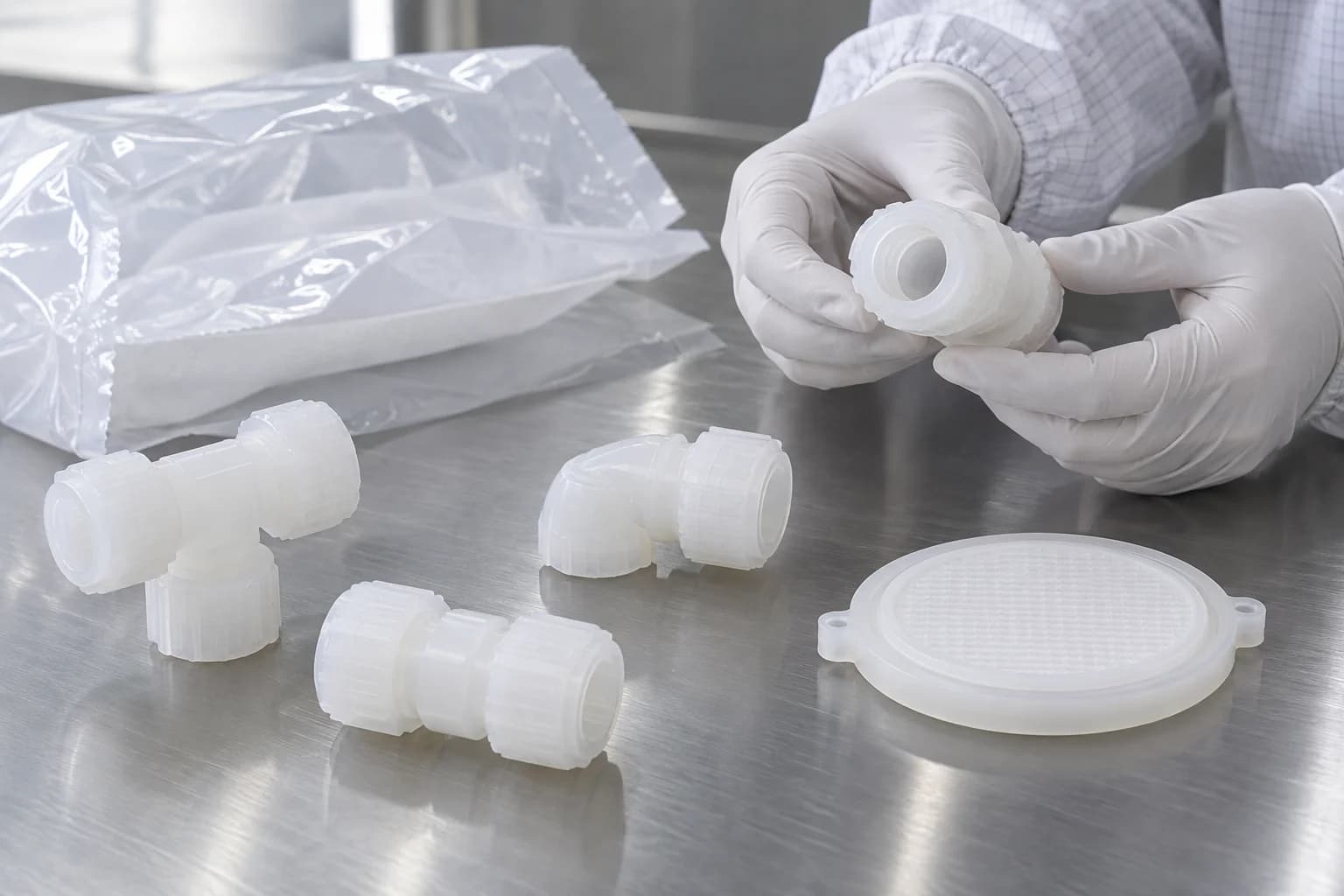
Confirm grade, supplier designation and batch documentation required by the customer before cutting stock.
Review coolant or lubricant compatibility, tool history and handling. Do not assume a general shop process meets an ultra-clean specification.
Inspect port intersections and internal exits where a loose burr could enter the process stream. Design access for inspection and removal.
Define fluid-contact surfaces, roughness requirements and permissible marks. A visually glossy surface alone does not establish low particle release.
Agree cleaning method, drying, handling and individual protection. Certified cleanroom processing and validated cleanliness are not implied; support must be confirmed separately.
A practical acceptance plan separates material documentation from finished-part cleanliness. If particle, ionic contamination or extractables testing is required, identify the method, limits, sampling and responsible testing party before quotation.
Make functional and cleanliness requirements visible on the drawing so they can be assessed during DFM review.
State supplier designation, additives, stock form and required documentation, particularly for purity-sensitive applications.
Provide support around ports and threads. No universal minimum wall thickness suits every diameter, pressure or fixture.
Identify wetted surfaces and distinguish them from nonfunctional exterior faces. Include cleaning access to intersecting passages.
Tool-compatible radii improve access and reduce long, unstable tool reach. Agree any local relief that changes the drawing.
Provide adequate engagement and surrounding wall. State whether the thread locates, retains or seals and define assembly conditions.
Identify critical-to-quality features and common datums. Avoid imposing a narrow blanket tolerance on unrelated surfaces.
Include medium, concentration, mixtures, pressure and exposure duration. Temperature changes chemical performance and mechanical load capacity.
List applicable limits, process restrictions and packaging requirements. Do not leave them implicit in the word semiconductor.
Representative component families for drawing review, not verified customer projects or fixed catalog items.
Port networks and sealing faces for compatible fluid systems.
Seats, bodies and guides with defined mating and sealing geometry.
Threaded or other specified interfaces with adequate wall and engagement.
Controlled bores and transitions that connect equipment fluid paths.
Faced thickness and contact areas matched to the intended load.
Controlled length and bore clearance for assembly separation.
Electrical separation features subject to grade and service review.
Mounting and fluid interfaces for analytical or process instruments.
Hole patterns and sealing lands with cleaning and burr access.
Bolt patterns, flatness and gasket contact areas for a specified assembly.
Rotational wear components with load, speed and shaft-fit review.
Closure features with a defined retention and sealing method.
Drawing-based interfaces with explicit purity and documentation requirements.
Corrosion-resistant components selected for the actual chemical environment.
Wetted features with agreed traceability, finishing and cleaning acceptance.
Surface acceptance should distinguish sealing lands, wetted passages and exterior appearance. Sharp tools and a deliberate deburring route matter around ports and threads.
Reduce rubbing and smearing by reviewing edge condition and tool suitability. A worn edge can displace material rather than cut cleanly.
Plan consistent tool engagement and support. Specify a numerical surface requirement only where function requires it and a measurement method is practical.
Review internal intersections as well as visible edges. Avoid abrasive residue or an uncontrolled edge break on a sealing feature.
Protect accepted surfaces from scratches and handling contamination. Agree any washing, drying or protective packaging process before shipment.
Inspection links the approved drawing to the released and stabilized component. Define gaging for bores, ports, threads, sealing surfaces, flatness, wall thickness and related passage locations.
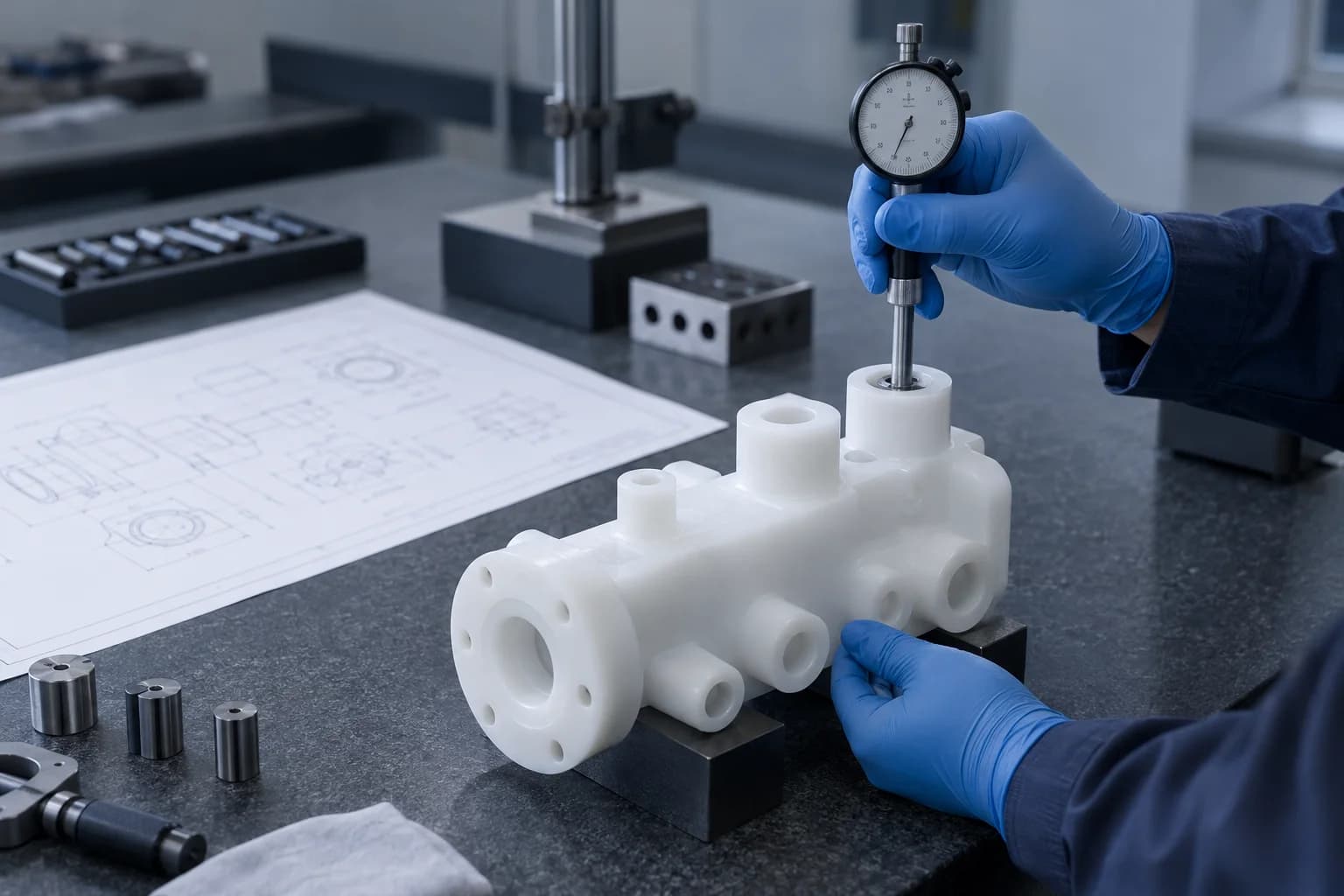
Factory testing, pressure testing or cleanliness testing must be agreed as separate requirements, including limits, fixtures and records. Shipment inspection can verify approved dimensional and packaging criteria; it does not automatically qualify a part for semiconductor, medical or pressure-system use.
Choose PVDF for compatible chemical service where greater stiffness and dimensional control matter. Consider PTFE where broader chemical inertness or very low friction outweigh the need for rigidity.
| Factor | PVDF | Unfilled PTFE |
|---|---|---|
| Chemical resistance | Broad resistance; medium-specific review | Broader inertness in many environments; still verify |
| Stiffness | Generally higher | Generally lower |
| Dimensional control | Usually easier for structural features | More sensitive to deformation and temperature |
| Friction | Application-dependent; not a universal bearing choice | Very low friction is a common selection reason |
| Precision machining | Useful with heat and workholding control | Often needs more allowance for soft-material behavior |
| High-purity suitability | Grade and process dependent | Grade and process dependent |
| Creep under load | Still requires sustained-load review | Often more pronounced in unfilled grades |
| Structural fluid parts | Often a practical candidate | May need more support |
| Low-friction service | Validate wear pair and lubrication | Often preferred where compatible |
PVDF can justify higher material cost when purity, weatherability or temperature requirements exceed the practical range of an economical PVC or PP design. Select against actual grade data, not a universal ranking.
| Factor | PVDF | Rigid PVC | Polypropylene |
|---|---|---|---|
| Chemical resistance | Broad; verify medium and temperature | Broad for selected media | Broad for selected media |
| Purity | Documented high-purity grades available | Grade and process dependent | Grade and process dependent; specialty grades exist |
| Temperature capability | Often higher than common PVC / PP stock | Usually more limited | Usually more limited |
| Stiffness | Useful structural rigidity | Good room-temperature rigidity | Typically more flexible |
| UV / weathering | Strong intrinsic weatherability | Grade and formulation dependent | Stabilization often required outdoors |
| Relative material cost | Usually higher | Usually lower | Usually lower |
| Semiconductor use | Established for qualified wet-process uses | Specific systems and qualified grades | Specific systems and qualified grades |
| High-purity fluid paths | Qualified material and processing required | Check application-specific requirements | Check application-specific requirements |
PVC and PP are not automatically unsuitable for clean process systems. Specialty grades and validated processes can change the comparison. Purchase on documented acceptance criteria rather than treating the polymer family as a certification.
Application examples indicate a review route, not automatic regulatory or system approval.
Wet-process equipment, manifolds and fluid connectors where exact grade, purity and documented handling are specified.
Valve bodies, fittings, housings and corrosion-resistant interfaces selected for compatible mixtures and operating conditions.
Pump, valve and manifold components with defined pressure, temperature, sealing and assembly requirements.
Fluidic interfaces and sensor housings where chemical compatibility and sample contamination are reviewed together.
Insulators and housings with grade-specific electrical and environmental requirements.
Only where material documents, process suitability and customer qualification support the intended use.
Fixtures and interfaces exposed to aggressive media, with loads and service life assessed for the application.
Validate the part and its environment before freezing the recurring production route.
Check fluid routing, seals, geometry, fit and representative chemical exposure. Define installation preparation and mating-part conditions before the trial.
Produce custom process-equipment components against an approved revision. Agree first-article acceptance, cleaning and documentation for the batch.
Control grade, drawing revision, programs, inspection and packaging requirements. Changes in stock or supplier grade need review rather than silent substitution.
Our project review connects material choice, machining strategy and inspection to customer requirements. Confirm required equipment, documentation and specialist process support for your actual component.
Review polymer behavior rather than applying a metal-part tolerance strategy unchanged.
Discuss the exact designation, availability and evidence required with the RFQ.
Choose a route around fluid paths, tool access and functional datum relationships.
Separate resin suitability from finished-part cleanliness and customer qualification.
Identify heat-sensitive dimensions and passage exits that require special attention.
Discuss critical features and practical inspection before an order is released.
Use prototype feedback to establish a repeatable drawing and acceptance plan.
Focus on sealing, port location and internal edge conditions as well as overall size.
A clear review and manufacturing sequence helps prevent missing grade, purity or sealing requirements.
PVDF can machine well with suitable sharp tooling and support. Heat buildup, elastic deflection, clamping and flexible burrs still require control, especially on thin features and internal ports.
PVDF is used in compatible chemical, fluid-handling, semiconductor wet-process, laboratory and electrical applications. The exact grade and finished-part requirements determine suitability.
Yes. Milling suits blocks, housings and manifolds; turning suits fittings, sleeves, plugs and other rotational components. Combined processes may be required for cross-ports or mounting features.
Tolerance must be reviewed against the drawing, grade, size, geometry and inspection conditions. Send critical dimensions and mating requirements for a feature-specific assessment rather than applying a universal capability claim.
PVDF is generally stiffer than unfilled PTFE and can be easier to hold dimensionally in structural parts. PTFE may be preferable for very low friction or broader inertness; compare service conditions and grade data.
Selected PVDF grades and qualified processes are used in semiconductor wet-process equipment. Not all PVDF or general machining processes satisfy high-purity requirements; documentation and acceptance limits must be specified.
Yes, to a broad range of chemicals, but not every chemical or mixture. Check the exact medium, concentration, temperature, exposure time and stress using grade-specific supplier guidance and representative validation.
PVDF is a fluoropolymer often selected for higher temperature, weatherability or qualified purity requirements. Rigid PVC is usually less expensive and can suit compatible lower-temperature chemical service.
Yes, when the grade, machining, cleaning and packaging meet the system requirements. Specify any particle, extractables or contamination limits; the polymer name alone does not prove compliance.
Common families include manifolds, valve components, fittings, connectors, washers, spacers, insulators, sensor housings, filter plates, flanges, rollers and plugs. Each component is reviewed to its drawing.
YOUR FLUID. YOUR LOAD. YOUR PVDF PART.
Upload your CAD model or engineering drawing and include the PVDF grade, quantity, critical tolerances, operating temperature, chemical exposure, purity requirements and fluid-contact conditions. Our team can review material suitability and machining strategy before quotation.
Company, name, email and phone are required. Country, part number, quantity and drawing upload are optional. Put grade, dimensions, pressure, surface finish, cleaning, semiconductor requirements, application and other notes in the drawing package or email; no lengthy technical form is needed.
info@tops-precision.comSTEP / STP / IGES / X_T / DWG / DXF / PDF or ZIP, maximum 10 MB. Please agree confidential-file handling before sending sensitive drawings.