Rigid PVC / PVC-U
The common starting point for machined manifolds, valve bodies, fittings, electrical supports and chemical-process equipment.

RIGID PVC · CHEMICAL PROCESS COMPONENTS
TOPS Plastics provides CNC machining of rigid PVC for custom components requiring chemical resistance, electrical insulation, corrosion resistance and practical industrial performance.
We manufacture manifolds, valve parts, fittings, insulators, fixtures and process-equipment components from customer CAD files and engineering drawings.
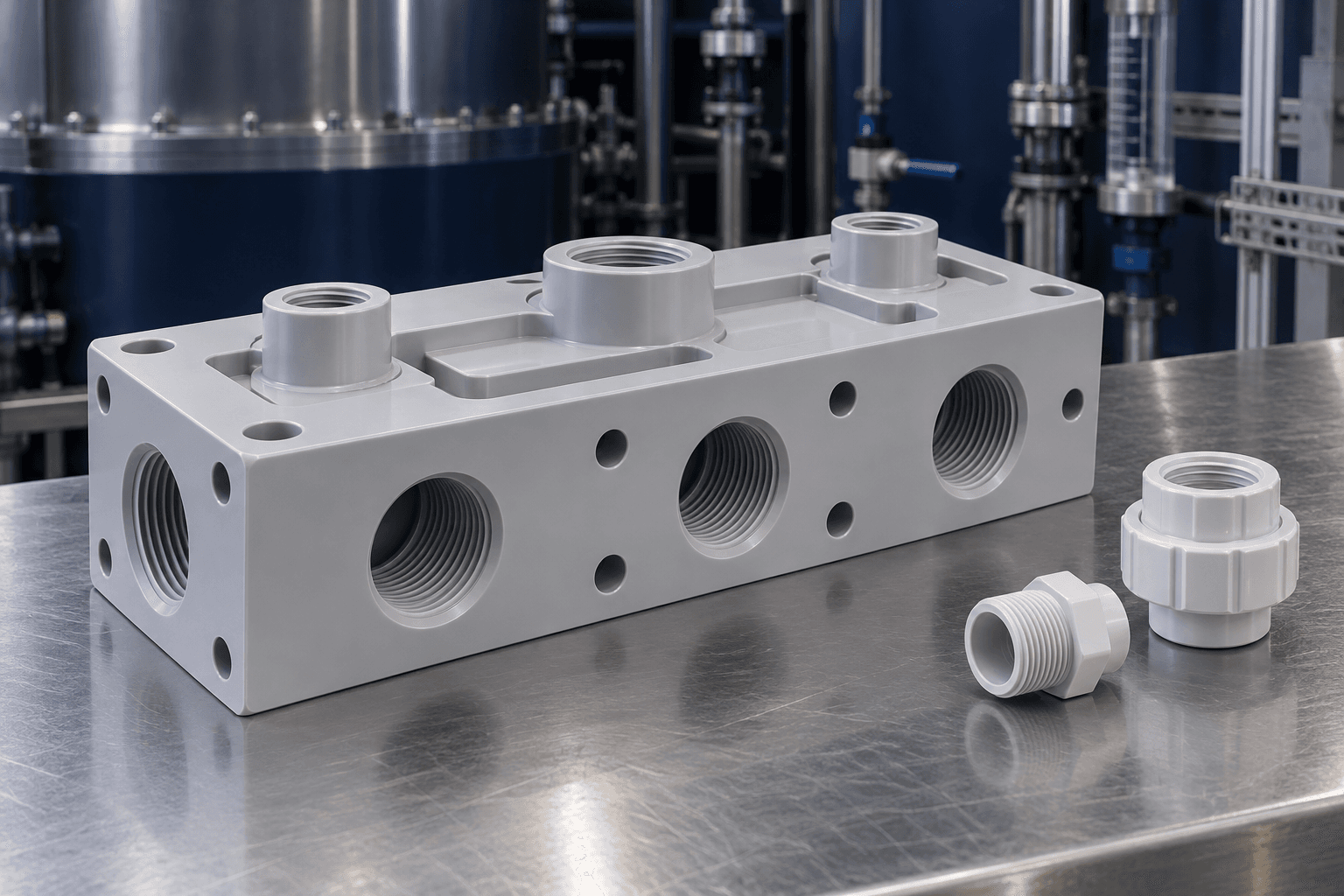
We machine drawing-based rigid PVC components from agreed stock forms. The final process, material availability and inspection plan are reviewed against the actual part rather than a generic material label.
| Capability | TOPS Plastics scope |
|---|---|
| Material | Rigid PVC / PVC-U and specified CPVC grades |
| Processes | CNC milling, turning, drilling, tapping and boring |
| Typical parts | Manifolds, valve parts, fittings, insulators and fixtures |
| Stock forms | Sheet, plate, rod and block where available |
| Production | Prototype, low-volume and repeat production |
| Input | CAD files, drawings and approved samples |
| Files | STEP, STP, IGES, X_T, DWG, DXF and PDF |
| Inspection | Dimensional inspection to the agreed drawing |
PVC, or polyvinyl chloride, is a thermoplastic used widely in industrial equipment because it can offer chemical resistance, corrosion resistance, electrical insulation and cost-effective rigidity. For CNC machining, rigid PVC—often called PVC-U—is usually the relevant grade.
The common starting point for machined manifolds, valve bodies, fittings, electrical supports and chemical-process equipment.
Considered where a specified grade requires improved toughness; confirm the exact stock grade before quotation.
Used only where the specified stock grade and required transparency are suitable for visual monitoring or laboratory equipment.
A higher-temperature PVC family for applications whose service conditions call for a verified CPVC solution.
Rigid PVC is often selected when a part needs a practical balance of chemical compatibility, stiffness and electrical insulation. The exact grade still controls the final material decision.
Suitable for many compatible acids, alkalis, salts and industrial process media after grade-specific review.
Useful for support blocks, spacers, housings and insulating interfaces.
A practical alternative to more expensive high-performance polymers where service conditions permit.
Helpful for many wet-process and fluid-handling assemblies.
Plate, rod and block stock support custom geometry without dedicated molding tools.
Any flame rating or self-extinguishing claim must be tied to the specified material grade and documentation.
Process selection follows the functional faces, ports, bores and assembly relationships in the drawing.
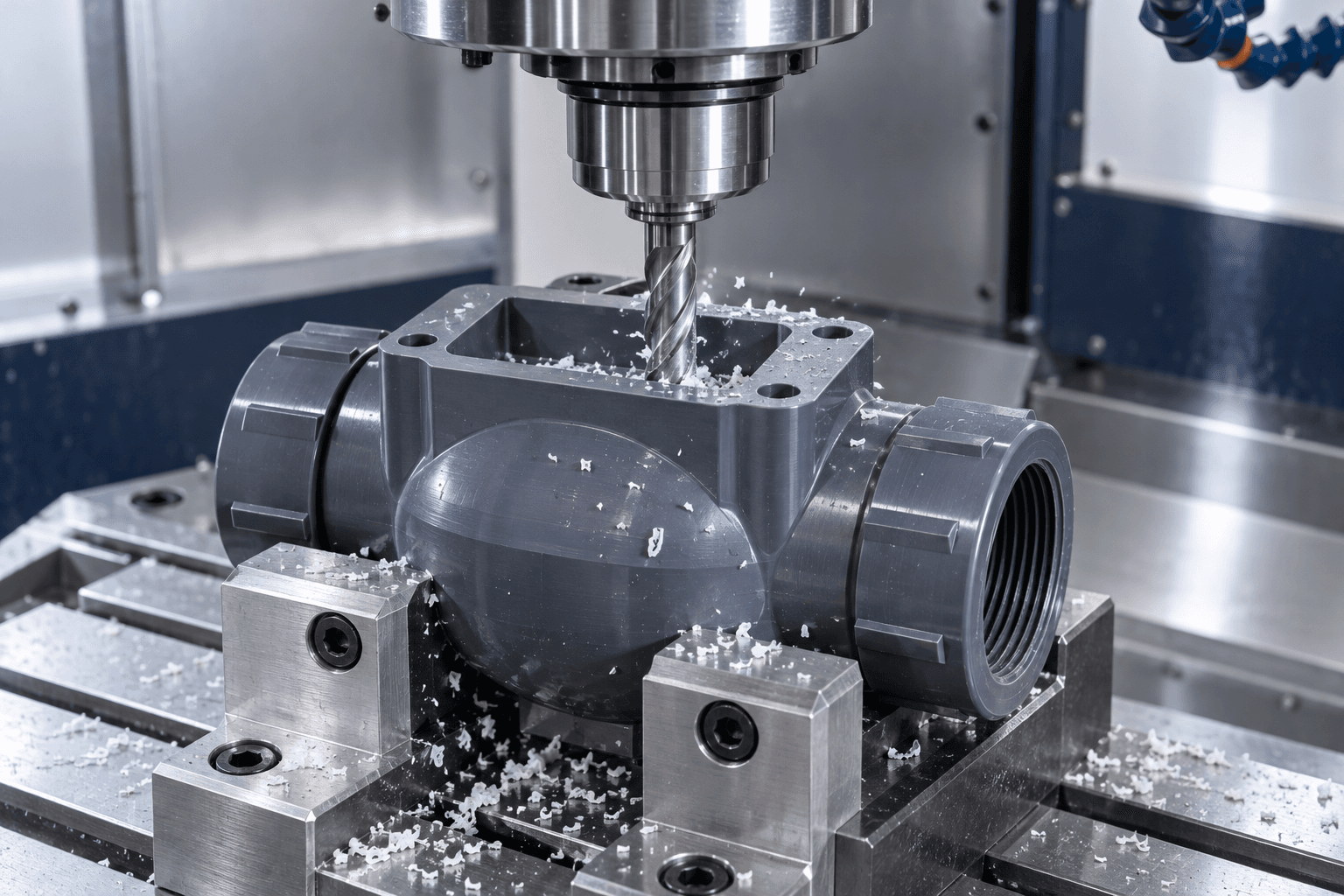
For manifolds, valve blocks, mounting plates, fixtures, electrical components and tank fittings.
For fittings, bushings, sleeves, rings, valve seats and threaded rotational parts.
For complex multi-face components where tool access and datum transfer justify a multi-axis route.
For threaded ports, fluid passages, mounting holes, counterbores and specified precision bores.
Rigid PVC machines effectively, but excessive heat, dull tools, poor chip evacuation or aggressive clamping can cause burrs, edge chipping, surface marking or released-part distortion.
Cutting conditions are selected to reduce rubbing, local overheating and compromised edge quality.
Holes, slots, threads and fluid ports need a deliberate deburring plan.
Distributed support or suitable soft workholding can reduce deformation during machining.
Sharp internal corners, unsupported edges and aggressive entry paths can increase chipping risk.
Critical dimensions are checked after the part returns to a stable inspection condition.
PVC can support useful precision, but achievable tolerance depends on the grade, geometry, wall thickness, size, workholding, temperature and agreed inspection method. We review each critical feature instead of promising one universal tolerance.
| Feature | Main consideration |
|---|---|
| Precision bore | Tool condition, support and adjacent wall thickness |
| Thin wall | Fixture pressure and released-part deformation |
| Large plate | Thermal movement and flatness after unclamping |
| Threaded port | Edge quality, engagement and surrounding wall thickness |
| Manifold passage | Datum strategy, drilling depth and tool access |
| Multi-face part | Setup sequence and positional relationship |
| Tight fit | Operating and inspection temperature conditions |
PVC is rigid enough for precision work, but it can soften with heat and thin sections can move if clamped too aggressively. Tool sharpness, chip evacuation and distributed support matter most around sealing faces, ports and large pockets.
May leave gummy edges, discoloration or dimensional movement when it is not controlled.
Reduce rubbing and help produce cleaner edges and threads.
Soft jaws, distributed support or specialized fixtures can reduce localized deformation.
A critical part should be checked after it has stabilized, not only while held in the fixture.
A practical drawing gives the material, function and acceptance criteria alongside nominal geometry.
Call out PVC-U, CPVC or the specified commercial grade rather than only “PVC”.
Very thin unsupported sections are more susceptible to clamping and cutting deformation.
Media, concentration, temperature and duration all affect suitability.
Focus precision on sealing faces, bores, ports and critical mating interfaces.
Provide adequate surrounding material and identify thread standard and engagement requirements.
Joint access and surface condition must be considered before parts are machined.
These representative component families show the scope of drawing-based PVC machining. They are not fixed catalog products or verified customer projects.
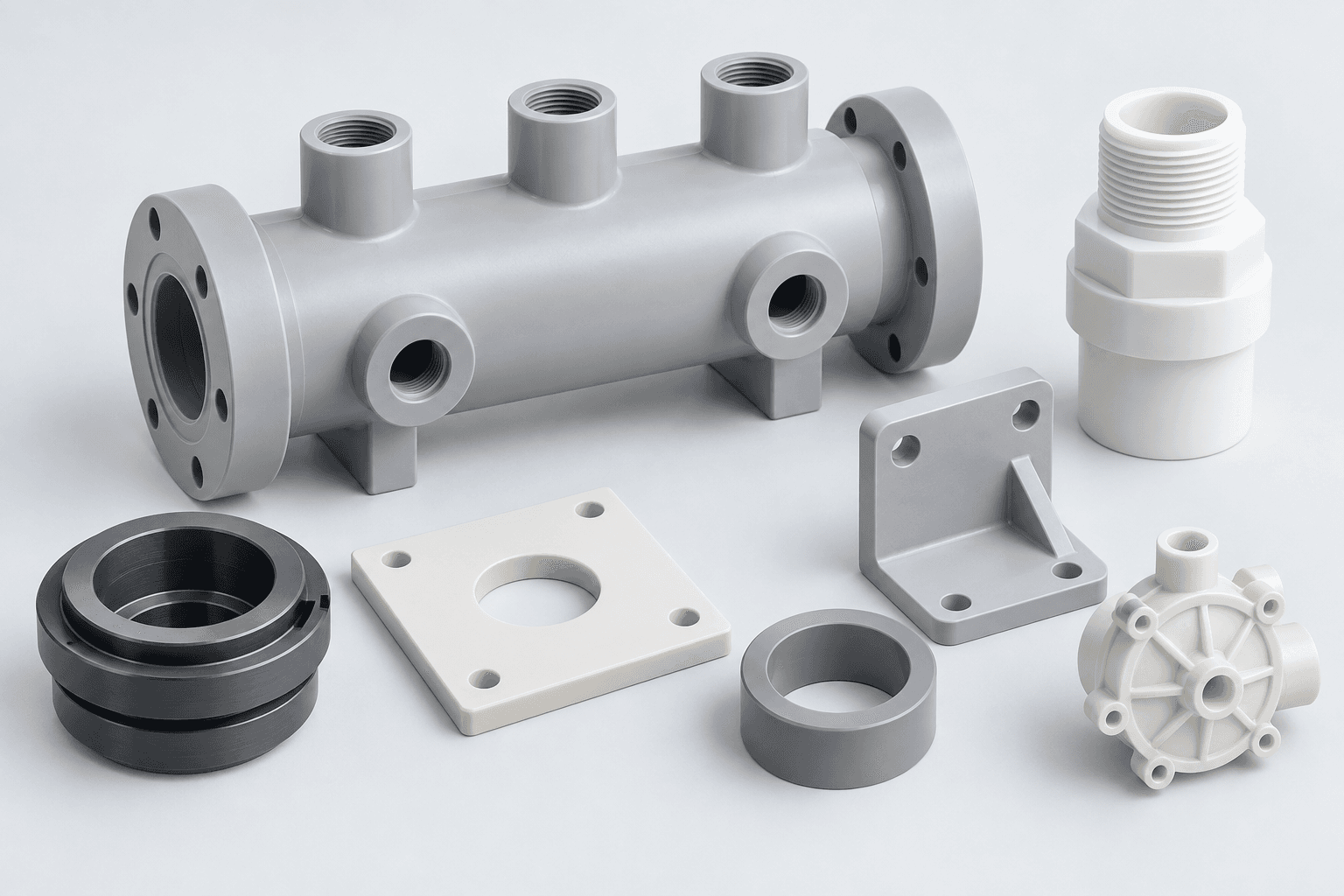
Multi-port blocks and fluid distribution components.
Seats, bodies, covers and support components.
Custom connectors, threaded adapters and flanges.
Compatible covers, supports and fluid-handling features.
Mounting blocks, spacers and electrical supports.
Plates, fittings, covers and custom interfaces.
Chambers, fixtures and fluid-routing parts.
Location and support geometry for process equipment.
Machined covers and low-volume functional enclosures.
Rotational and mounting components made to drawing.
Brackets, bases and equipment interface parts.
Geometry built from your model, drawing and acceptance criteria.
PVC assemblies can require more than machining. Solvent bonding, selected adhesive bonding, plastic welding, mechanical assembly and hardware insertion are discussed against the actual grade, joint geometry and chemical-service requirements.
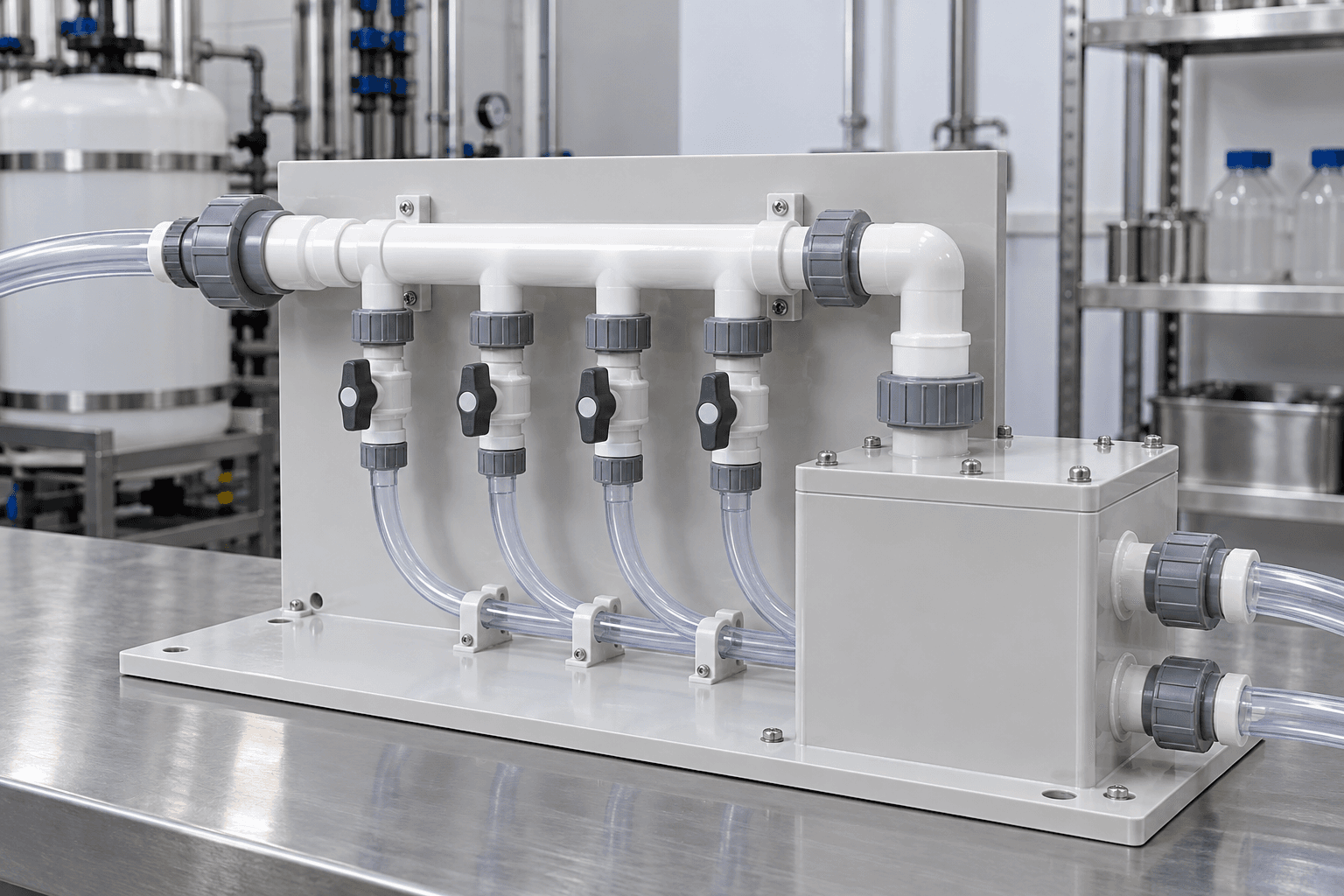
Commonly considered for compatible PVC assemblies where the joint design and system are defined.
For multi-part equipment, fixtures and serviceable fluid-handling modules.
Reviewed with wall thickness, loads and the intended installation method.
Protective handling may be appropriate for visible or sealing surfaces.
Inspection starts with the drawing and acceptance condition. Material grade, datums, critical bores, threads, ports, flatness and edge condition are reviewed before final packaging.
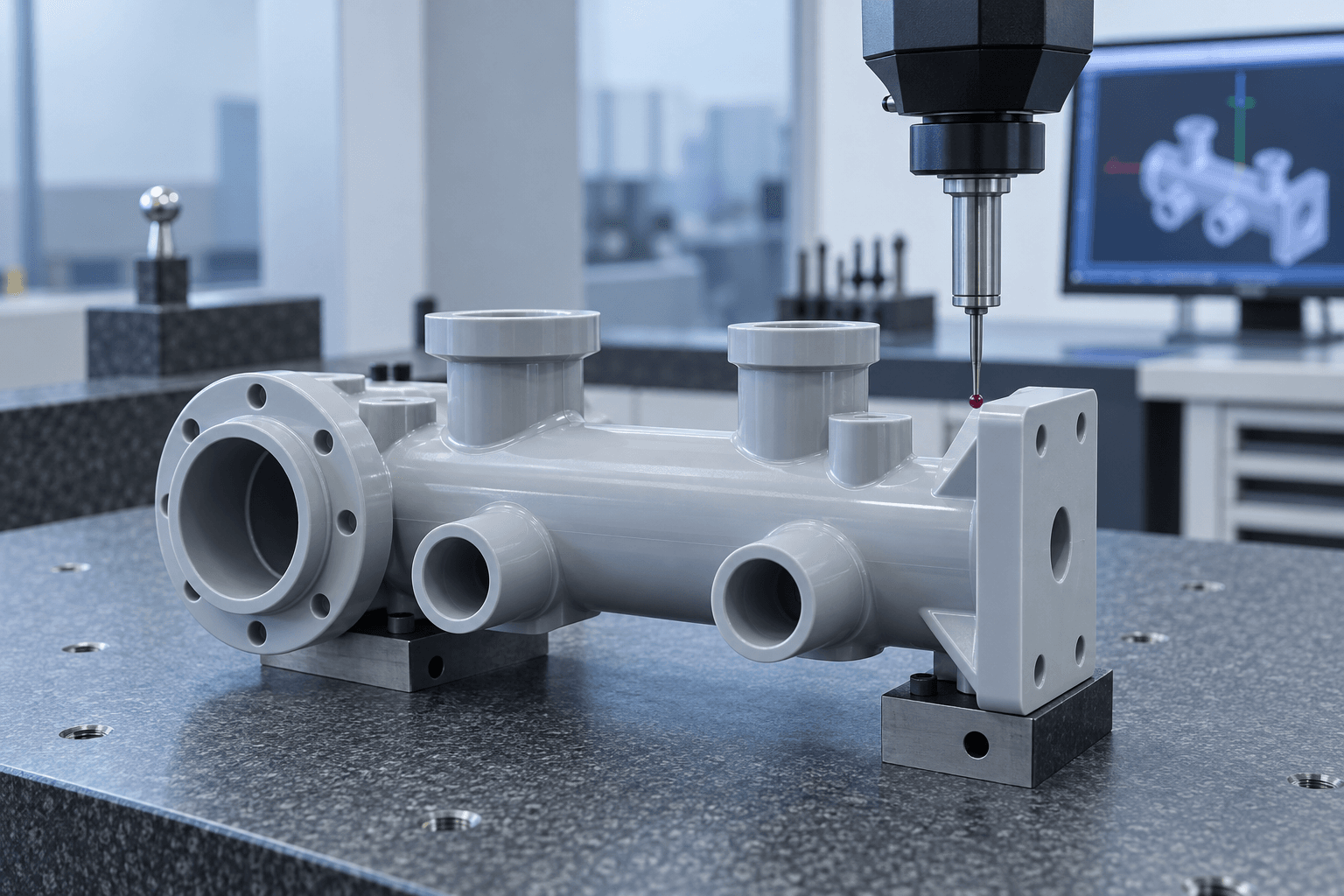
Both materials can suit chemical-handling equipment. The deciding factors are usually rigidity, assembly conditions, impact requirements, density and the exact service environment.
| Factor | PVC | HDPE |
|---|---|---|
| Rigidity | Higher | Lower |
| Chemical resistance | Excellent for compatible media | Excellent for compatible media |
| Electrical insulation | Excellent | Good |
| Tight-tolerance potential | Often better for stable rigid geometry | More deformation-sensitive |
| Impact flexibility | Lower | Higher |
| Bonding / welding | Commonly considered for PVC systems | Requires a different joining approach |
| General use | Manifolds, fittings, electrical and process parts | Guides, liners and impact-resistant industrial parts |
PVC is often selected for rigid, cost-effective process components. PTFE can be preferable where extreme chemical resistance or ultra-low friction outweighs stiffness, dimensional stability and cost.
| Factor | PVC | PTFE |
|---|---|---|
| Chemical resistance | Excellent for compatible media | Exceptional for many demanding media |
| Rigidity | Higher | Lower |
| Dimensional stability | Typically easier to hold in rigid geometry | More deformation-sensitive |
| Friction | Moderate | Extremely low |
| Cost | Lower | Higher |
| Typical choice | Rigid manifolds, fittings and insulating components | Seals, low-friction components and demanding chemical service |
Material suitability is confirmed for the actual grade and environment; an application label alone does not qualify a component.
Manifolds, valve components, tank fittings and process fixtures.
Fluid-routing components, fittings, mounting plates and equipment interfaces.
Insulators, supports, housings and mounting plates.
Chambers, fixtures and compatible fluid-handling components.
Specified chemical-handling and wet-process components where the grade is suitable.
Guards, structural supports, fixtures and low-volume equipment parts.
The manufacturing plan keeps material, application conditions and drawing requirements visible through review, production and shipment inspection.
CNC turning supports stepped diameters, bores, grooves, faces and selected threaded features. For sleeves, valve seats and fittings, the bore-to-OD relationship, wall thickness and service loads should be identified in the drawing review.
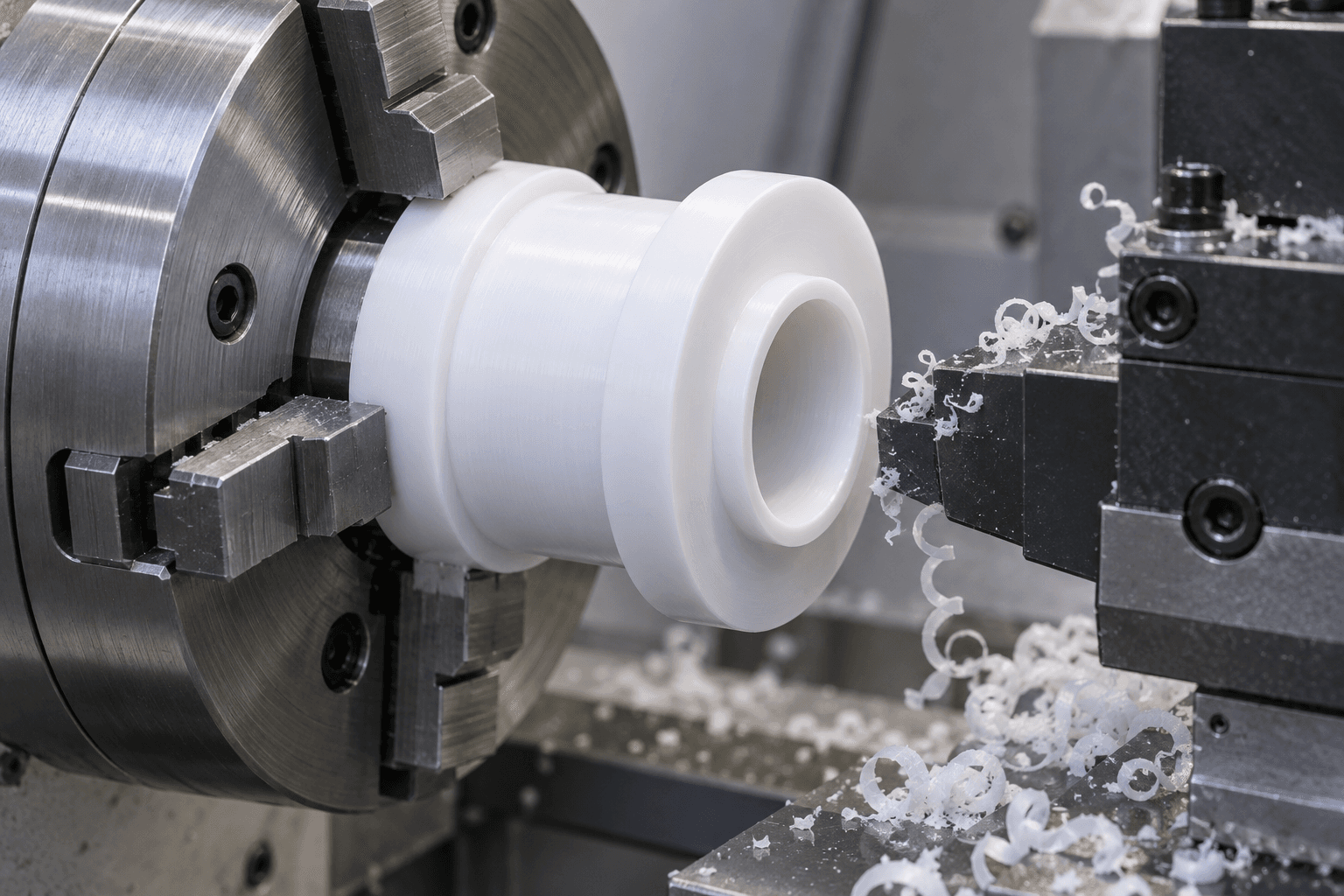
Thread form, engagement length and wall thickness are reviewed together.
Sealing geometry and mating-part conditions guide the tolerance and finish discussion.
Bores, outside diameters and operating loads define the functional fit.
Off-axis holes, flats and mounting features can be added after turning where required.
PVC parts generally prioritize clean functional geometry over cosmetic polishing. The required edge condition should be stated where ports, threads, sealing faces or hand-contact surfaces are involved.
Appropriate for many functional industrial parts when the drawing does not require a secondary cosmetic treatment.
Especially important around threaded holes, fluid ports, slots and drilled cross-passages.
Can reduce edge chipping and improve safe handling and assembly entry.
Protective handling can help keep visible, sealing or mating surfaces free from avoidable scratches.
The same drawing-based process can support functional prototypes, low-volume process equipment and repeat OEM parts. The key is maintaining control of the material grade, drawing revision, inspection points and agreed acceptance conditions.
Validate fit, fluid routing, mounting, sealing and compatible material selection before a repeat program.
Suitable for specialized equipment, fixtures, laboratory assemblies and custom process systems.
Controlled programs, documented grades and defined inspection points support recurring OEM components.
PVC machining is not only a dimensional exercise. Grade selection, chemical exposure, service temperature, threaded ports, heat control and bonding requirements affect whether a finished component will work reliably in service.
Material and process review starts with the functional application and the drawing.
Fluid connections, datum relationships and sealing features are discussed before machining begins.
Workholding, cutting conditions and edge finishing are planned for rigid PVC geometry.
The quote scope can cover first parts, repeat orders and agreed dimensional inspection.
Direct answers to common material-selection, machining and application questions.
Rigid PVC machines well when heat, tool sharpness, chip evacuation and workholding are controlled. The actual result depends on grade and geometry.
Rigid PVC or PVC-U is the usual starting point. Use CPVC where a higher-temperature chemical-service profile is needed, subject to a grade-specific review.
Yes. Milling is used for manifolds, plates and multi-face components; turning is used for fittings, bushings, sleeves and valve-related rotational geometry.
Tolerance depends on the component size, wall thickness, geometry, grade, fixture method, temperature and inspection conditions. Share the critical features for review.
PVC is commonly used for compatible chemical-processing and fluid-handling components. Confirm the grade against the actual media, concentration, temperature and exposure duration.
Rigid PVC can be useful for electrical supports and insulating parts. Confirm any required electrical or flame documentation for the specified grade.
Yes, provided wall thickness, thread form, engagement and assembly loads are considered in the drawing review.
PVC assemblies can use compatible solvent systems, selected adhesive methods, welding or mechanical assembly. The joint and grade must be reviewed for the intended service.
Choose PVC when higher rigidity, electrical insulation and stable process-component geometry are important. Consider HDPE when impact tolerance and flexibility are more important.
Choose PVC for rigid, cost-effective compatible chemical or electrical parts. Consider PTFE when extreme chemical resistance or low friction is the decisive requirement.
YOUR PVC GRADE. YOUR PROCESS CONDITIONS.
Upload your CAD model or engineering drawing. If known, include the PVC grade, quantity, critical tolerances, operating temperature, chemical exposure, pressure, thread requirements and application.
Our team can review material suitability and the machining strategy before quotation. Company, name, email and phone are required; country, part number, quantity and drawing upload are optional.
info@tops-precision.comSTEP / STP / IGES / X_T / DWG / DXF / PDF or ZIP, maximum 10 MB. Larger files can be shared by email. Please agree confidential-file handling before sending sensitive drawings.