Chemical Resistance
A candidate for many aqueous chemical environments. Check medium, concentration, temperature, exposure time and stress against the selected grade.

POLYETHYLENE · DRAWING-BASED MANUFACTURING
TOPS Plastics provides custom High-Density Polyethylene CNC machining for lightweight industrial parts requiring chemical resistance, impact resistance, low moisture absorption and practical manufacturing cost. We review milling, routing, turning, drilling and secondary operations against your CAD model and drawing.
HDPE cuts readily, but its flexibility and thermal movement need careful workholding and realistic tolerances. Start with the function of your guide, roller, liner or machine plate; we will review the grade, geometry and inspection conditions together.
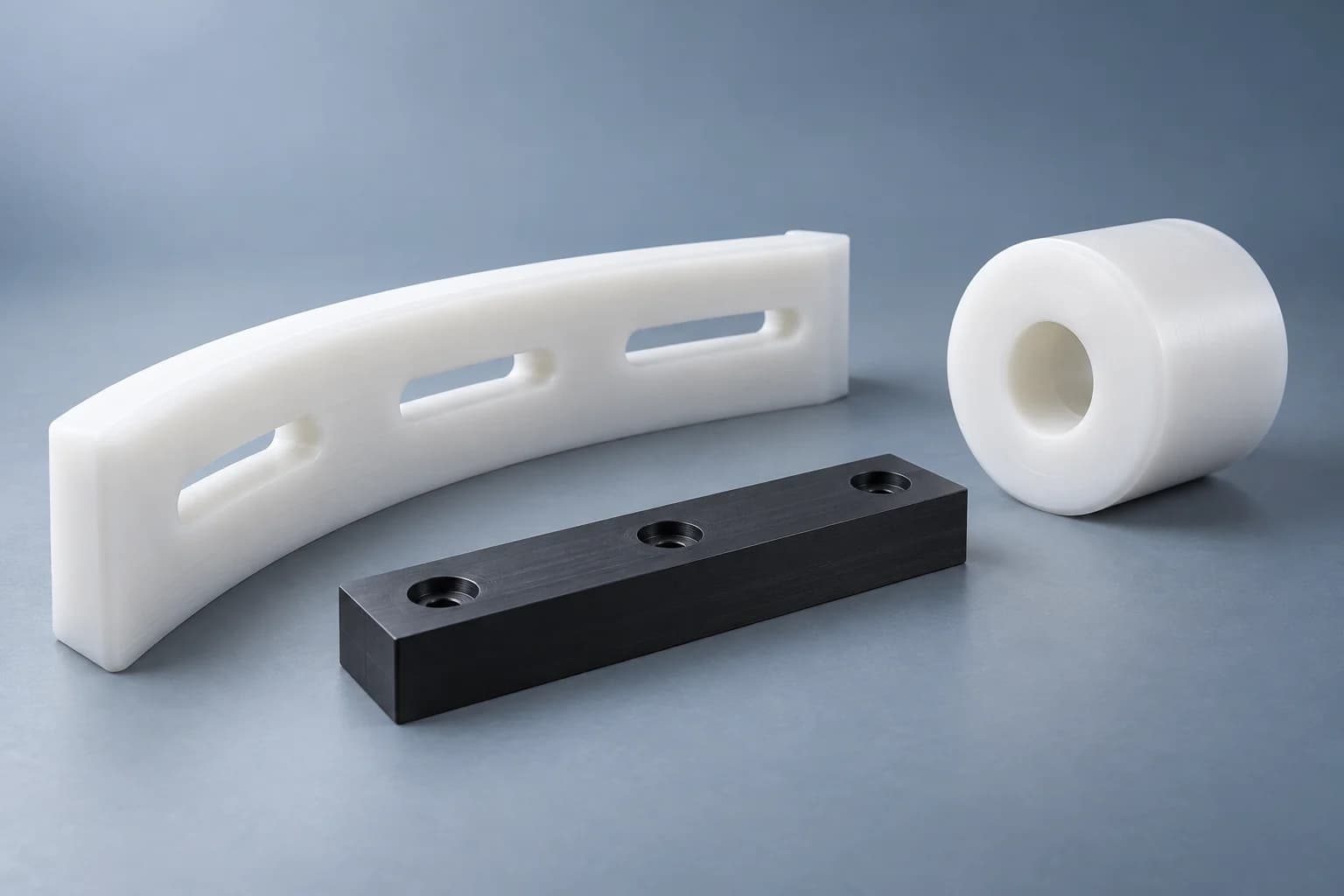
Manufacturing scope is confirmed from the complete drawing, part envelope, stock availability and acceptance requirements.
| Requirement | Drawing-based scope |
|---|---|
| Material | High-Density Polyethylene; specify supplier grade, color and any additives. |
| Processes | CNC milling, routing, turning, drilling and tapping, subject to feature review. |
| Part families | Guides, rollers, bushings, liners, machine plates, spacers and fixtures. |
| Stock forms | Sheet, plate, rod and block, subject to grade and size availability. |
| Order stages | Prototypes, low-volume orders and repeat production. |
| Engineering input | CAD model and controlled drawing; samples need an agreed dimensional specification. |
| File formats | STEP / STP / IGES / X_T / DWG / DXF / PDF; combine files into one ZIP if needed. |
| Inspection | Drawing-defined dimensional checks with agreed datums and measurement conditions. |
HDPE is a semi-crystalline thermoplastic in the polyethylene family. It combines low density, low moisture uptake and useful impact and chemical resistance for many general industrial components.
For a guide plate exposed to washdown, low water absorption can help maintain function without the moisture-related growth associated with some other polymers. For a large liner, low weight and readily available sheet forms can simplify handling and replacement. Neither benefit establishes suitability for every chemical, temperature or load.
HDPE is relatively soft and flexible compared with rigid engineering plastics such as POM. A surface that measures correctly while clamped may move after release. Design and inspection should account for thermal expansion, elastic recovery and long-term deformation under load.
Select HDPE when these advantages match the actual application, while keeping its stiffness and temperature limitations visible.
A candidate for many aqueous chemical environments. Check medium, concentration, temperature, exposure time and stress against the selected grade.
Useful for wet environments and washdown equipment where water uptake would otherwise affect dimensions.
Can tolerate knocks and handling impacts in suitable geometries; cold-temperature and notch behavior remain grade-specific.
Low density can reduce replacement-part weight and ease installation of larger panels, guides and liners.
Useful for moderate-duty contact surfaces. Review friction, wear, counterface finish, load and speed rather than assuming a universal low-friction result.
Standard stock can be economical for large industrial parts. Total cost also includes machining, inspection, replacement frequency and service life.
Grade names describe a starting point. Confirm availability and documentation before treating a special property as mandatory.
An unpigmented option for general machined components. Specify supplier designation where material identity matters.
Useful where a dark finish is preferred. Black color alone does not prove UV stabilization; request documented outdoor performance.
Use only an identified stock grade with applicable declarations for the intended contact, cleaning and operating conditions.
Review UV exposure, saltwater, fasteners and sustained loads. A marine label does not establish structural suitability for every design.
Anti-static, conductive or other modified grades need availability, electrical performance and application-specific document review.
Match the operation to the geometry. Routing is particularly relevant to larger sheet profiles; turning suits rotational interfaces.
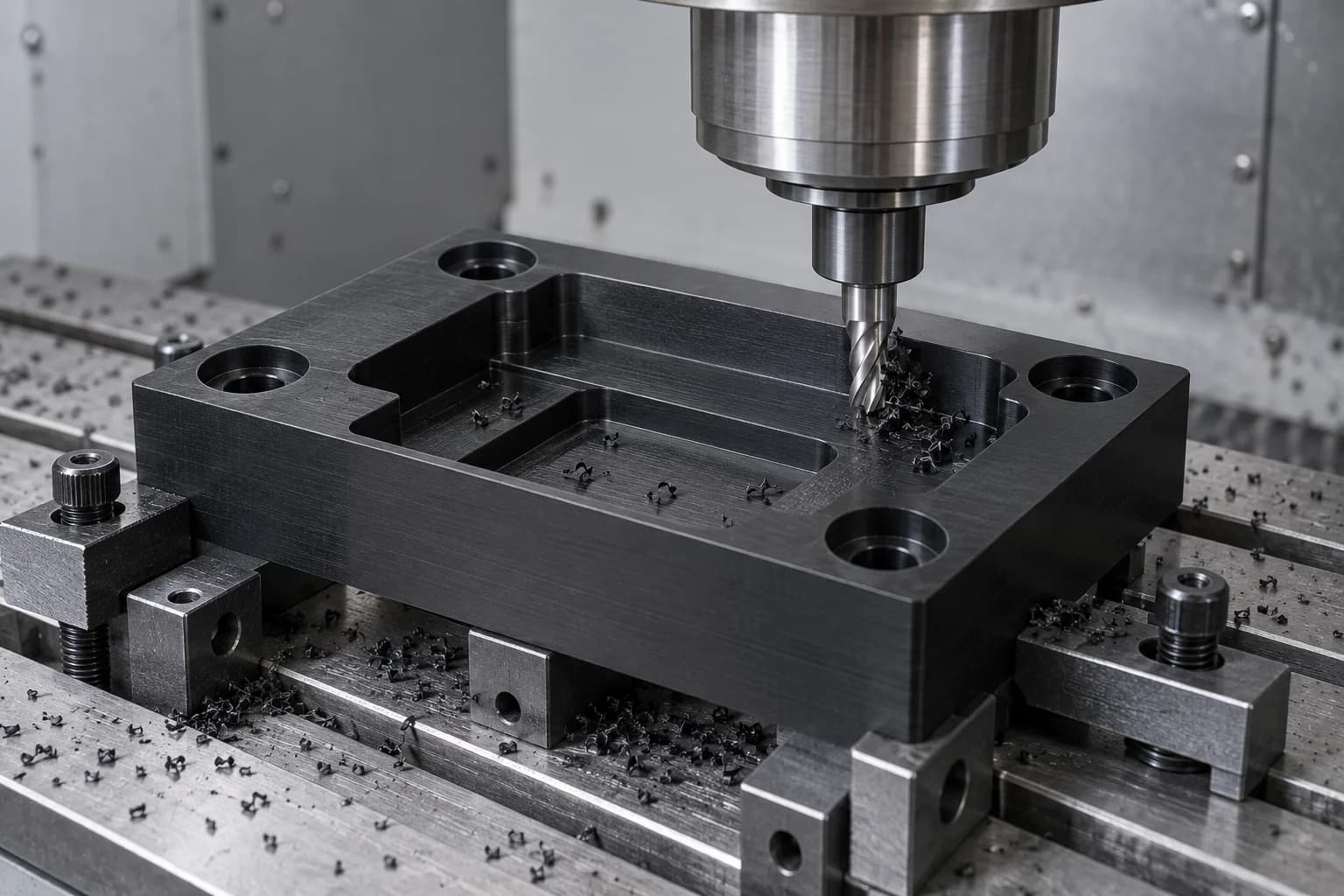
Pockets, steps, mounting patterns and multiple machined faces on fixtures, blocks and plates. Tool access and support are reviewed before machining.
Explore the process →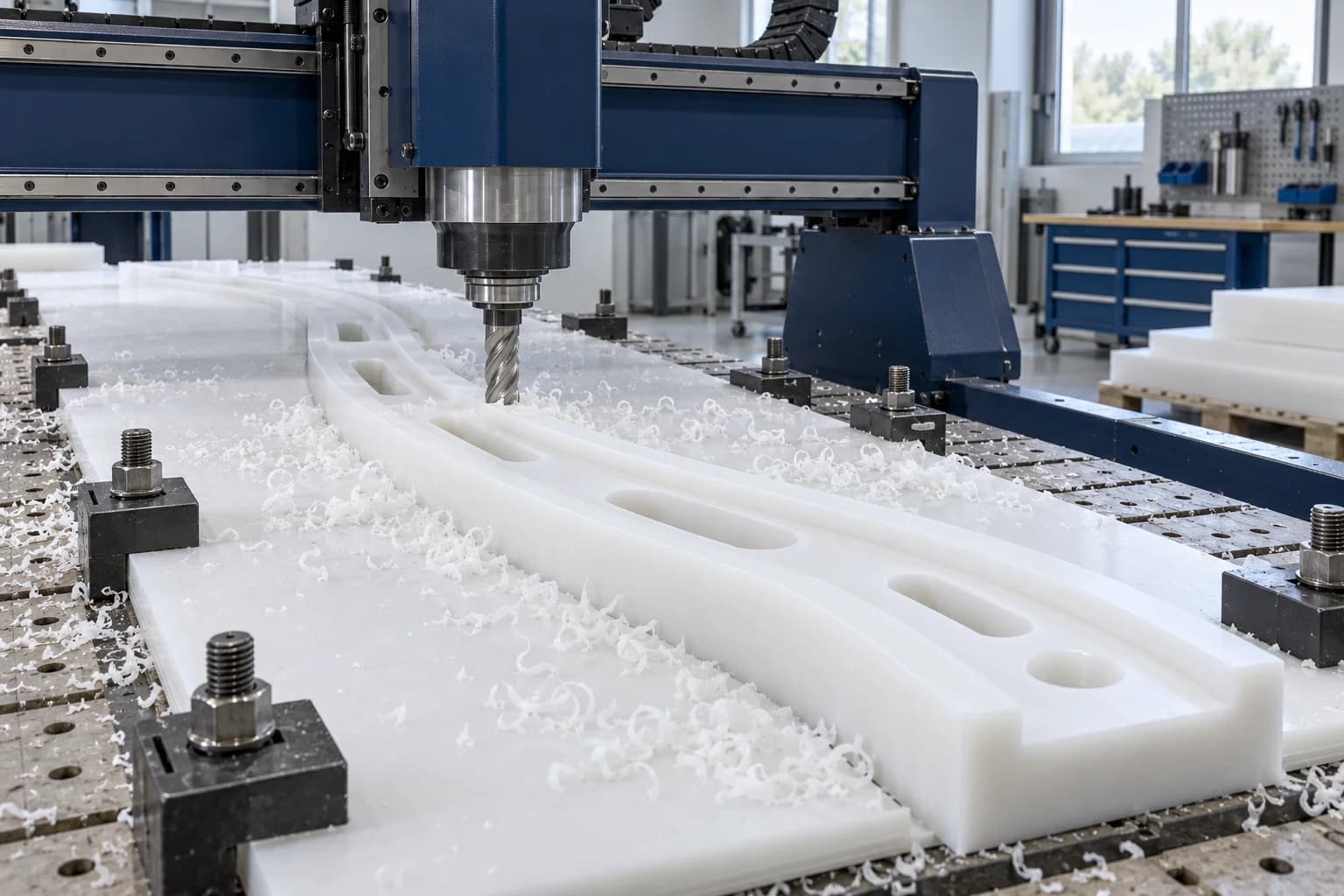
Large sheet profiles, panels, guide rails and liners with slots and mounting features. Send overall dimensions so working envelope, full-area support and handling can be confirmed.
Explore the process →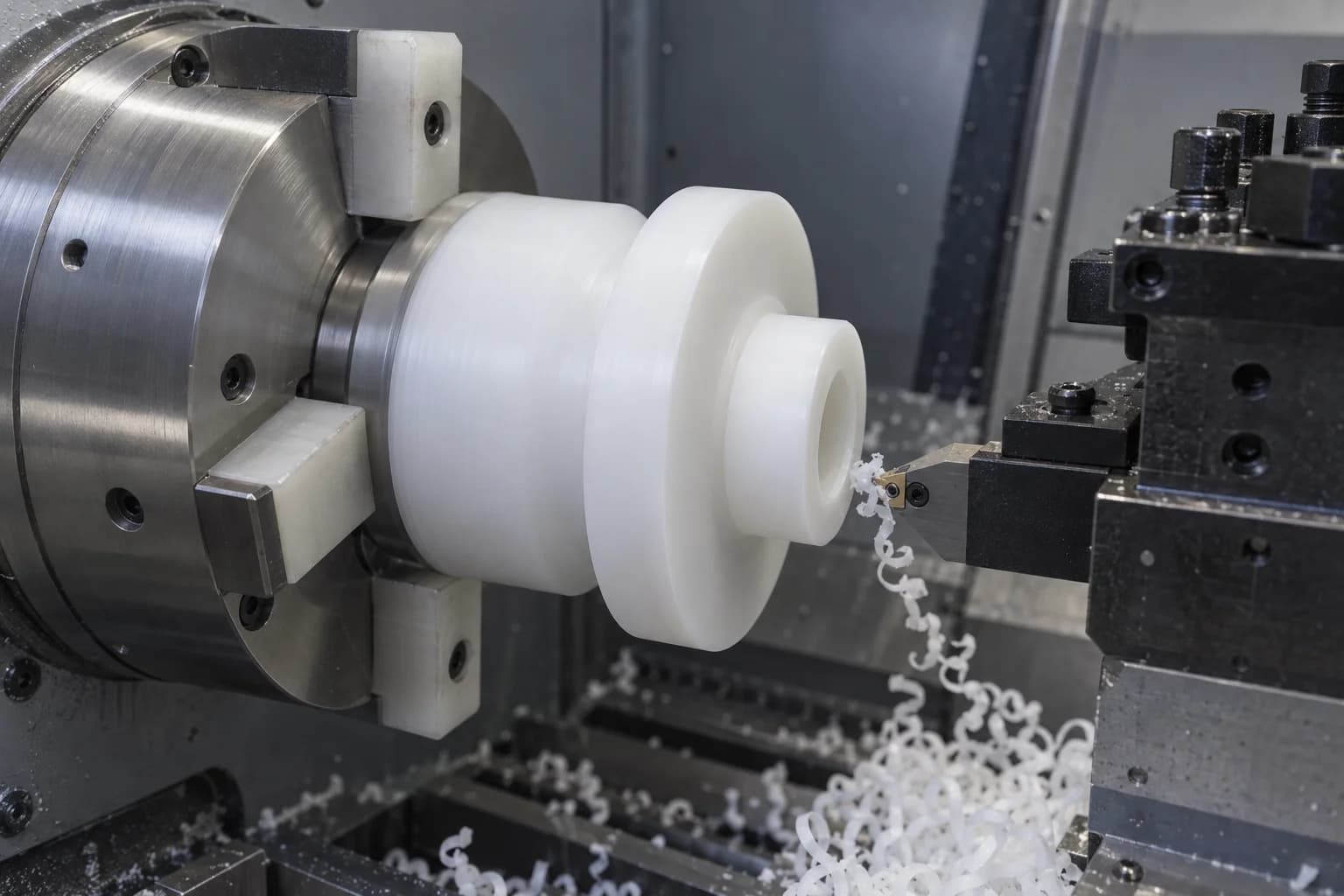
Bushings, sleeves, rollers, spacers and rings. Low-distortion workholding, bore recovery and released-part diameter are important for functional fits.
Explore the process →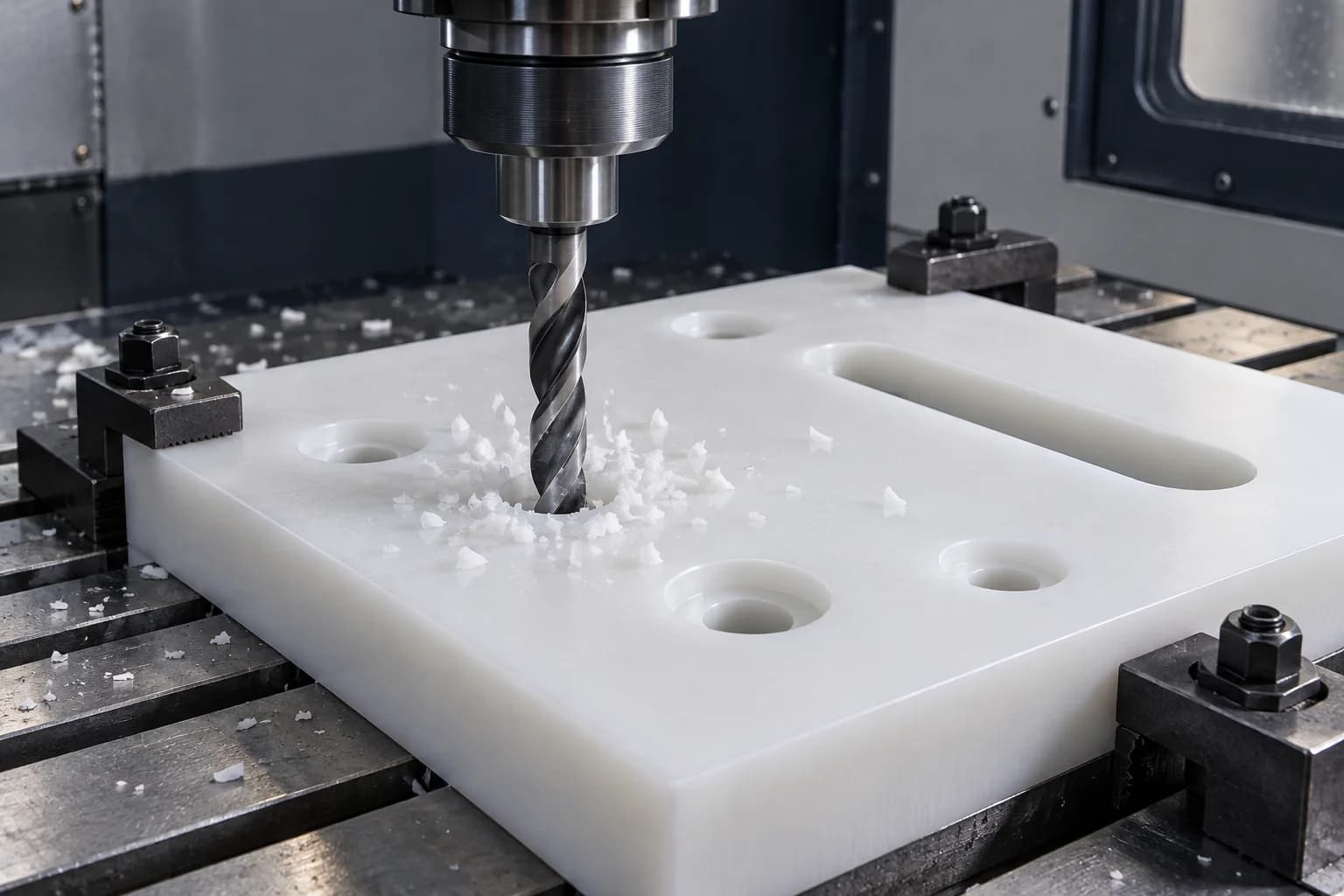
Mounting holes, slots, counterbores and tapped features. Thread engagement and assembly loads need review because HDPE can creep under sustained fastener stress.
Explore the process →Easy chip removal does not mean easy dimensional control. The process must manage five interacting effects.
A rubbing tool can soften the cut and change dimensions. Sharp edges, suitable chip load and chip evacuation reduce localized heating.
Unsupported walls and long spans can deflect under cutting force. Support strategy matters as much as the programmed tool path.
Excessive pressure can compress or bow a part. Distributed support and the minimum practical holding force help avoid measuring a distorted shape.
Trapped or stringy chips can mar surfaces and increase heat. Keep the cutting zone clear using a material-appropriate evacuation method.
Soft edges can stretch rather than separate cleanly. Tool geometry, exit strategy and controlled deburring need to work together.
There is no responsible single tolerance for every HDPE component. We review critical features by size, geometry, grade and measurement condition, then agree acceptance before production.
| Feature | Main risk | Drawing or inspection action |
|---|---|---|
| Thin walls | Deflection during cutting or clamping. | Define supported and released states; consider thicker sections. |
| Large plates | Thermal movement and stock stress. | Specify overall size, flatness, support and inspection temperature. |
| Bores | Elastic recovery after tool and clamp release. | Review shaft fit, bore depth and low-force measurement. |
| Roller diameters | Flexibility and temperature-related size changes. | Define OD, runout, bore relationship and reference condition. |
| Long guides | Straightness, mounting restraint and expansion. | Review mounting slots and installation clearance. |
| Slots | Tool heating and part movement. | Identify functional width and end-radius requirements. |
| Flatness | Fixture-induced bow and stress release. | Agree how a released part rests during measurement. |
| Press fits | Creep, yielding and assembly stress. | Review retention method instead of transferring a metal fit unchanged. |
A tight bore tolerance may be feasible on a short supported part but unsuitable for a long thin sleeve. State which dimensions are critical to quality and which can use practical manufacturing allowances. If the function needs rigid, repeatable precision under load, consider POM or another material instead.
Send Your Drawing for an HDPE Tolerance Review →A part can change between the machine, inspection area and installation. Define the relevant state rather than judging only the freshly cut surface.
Long dimensions amplify temperature-related movement. For design calculations, use the selected supplier grade's coefficient and the actual temperature difference.
Heat near a cut can temporarily enlarge a feature or soften the edge. Avoid final acceptance while the part is still thermally uneven.
Clamped parts can spring back after release. Measure with support and contact forces that do not recreate the machining distortion.
Stiffness and creep behavior change with temperature. Review continuous load and peaks separately; melting temperature is not a safe working-temperature rating.
A functional drawing makes it possible to control what matters without adding cost to noncritical surfaces.
Identify the dimensions governing clearance, alignment and retention instead of applying tight limits everywhere.
Avoid very thin unsupported walls and deep slender ribs; review spans against cutting and service loads.
Use appropriate clearances or slots where a long plastic part is attached to a metal frame.
Allow cutter access in pockets and slots. Small internal corners can require slower, less robust tooling.
Consider mechanical retention and controlled clearances where excessive interference would deform or creep the part.
Describe whether flatness is needed free-standing or installed. Distribute support during machining and measurement.
Review washers, broad contact areas and fastening torque. Sustained concentrated loads can cause indentation.
Provide temperature, chemicals, speed, loads, cleaning and outdoor exposure for material review.
These component families are reviewed to your drawing. The illustration shows representative geometries, not fixed catalog products or verified customer projects.
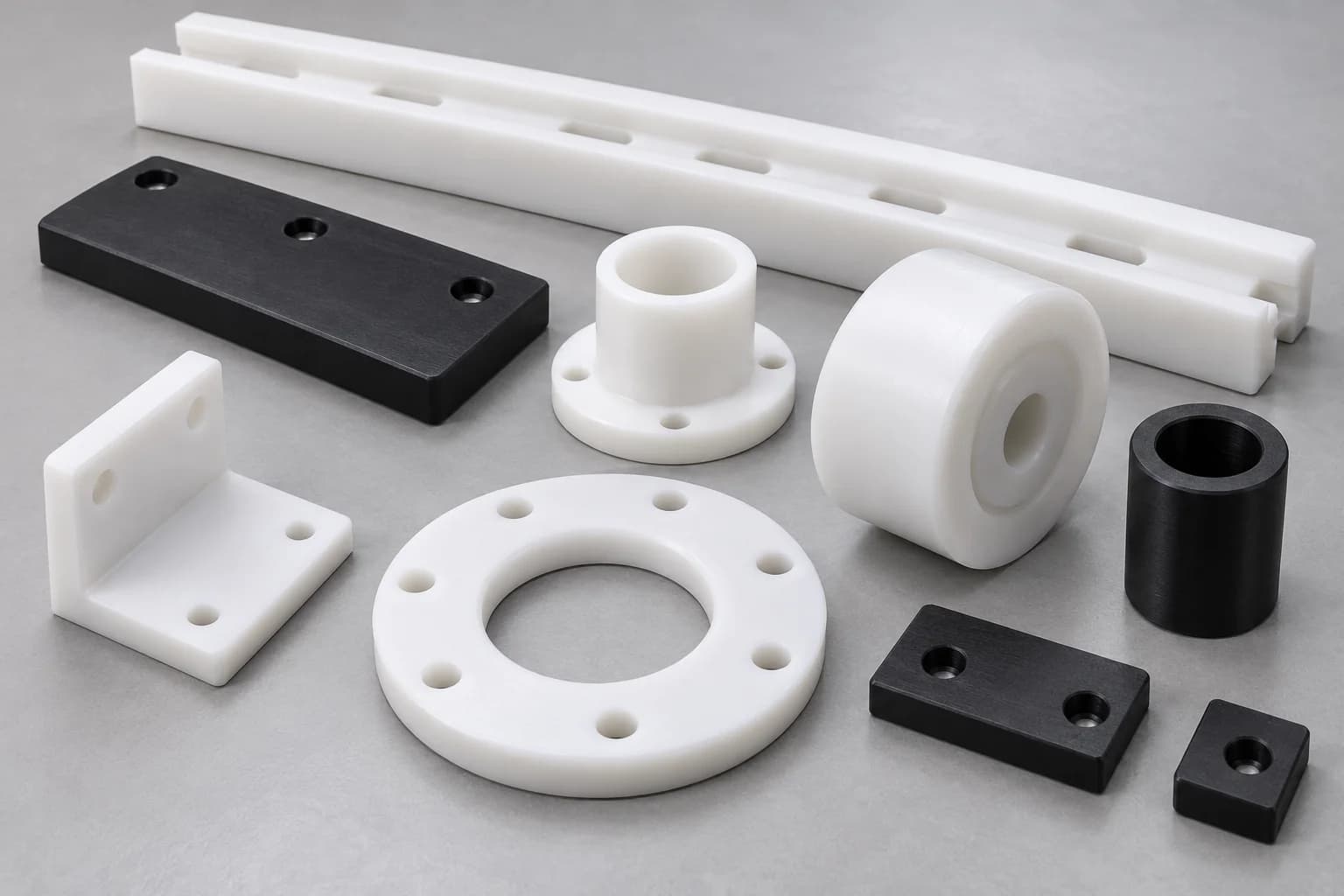
Straight or profiled guides with slots and clearances matched to moving products.
Turned working surfaces with controlled bore and mounting relationships.
Sleeves and flanged interfaces reviewed against load, speed and shaft fit.
Replaceable sheet profiles with mounting holes and expansion allowance.
Pads for moderate-duty sliding contacts with defined thickness and counterface.
Machined panels and support plates with pockets, slots and mounting patterns.
Nests and supports where nonmarring contact matters and flexibility is acceptable.
Separation components with distributed bearing area and reviewed compressive load.
Protective or guiding cylindrical parts with defined wall thickness and bore.
Machined covers, flanges and brackets; complete welded tanks require separate scope confirmation.
Drawing-based interfaces reviewed for exact chemicals, temperature and exposure.
Guides, change parts and profiles reviewed for speed, load and cleaning.
Panels and fittings using a documented grade suitable for actual outdoor conditions.
Equipment parts subject to grade-specific food-contact and cleaning requirements.
Combine routed, milled and turned features around your assembly interfaces.
Define the surface's function first. A glossy appearance or a nominal roughness number alone does not establish sliding performance or cleanliness.
A keen edge reduces rubbing and tearing. Tool condition should be reviewed when finish or burrs change.
Suitable rake and clearance help cut the soft polymer cleanly rather than push it aside.
Clear chips before they are dragged across finished faces or recut inside pockets.
Specify accessible break edges and functional surfaces. Excessive scraping can change a critical edge or bore.
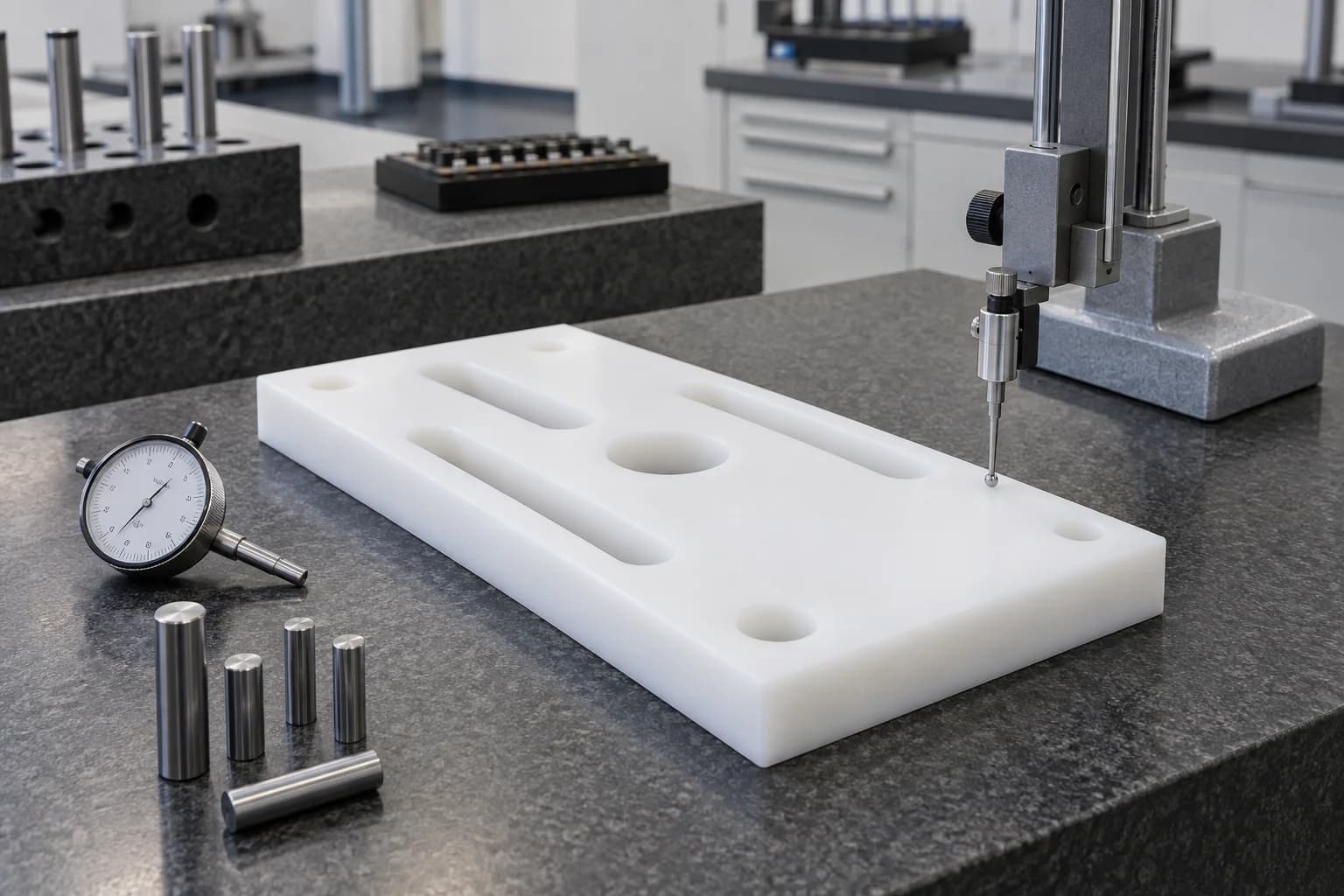
Inspection follows the released component and the customer's functional requirements. Required records and any factory testing are agreed before manufacture.
Choose HDPE for economical general-purpose chemical and moisture-resistant components when its mechanical behavior fits. Consider UHMW when abrasive wear, impact and sliding duty are the main constraints. Exact grades and conditions control the result.
| Decision factor | HDPE | UHMW |
|---|---|---|
| Material cost | Often economical in standard sheet forms. | Specialty grades and stock forms may cost more; compare actual quotations. |
| Machinability | Often more straightforward to cut cleanly. | Stringy chips and soft edges can need extra process attention. |
| Dimensional stability | Still flexible and temperature-sensitive. | Also requires careful thermal and released-part review; no universal ranking. |
| Abrasive wear | Useful for moderate service. | Often preferred for more demanding abrasion; validate against actual contact. |
| Impact | Useful toughness for many general parts. | Often selected for demanding impact conditions. |
| Sliding friction | Review counterface, pressure and speed. | Often favored for low-friction sliding; grade and interface matter. |
| Welding and fabrication | Commonly considered for thermoplastic fabrication with a qualified method. | Conventional joining is more difficult; do not assume the same welding route. |
| Conveyor use | Economical guides and general change parts. | Often selected for wear strips and severe sliding duty. |
| Chemical environment | Check compatibility for the selected grade and medium. | Also needs medium, concentration and temperature review. |
POM is generally the stronger starting point for stiff mechanical interfaces and repeatable precision fits. HDPE is often attractive for large, economical parts with suitable chemical exposure and more forgiving dimensions.
| Requirement | HDPE selection question | POM / Delrin selection question |
|---|---|---|
| Cost | Does inexpensive sheet stock reduce total installed cost? | Does better rigidity reduce machining or replacement cost? |
| Chemicals | Is the exact medium compatible at service temperature? | Check chemical limits rather than assuming equal resistance. |
| Stiffness | Can the design accommodate flex and sustained-load creep? | Is greater rigidity needed for alignment or mechanical load? |
| Dimensions | Can thermal movement and released-part shape be tolerated? | Are stable mechanical dimensions the main requirement? |
| Precision fits | Can clearance or alternate retention be used? | Is a rigid bore, shaft or gear interface required? |
| Friction | Is moderate sliding duty acceptable? | Does the mechanical interface favor POM's sliding behavior? |
| Large sheets | Is a routed sheet profile the most economical solution? | Does increased rigidity justify material and stock cost? |
| Mechanisms | Is the part a guide, liner or low-stress support? | Does the part transmit motion or require repeatable positioning? |
HDPE and PP are both lightweight polyolefins, but they are not automatic substitutes.
| Question | What to compare |
|---|---|
| Temperature and stiffness | Compare exact-grade temperature-dependent stiffness and sustained-load behavior. |
| Impact and cold service | Review low-temperature toughness, not room-temperature data alone. |
| Chemicals and fabrication | Confirm chemical compatibility and joining method for each grade. |
| Precision and expansion | Both need allowances for thermal movement, flexibility and realistic fit requirements. |
For hot chemical service or a change in cleaning conditions, compare current supplier data sheets and application tests before switching from HDPE to PP. Share the operating environment if the material is still open.
Discuss HDPE or polypropylene for your application →Application examples help define the review; they do not establish regulatory approval or performance certification.
Covers, brackets and handling components for documented compatible media.
Guides and change parts using a documented grade suitable for contact and washdown.
Product guides, spacers and machine panels with practical fit and wear requirements.
Outdoor panels and fittings with confirmed UV grade, loads and fastening details.
Custom plates, liners and nonmarring supports with drawing-defined interfaces.
Guides, rollers and liners reviewed for impact, abrasion and maintenance access.
Components reviewed for water chemistry, cleaning agents and operating temperature.
Fixtures and guide elements where low weight and nonmarring contact fit the motion requirements.
Use each stage to establish a controlled baseline rather than assuming a prototype proves every operating condition.
Check fit, installation preparation and functional clearances. Agree what application testing the customer will perform.
Confirm stock source, workholding, released-part checks and packaging before the next order.
Control revisions, grade substitutions, CTQ dimensions and shipment inspection requirements.
Our drawing review focuses on the practical difference between cutting a soft polymer and delivering an acceptable functional component.
Connect material identity to the load, chemical and temperature requirements.
Match the process to plate, profile, block and rotational features.
Confirm part dimensions, available stock, machine envelope, support and handling before promising feasibility.
Review sharp tooling, chip removal and low-distortion holding.
Focus on functional datums and realistic released-part acceptance.
Use revision and inspection control as quantities increase.
Discuss color, additives and mandatory documents before ordering stock.
Work from customer requirements rather than fixed catalog geometry.
A clear ten-step route connects your RFQ to the agreed final inspection and packaging scope.
Supplier guidance helps frame material selection. The current data sheet for your exact grade controls calculations and acceptance.
HDPE can be cut readily with suitable sharp tools, but clean chips do not guarantee precision. Heat, flexible walls, clamping distortion and burrs must be controlled.
Yes. Milling and routing suit plates, pockets, profiles and guides; turning suits rollers, bushings, sleeves and rings. Feasibility depends on the complete geometry.
Tolerance is reviewed by feature, size, grade, support and inspection condition. Send the drawing and identify critical fits rather than applying a universal metal-like tolerance.
Cutting heat, residual stock stress, concentrated clamping and insufficient support can change shape. Elastic recovery after release and thermal changes can also affect measured dimensions.
HDPE is often suitable for economical general industrial parts and fabrication. UHMW is often considered for higher abrasion, impact and sliding demands. Compare exact grades against the application.
Do not assume a universal ranking. Both are flexible and thermally sensitive; size, stock history, grade, geometry and measurement condition determine practical stability.
HDPE can be tapped, but thread strength and sustained-load creep need review. Specify engagement, assembly torque, repeat disassembly and any inserts or alternate retention.
It is compatible with many chemicals, but suitability depends on the medium, concentration, temperature, exposure and stress. Verify the selected grade before use.
Only use an identified grade with appropriate documentation for the actual food-contact, cleaning and temperature conditions. The generic material name alone does not establish compliance.
Typical drawing-based families include guides, rollers, bushings, liners, wear pads, machine plates, fixtures, spacers, sleeves, tank components and custom equipment interfaces.
YOUR APPLICATION. A PRACTICAL HDPE SOLUTION.
Send your CAD model or drawing for a review of HDPE grade, quantity, dimensions and manufacturing route. Include critical fits, temperature, chemical exposure and application details in the drawing or accompanying email where available.
Company, name, email and phone are required. Quantity, part number and country are optional. One drawing or CAD upload is optional; larger files can be shared by email.
info@tops-precision.comSTEP / STP / IGES / X_T / DWG / DXF / PDF or ZIP, maximum 10 MB. Please agree confidential-file handling before sending sensitive drawings.