
Choose PVDF when your compatible fluid-handling part needs a comparatively rigid body with machined ports and mounting features. Consider PTFE when low friction or a supported sealing function drives selection. Verify the exact grade, fluid exposure and assembled geometry before approving either material.
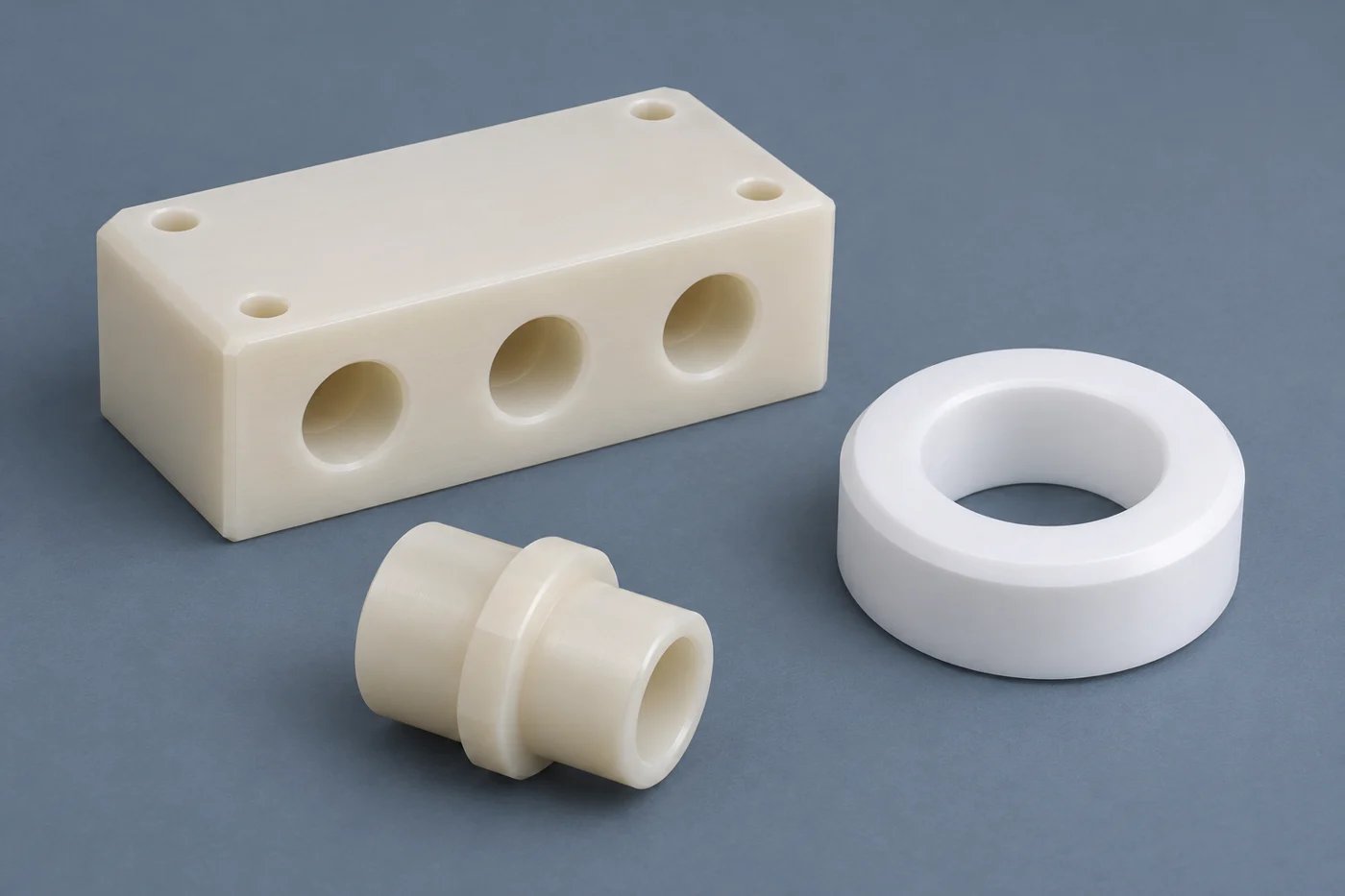
How Should You Compare PVDF Vs PTFE?
Compare PVDF and PTFE by the component’s job before comparing headline material properties.
Your valve body must locate passages, support connections and maintain sealing relationships. Your seat or ring may instead need controlled contact and accommodation within a supporting assembly. These functions can favor different materials within the same equipment.
Start with the fluid, temperature, pressure history, mechanical loads and required service life. Then identify the features that determine acceptance. A material comparison becomes useful when you connect each property to a specific failure mode.
Your initial selection should produce a qualified candidate, rather than an automatic production release. Confirm stock availability, machining feasibility and inspection requirements with the supplier. Keep application approval with your responsible design team.
Which Material Fits Your Chemical Exposure?
Both materials require chemical compatibility review against your actual operating conditions.
PTFE offers broad chemical resistance, but that description does not approve every formulation or operating environment. PVDF also serves compatible chemical applications. Neither family name replaces the exact fluid identity, concentration and exposure history.
Arkema’s Kynar chemical-resistance guidance identifies temperature, concentration, stress and exposure time as relevant factors. It also cautions that mixtures and actual service can differ from individual-chemical testing.
For your comparison, list process fluids, cleaning agents and accidental exposures separately. Include mixtures, reaction conditions and suspended particles where relevant. Ask your material specialist to identify remaining compatibility questions before selecting the machining stock.
Use the chemical resistance guide to organize those inputs. A room-temperature chart cannot establish your component’s complete service envelope. Review the material alongside loading, sealing and environmental changes.
When Does Structural Support Favor PVDF?
PVDF merits consideration when your compatible component needs stiffness around ports, mounting faces and internal passages.
Ensinger’s natural PVDF stock description identifies mechanical properties, low moisture absorption and machinability among its characteristics. These attributes support screening for machined bodies. They do not establish your part’s allowable pressure or minimum wall thickness.
Your drawing still needs sufficient material around threaded connections, intersecting passages and mounting holes. Consider loads from attached tubing and equipment interfaces. A chemically suitable material can fail functionally if the geometry cannot carry those loads.
Ask whether local reinforcement, different connections or another material would better serve the design. Avoid forcing PVDF into a requirement solely because it appears structurally stronger than PTFE. Compare the complete assembly and relevant grade data.
When Does PTFE Suit A Sealing Or Sliding Role?
PTFE merits consideration when low friction or a supported sealing interface is central to your component’s function.
Ensinger’s PTFE material overview highlights low friction, broad chemical resistance, thermal expansion and relatively low rigidity. Those characteristics explain its different design priorities. Your seat geometry, supporting structure and contact conditions remain essential.
Do not assume a soft material automatically produces a reliable seal. Define the mating surface, contact arrangement and permitted deformation. Your assembly must maintain the required relationship during installation and service.
Under sustained load, deformation can change sealing contact or installed dimensions. Review the creep and stress-relaxation guide when these effects matter. Treat time and temperature as design inputs, rather than evaluating only initial fit.
Which Parts And Machining Routes Should You Review?
Match the machining route to your functional surfaces, then compare candidate materials for that specific geometry.
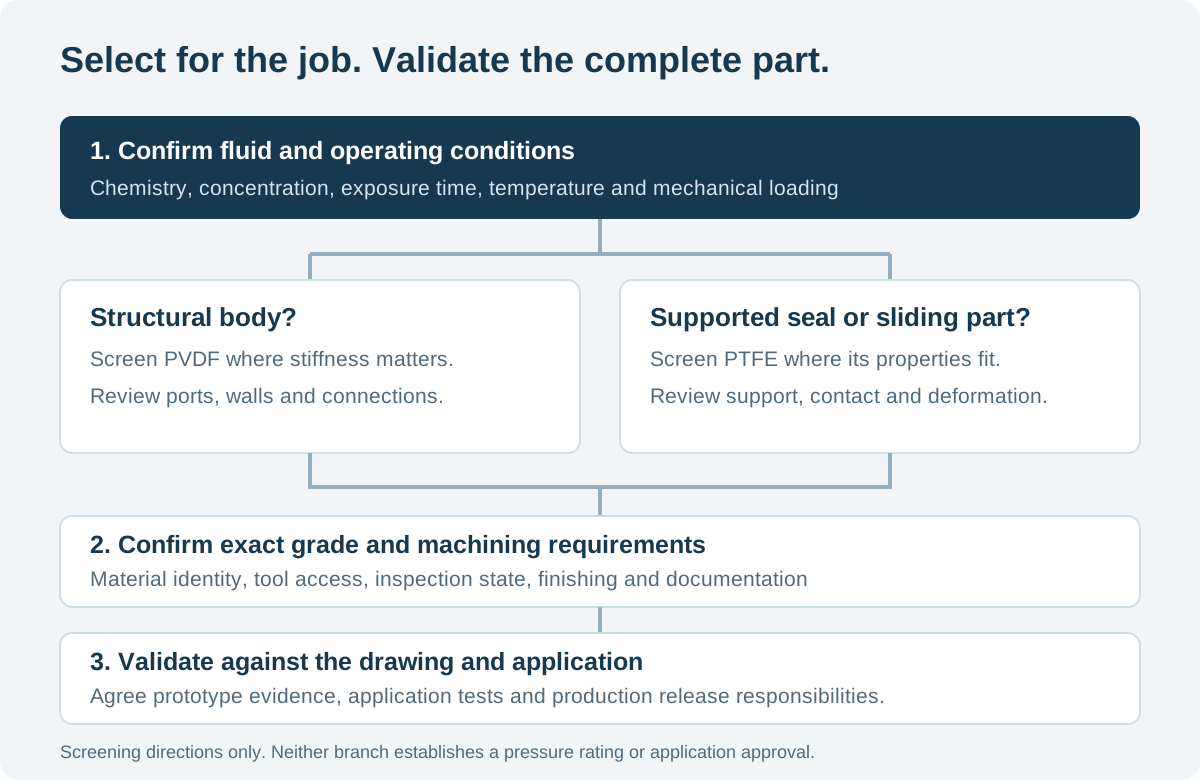
The table below identifies screening directions, not approved application recipes. Each candidate requires grade-specific chemical and mechanical review. Your actual design may justify another polymer or a different construction.
| Component Function | Machining Route To Review | Material Direction | Main Acceptance Question |
|---|---|---|---|
| Ported fluid body | Milling, drilling and boring | PVDF candidate for compatible structural service | Do passages, walls and connections meet the design? |
| Supported valve seat | Turning and controlled edge finishing | PTFE candidate where sealing contact favors it | Does the installed seat maintain required contact? |
| Threaded fitting | Turning, drilling and threading | Compare exact PVDF and PTFE grades | Can the joint carry assembly and service loads? |
| Sliding guide or sleeve | Turning or milling | PTFE candidate where friction drives selection | Are wear, loading and released dimensions acceptable? |
| Mounting or sensor interface | Milling and boring | PVDF candidate where stiffness matters | Are mating relationships stable under relevant conditions? |
For a complex part, identify which features belong to the fluid boundary. Separate them from mounting or locating features. This helps you assign inspection effort where a dimensional error would affect operation.
A multi-axis route can improve access to certain geometries. It does not remove material deformation or guarantee tighter dimensions. Choose it because your features justify the route, rather than treating machine complexity as automatic quality evidence.
How Should You Design For Machining?
Your geometry should provide tool access and support without creating unnecessary thin sections or inaccessible internal edges.
Show the supplier the complete passage layout and mating components. Mark sealing lands, datum relationships and critical port positions. Avoid asking the supplier to infer functional surfaces from an undimensioned model alone.
For rotational PTFE components, discuss chuck contact and released dimensions. For PVDF blocks, review support around deep pockets and intersecting holes. In both cases, the inspection state should represent the drawing requirement.
Apply these practical review points before ordering:
- Allow accessible internal radii where the function permits them.
- Define thread form and sealing method at every fluid connection.
- Identify internal intersections requiring burr inspection.
- Distinguish cosmetic surfaces from functional sealing surfaces.
- Request review before changing a thin wall or engagement length.
Your supplier can propose a process or geometry adjustment. Have your design owner approve changes before manufacture. Keep machining feasibility separate from application qualification.
How Do Temperature And Fit Change The Comparison?
Evaluate dimensions at the temperatures and assembly conditions that your component will actually experience.
A supplier’s material temperature listing does not define the working temperature of your loaded fluid component. Chemical exposure, stress and geometry can change the practical limit. Ask which properties and assumptions support the selected design conditions.
Specify your inspection reference state and relevant operating range. Include startup, shutdown and cleaning cycles when they affect fit. Review differential movement where the polymer contacts metal or another plastic.
The thermal expansion guide explains how reference conditions affect dimensional discussions. Use it to coordinate drawing and inspection requirements. Do not assume that a room-temperature assembly trial represents every later operating condition.
Can Filled PTFE Replace Virgin PTFE?
A filled PTFE grade requires separate approval because its composition changes the material comparison.
Fillers can alter mechanical, wear and other properties. They can also change the compatibility and cleanliness questions for fluid-contact service. Identify the exact compound instead of requesting only “improved PTFE.”
Use the virgin versus filled PTFE guide when evaluating those alternatives. Compare the complete formulation with your fluid and contact requirements. A useful mechanical improvement does not automatically preserve every other desired property.
Apply the same discipline to specialty PVDF grades and different stock products. Record approved substitutions explicitly. Your purchase order should identify what the supplier may supply without another design review.
What Must Your Cleanliness Specification Include?
Your cleanliness specification should describe the delivered component, rather than relying on the polymer’s appearance or family name.
Specify relevant residues, particles, handling and packaging requirements. Identify whether any cleaning agent needs approval. A natural white stock or familiar fluoropolymer brand does not prove a particular cleanliness level.
Keep material identity, chemical compatibility and finished-part cleanliness as separate evidence categories. If your application needs specialized contamination data, request it explicitly. Confirm its scope and availability before assuming the quotation includes it.
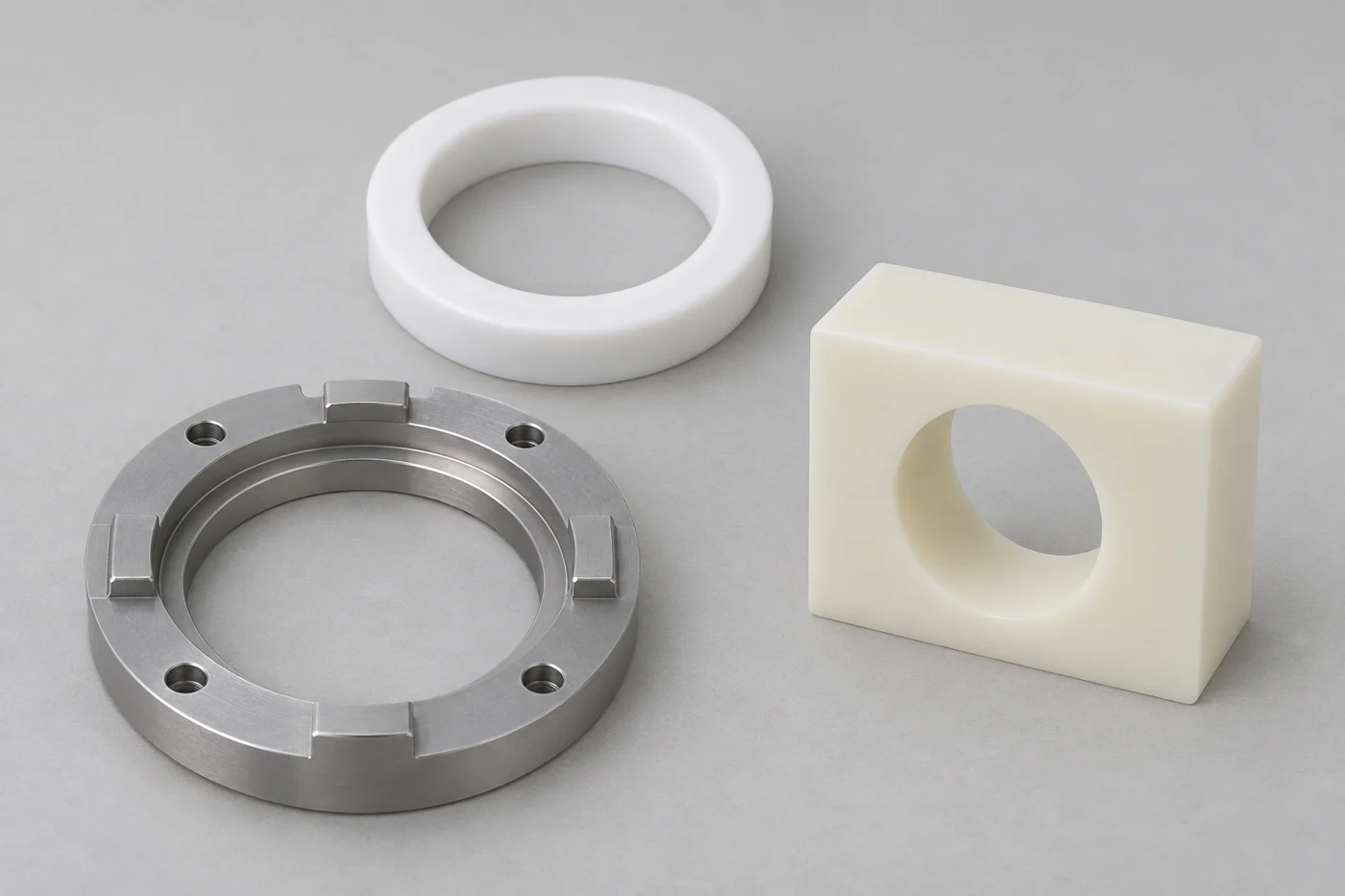
The support illustration separates a seat, carrier and body for discussion. It does not show a validated sealing arrangement or identify material by color. Use the actual drawing and material records to establish those details.
What Does A Useful Validation Workflow Look Like?
Your validation workflow should connect material approval, dimensional evidence and application testing to a controlled drawing revision.
Use this sequence to agree responsibilities before the first order:
- Define fluid exposure, component function and operating conditions.
- Select exact candidate grades and obtain relevant supplier information.
- Review geometry, machining access and inspection state.
- Produce representative samples using the approved stock and finishing scope.
- Review dimensional, visual and material records against agreed requirements.
- Complete application tests using the design owner’s approved procedure.
- Record the release decision and change triggers for repeat production.
A pressure or leakage test needs its own approved procedure and acceptance criteria. Define who develops it, performs it and reviews results. Do not derive a safe test pressure from this comparison article.
Your first-article inspection plan can organize component evidence. It does not replace equipment qualification. Record unresolved application tests instead of treating a dimensional report as complete service approval.
When comparing samples, inspect both before and after the relevant assembly step where your plan requires it. A supported seal and an unsupported blank can present different dimensions. Record which condition each result represents.
Keep the mating component’s revision in the same record. A changed carrier, fitting or mounting face can alter the interface. Your repeat-order review should consider those changes even when the polymer drawing remains unchanged.
What Drives The Quoted Cost?
Your quoted cost depends on stock, geometry, process steps and acceptance scope, rather than material name alone.
Compare stock size and usable geometry before assuming one candidate is cheaper. A purchased blank may contain substantial material that machining removes. Availability and required documentation can also affect the quotation.
Deep passages, delicate seats and multiple setups add different manufacturing challenges. Detailed inspection, internal-edge checks and special packaging add scope beyond cutting time. Quantity affects how setup and review work are shared across the order.
Ask for quotations against the same drawing and acceptance requirements. Identify prototype quantities and expected repeat demand. A lower machining price is difficult to compare when one offer excludes records or finishing that another includes.
When Should You Reconsider Both Materials?
Reconsider both candidates when neither can satisfy your combined chemical, mechanical and verification requirements.
For example, a loaded connection may demand a different structure despite favorable chemical screening. A sealing interface may need an altered support arrangement. A cleanliness requirement may need a stock product with more specific evidence.
Do not use a more expensive fluoropolymer to compensate for an unresolved design problem. Compare alternatives with your responsible engineer. Confirm the required acceptance plan before committing to production stock.
What Can You Review With TOPS Plastics?
You can discuss drawing-based PVDF and PTFE machining through TOPS Plastics’ existing material service pages.
The PVDF machining page describes milling, turning and port-related feature review. The PTFE machining page covers turned and milled components with grade-specific considerations.
Use those pages to frame a project enquiry. Confirm your exact stock grade, geometry, quantity and inspection deliverables before ordering. Do not infer a numerical tolerance guarantee or specialized certification from the material name.
For supplier comparison, request evidence relevant to your own drawing. Confirm any required test equipment, documentation or external testing arrangements individually. A technical article is not evidence of a completed customer qualification or a particular instrument inventory.
Frequently Asked Questions
Your final choice depends on the complete part and operating conditions; these answers address common comparison errors.
Is PVDF Always Better For A Manifold Body?
No. PVDF can merit structural screening, but your fluid, temperature and geometry determine suitability. Review the exact grade and connection loads. Another material or construction may better serve the application.
Does PTFE Automatically Produce A Leak-Free Seal?
No. You must define contact geometry, support, mating finish and operating conditions. Evaluate the assembled design under an approved procedure. Initial fit alone does not establish service performance.
Can You Compare Materials Using Only Chemical Charts?
No. Charts support screening, while loading, mixtures and exposure conditions still require review. Ask what evidence applies to your exact grade. Resolve gaps before approving the finished component.
Can Filled PTFE Be Substituted Without Drawing Changes?
Only use a substitution authorized by your design owner. Document the compound and relevant requirements. Revisit compatibility and application evidence when the formulation changes.
Which Material Is Easier To Machine Precisely?
Your achievable dimensions depend on geometry, grade, support, cutting conditions and inspection method. Discuss critical features rather than requesting a universal tolerance. Evaluate released parts in the agreed state.
Should You Request A Pressure Test With Every Order?
Let your design authority define the required tests and sampling. Specify the approved procedure and acceptance criteria. Confirm whether the supplier’s quotation includes that scope.
How Do You Compare Prototype And Repeat Orders?
Keep the approved grade, drawing revision and acceptance baseline visible. Identify changes before reordering. Confirm which prototype observations became controlled production requirements.
What Should You Send For A Material Comparison Quote?
Send drawings, candidate grades, quantities, fluid details and operating conditions. Identify critical sealing surfaces and inspection deliverables. Include assembly information where it changes machining or acceptance.
Request A Drawing-Based Review
For a PVDF vs PTFE review, send your drawing, candidate grades, fluid exposure, quantities and critical acceptance requirements. Contact TOPS Plastics to discuss the machining scope. Agree confidential-file handling before sending sensitive drawings, and confirm application validation responsibilities separately.