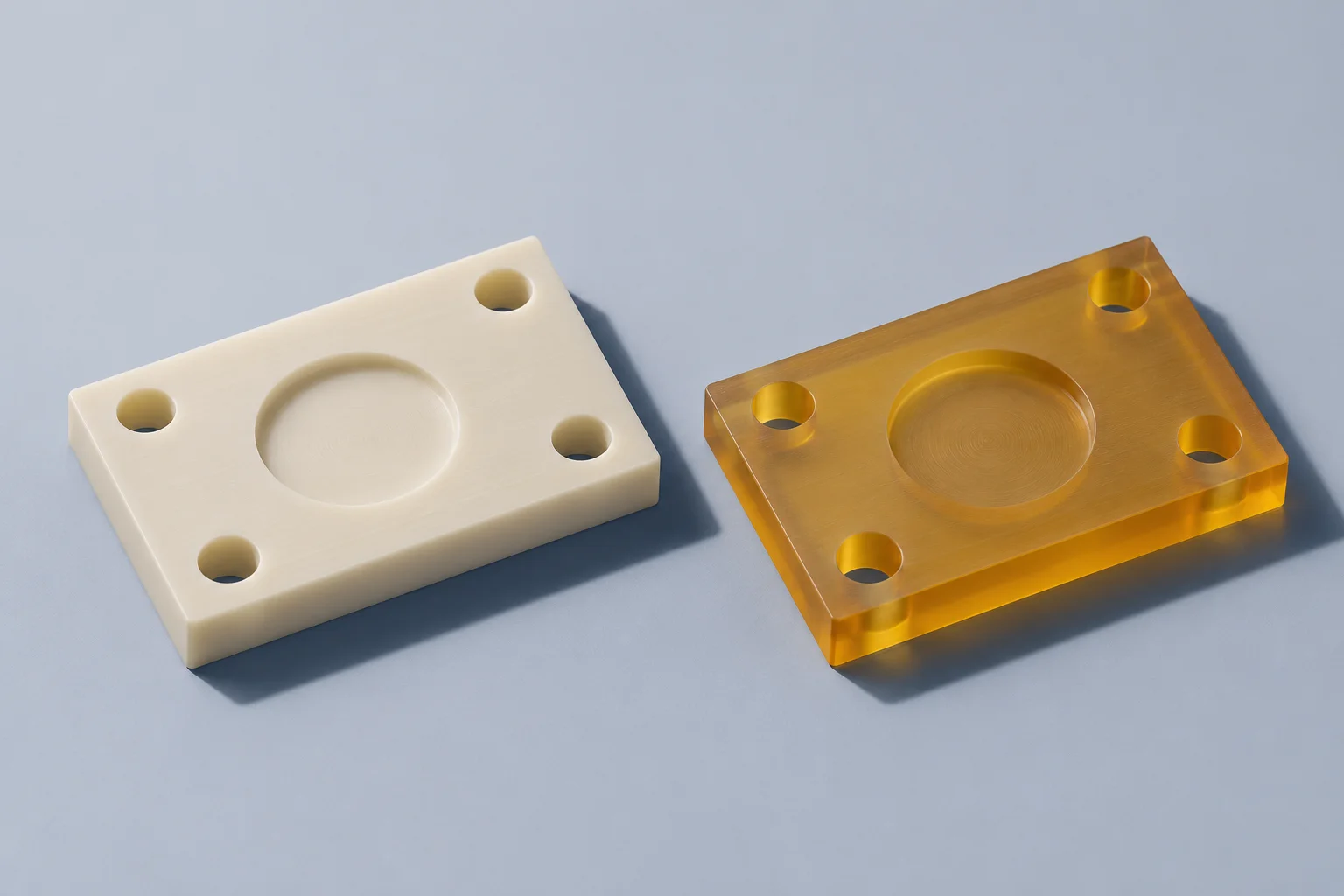
PPS vs PEI selection starts with your chemical exposure, electrical requirements, loading and available stock grade. PPS deserves consideration for demanding chemical environments and low moisture uptake. PEI deserves consideration for structural electrical components. Neither polymer name proves that your finished part will meet its application.
Choose The Material Around The Failure You Must Avoid
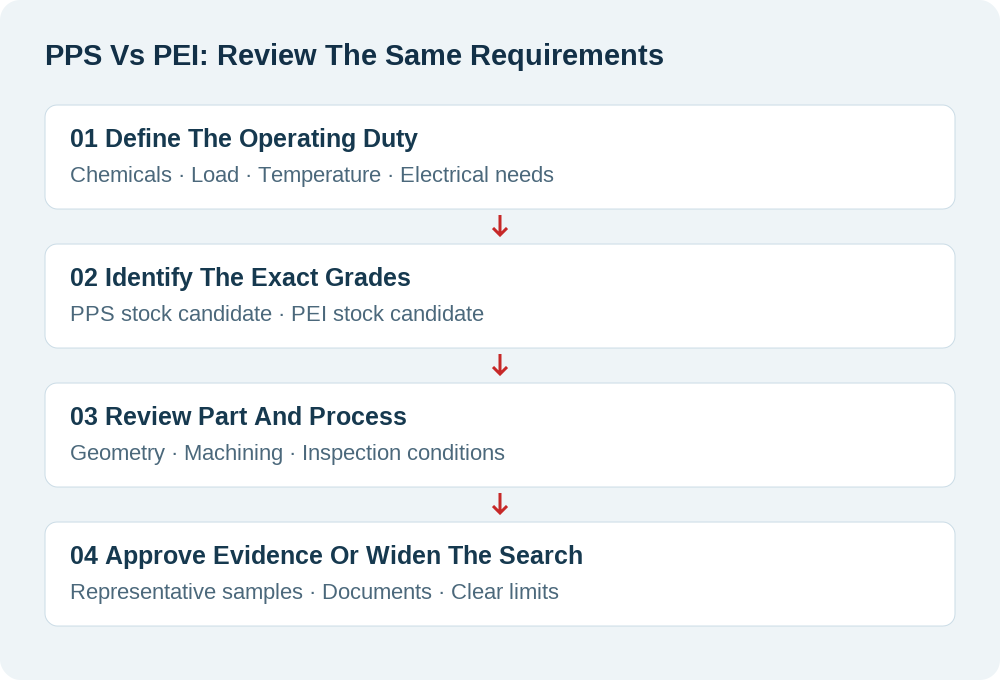
You should compare PPS and PEI against the same operating requirements rather than selecting a winner from isolated datasheet values.
Begin with the consequence of failure. A spacer that loses alignment creates a different problem from an insulator that cracks during cleaning. Your selection priorities should follow those consequences.
Write down normal temperature, peak temperature and exposure duration. Add load, assembly restraint, fluids and cleaning chemicals. Include electrical requirements when they influence the component's function.
Then identify the exact candidate stock grades. Compare their data using compatible test methods and conditions. A room-temperature tensile result cannot independently answer a sustained-load question at operating temperature.
Keep a short rejection list alongside your preferred candidate. If neither grade meets a critical requirement, widen the material review. You do not need to force every application into a two-material comparison.
Understand What PPS And PEI Actually Describe
You should distinguish polymer families from the specific stock shapes available for machining.
PPS means polyphenylene sulfide, a semi-crystalline thermoplastic. PEI means polyetherimide, an amorphous thermoplastic. These structural differences help organize material behavior, but they do not replace grade-specific evidence.
Ensinger's unfilled PPS product information identifies chemical resistance, low water absorption and dimensional stability among its characteristics. Its PEI material overview describes an amorphous material with structural, thermal and electrical uses.
Those descriptions establish candidate directions. They do not guarantee a tolerance, lifetime or chemical duty for your particular geometry. The supplied grade, stock manufacturing route and finished configuration still matter.
Treat brand names carefully. ULTEM is associated with PEI resin and material products, but you still need the complete grade designation. A broad trade name leaves formulation, reinforcement and documentation questions unresolved.
Use A Decision Table Before Comparing Prices
You should screen the critical requirements before evaluating commercial differences between the candidate grades.
The following table gives review priorities rather than blanket material approvals. Its questions apply to both candidates. Your final choice should follow the evidence for the actual supplied stock.
| Selection Question | PPS Review Priority | PEI Review Priority |
|---|---|---|
| Aggressive fluid exposure | Check compatibility for the exact medium and temperature | Review compatibility and stress-cracking risk |
| Tight installed alignment | Review stock stability, expansion and restraint | Review expansion, moisture condition and restraint |
| Electrical insulation | Check grade data under relevant conditions | Check grade data and component geometry |
| Visible internal features | Natural PPS is not a clear viewing material | Amber transparency may help selected tasks, subject to finish |
| Sustained structural load | Evaluate time-dependent deformation | Evaluate time-dependent deformation |
| Sliding contact | Review a suitable wear grade and counterface | Do not infer bearing suitability from structural strength |
Keep these priorities tied to function. An attractive transparent component may fail a chemical requirement. A chemically resistant component may still be unsuitable for a sharp, heavily loaded feature.
Review Chemicals Together With Stress And Temperature
You should evaluate chemical compatibility under the component's actual exposure and loading conditions.
List each process fluid, cleaner and disinfectant separately. Include concentration, temperature, contact duration and whether exposure is repeated. A brief wipe and prolonged immersion are different duties.
PPS often enters the shortlist when chemical resistance drives selection. However, resistance to one fluid does not establish compatibility with mixtures or every operating condition. Ask the stock manufacturer for information covering the proposed grade.
PEI requires careful review where chemicals and stress interact. Ensinger's machinable-plastics FAQ identifies stress-cracking concerns for amorphous materials, including PEI, with aggressive media. Do not translate that concern into a claim that every oil attacks every PEI component.
Consider stress introduced by fasteners, press fits and residual machining effects. A compatibility review should reflect those conditions where they matter. Inspect representative parts after realistic exposure rather than accepting appearance before the exposure as sufficient evidence.
Separate Heat Resistance From Loaded Performance
You should assess temperature with load and duration instead of treating a single thermal number as a universal service limit.
A melting point, glass-transition temperature and heat-deflection result describe different material behaviors. They are not interchangeable component operating limits. Compare the test basis before placing values beside each other.
For your part, identify the dimension or property that must remain acceptable. A bracket may still appear intact while losing alignment under sustained loading. An insulator may need electrical performance after repeated thermal cycles.
Request relevant grade data at the conditions you expect. Where information is incomplete, define a representative trial or a broader material review. Avoid filling the evidence gap with an unsupported temperature promise.
Consider the surrounding assembly as well. Different expansion behavior can change clearances and restraint. Our plastic thermal expansion guide explains why the mating materials and temperature range belong in that discussion.
Specify Electrical Requirements At Component Level
You should define the electrical function before assuming either polymer family provides adequate insulation.
Identify voltage conditions, frequency, geometry and relevant environmental exposure. Review moisture, contamination and the operating temperature. A datasheet's electrical result applies to its stated test conditions and specimen.
Ensinger's unfilled PEI stock information lists dielectric and flame-related characteristics. If those characteristics drive your purchase, request the applicable grade documentation. Do not infer finished-assembly approval from a material description.
Keep electrical insulation and electrostatic control separate. An insulating grade is not automatically a static-dissipative grade. Additives that change electrical behavior can also change other properties and documentation.
For an electrical fixture or housing, connect material selection to creepage, clearance and mechanical design requirements. Your responsible engineer should confirm the applicable acceptance basis. This article does not establish an electrical safety rating for a TOPS component.
Match Unfilled And Reinforced Grades Fairly
You should compare equivalent formulations before attributing differences to PPS or PEI alone.
Unfilled stock and glass-reinforced stock are different candidates. Reinforcement can change stiffness, dimensional response, machining behavior and surface characteristics. Its effects depend on formulation and orientation.
Avoid comparing an unfilled PEI grade with a reinforced PPS grade and calling the result a universal polymer ranking. State the complete grade names in your comparison table. Include the source and test method beside relevant property data.
Filled stock can also change how small features behave during machining. Review edge quality, tool access and the function of finished surfaces. A reinforced formulation may be inappropriate where exposed fibers or a specific surface condition are unacceptable.
If reinforcement is relevant, use the reinforced-plastics machining guide for the manufacturing discussion. Keep that decision separate from choosing the base polymer family.
Review Machining Geometry Before Freezing The Grade
You should review the actual drawing because material selection and machining feasibility influence each other.
Identify thin walls, deep pockets, sharp internal corners and heavily loaded bosses. Ask which features control function and which can change. A small geometry adjustment may reduce manufacturing risk without changing the polymer.
Discuss internal radii and tool access before specifying every corner as sharp. Deep narrow features may require a different machining sequence or design review. Material capability alone does not eliminate those constraints.
Review workholding and stock allowance for sensitive parts. Removing material unevenly can expose dimensional changes during processing. Ask the supplier how intermediate and final checks will address critical relationships.
If annealing is proposed, obtain a grade-specific procedure and dimensional plan. Do not assume every component needs the same treatment. Record any resulting process requirements so repeat orders use the approved manufacturing basis.
Compare Candidate Applications Without Claiming Universal Suitability
You should connect each candidate to an application-specific review instead of treating an industry label as approval.
The table shows possible screening directions for machined components. It does not establish that every PPS or PEI grade suits each duty. Regulatory or customer-specific applications require their own evidence.
| Component | Candidate Direction | Evidence Before Acceptance |
|---|---|---|
| Chemical equipment spacer | PPS may enter the shortlist | Fluid compatibility, loading and dimensional checks |
| Electrical support block | PEI or PPS depending on conditions | Grade electrical data and finished geometry |
| Amber inspection fixture | Unfilled PEI where appearance helps | Surface finish, optical usefulness and chemical exposure |
| Sliding bushing | Evaluated wear formulation | Counterface, load, speed and wear evidence |
| Thermally cycled mounting plate | Grade-specific PPS or PEI review | Expansion, restraint and alignment after cycling |
Use the actual operating environment to choose the next test. A familiar material in another assembly provides context, not automatic qualification. Avoid transferring a successful grade without reviewing the new geometry and duty.
Validate The Sample And Inspection State
You should approve representative samples against the conditions that distinguish the two candidates.
Begin with material identity and drawing revision. Review stock records before comparing sample results. Otherwise, an apparent polymer difference may actually reflect different formulations or processing histories.
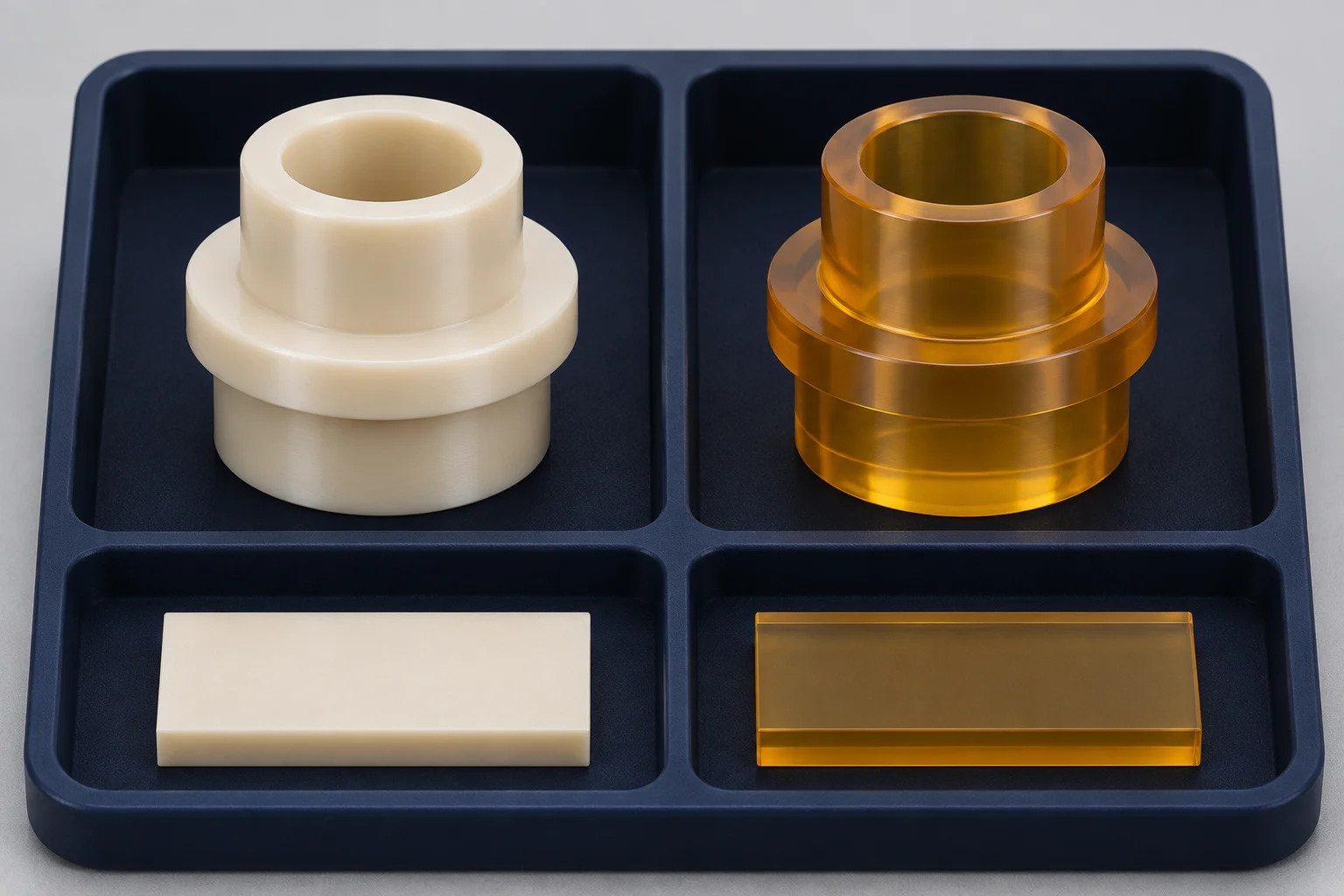
Label the candidate samples so their grades remain identifiable after machining. Keep photographs linked to sample numbers rather than relying on color alone. If one sample fails, record the condition and the affected feature before changing the design.
Repeat the relevant check after an approved geometry or process change. Otherwise, a successful revision can hide which change actually improved the result. Your approval record should describe the configuration you intend to reorder.
Define the sample's measurement condition and support arrangement. Record relevant preparation and temperature information. For flexible features, measuring force can influence what your report appears to show.
Use the machined-plastic measurement guide when agreeing that method. Compare both candidates using the same functional definition. A free-state measurement and an installed measurement should remain identifiable.
For exposure trials, agree the medium, duration, temperature and relevant acceptance checks. Measure what matters after the trial, not only before it. Retain observations of cracking, surface changes and fit where those affect the intended function.
Compare Total Accepted-Part Cost
You should compare costs for the same approved scope rather than assuming one polymer is always the economical choice.
Stock size and availability influence material yield and delivery planning. Geometry, tolerances and secondary processing influence machining effort. Inspection records and application-specific assessment can add further work.
Ask both quotations to identify the proposed grade and stock source. Include prototype quantity, repeat quantity and annual demand. A low quoted price may represent a different grade or omitted evidence.
Review the cost of replacement and downtime without inventing a universal service-life advantage. A material change can require new fixtures, assembly checks or approval work. Those costs belong in the comparison when they apply.
If neither candidate provides adequate evidence, pause the price comparison. Clarifying the specification can be more useful than negotiating an unsupported substitution. Keep alternate-grade approval explicit on the purchase order.
Confirm The Supply Scope With TOPS
You should request order-specific confirmation of material, machining and inspection requirements before releasing your drawing.
TOPS presents plastic machining services and engineering material information on this website. Those pages provide a starting point for discussing your component. They do not establish every stock grade's availability or every application approval.
Ask TOPS to confirm the proposed PPS or PEI designation, stock form and available documentation. Include special inspection, cleaning and packaging requirements. Confirm any confidentiality requirements before sharing sensitive drawings.
No customer case, certification, guaranteed tolerance or validated application result is claimed here. Your order should identify the evidence needed for its particular duty.
PPS Vs PEI FAQ
You should resolve these recurring questions before approving a material substitution.
Is PPS Always Better For Chemical Exposure?
No. PPS is a useful candidate, but compatibility depends on the grade and exposure. Review the actual medium, temperature and stress.
Is PEI The Same As PEEK?
No. PEI and PEEK are different polymer families. A similar-looking component or abbreviation does not establish interchangeable performance.
Does Amber Color Prove That A Part Is PEI?
No. Appearance can support identification, but it cannot replace a documented grade and traceable material supply.
Can I Replace Unfilled Stock With Glass-Filled Stock?
Only after a separate review. Reinforcement changes the candidate material and can affect machining, surface requirements and installed behavior.
Does A Flame Classification Approve My Assembly?
No. Verify the grade, test conditions and applicable component requirements. Material information does not automatically approve a finished assembly.
Which Material Machines More Accurately?
Neither has a universal accuracy advantage. Geometry, supplied stock, processing sequence and inspection conditions determine the achievable result.
Can Either Material Be Used For A Bearing?
Possibly, with a suitable grade and application review. Structural properties alone do not establish wear behavior against your counterface.
What Information Helps Compare Quotations?
Send the drawing, exact candidate grades, environment and quantities. Include critical tolerances, inspection evidence and any restrictions on substitution.
Request A Grade-Specific Material Review
You can choose PPS or PEI more confidently when both candidates face the same requirements. Compare chemical duty, loaded temperature and inspection evidence together. Keep stock identity and substitution approval visible throughout purchasing.
Contact us with your drawing, candidate grades, operating conditions and expected quantities. Include required documents and critical acceptance checks for a project-specific review.