Plastic stock selection for CNC machining should match the approved material, finished geometry and manufacturing plan. Rod, plate and tube offer different starting envelopes. The closest-looking blank is not automatically the best choice. Compare usable dimensions, machining access, verification and total order scope before buying material.
Start With The Finished Part And Approved Grade
You should select a stock shape only after defining the material specification and finished component requirements.
A convenient blank cannot compensate for an unsuitable polymer or an unapproved grade. Record the material designation, filler content and required documentation. Identify any restrictions on manufacturer, production route or substitution. Keep those requirements consistent across prototype and repeat orders.
Then define the finished envelope and functional features. A drawing should show the largest outside dimensions, internal openings and relevant datums. Include surface requirements and the final measurement condition. Your supplier needs those details before deciding what material must surround the finished shape.
The process discussion should connect stock selection to machining, inspection and quantity. A one-off prototype may justify a different purchasing arrangement from recurring production. The finished acceptance requirements still need to remain clear.
This guide provides a selection framework. It does not establish universal machining allowances, stock tolerances or available sizes for every grade.
Compare Rod, Plate And Tube Against The Part Envelope
You should compare candidate stock shapes by the usable material surrounding the complete finished geometry.
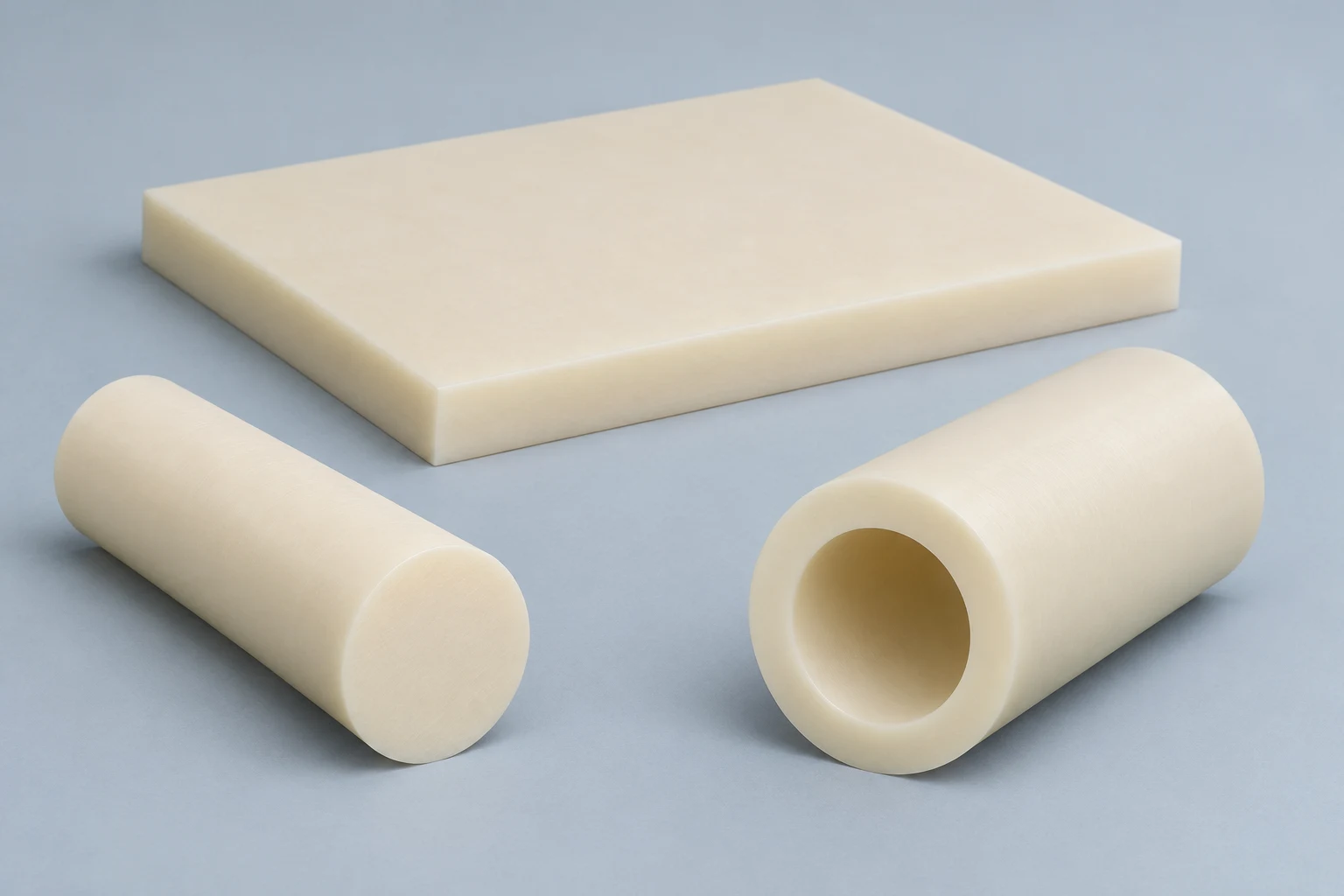
Rod provides a solid circular section. Plate provides a broad rectangular section. Tube already contains an internal opening. Those geometric differences affect the material you remove and the surfaces you must finish.
The Mitsubishi Chemical Group stock-shape portfolio lists rods, sheets, tubes and profiles. It also identifies near-net shapes for selected products. That portfolio description does not establish availability for your particular material, dimensions or delivery schedule. Obtain a grade-specific quotation before committing the design to a stock format.
| Finished Geometry | Candidate Starting Shape | Question To Resolve |
|---|---|---|
| Solid roller or cylindrical spacer | Rod | Is there usable diameter and length for machining and gripping? |
| Cover, mounting plate or rectangular block | Plate | Does the thickness support cleanup, workholding and the finished section? |
| Sleeve or open ring | Tube or rod | Does the available bore leave material for the required finished opening? |
| Deep housing with several machined faces | Plate, block or another approved blank | Which route provides practical access and stable support? |
| Repeating unusual geometry | Standard stock or qualified near-net blank | Does lower removal justify procurement and qualification work? |
Treat these as candidates rather than automatic recommendations. The drawing, grade and manufacturing review determine the actual route.
Choose Rod When The Solid Circular Section Helps
You should consider rod when a circular starting section suits the finished geometry and workholding approach.
A solid roller, stepped shaft-like component or cylindrical spacer may fit this route naturally. Compare the maximum finished diameter with the actual usable stock diameter. Include any flange, offset feature or later milling operation. A small noncircular feature can change the required starting envelope.
Review the length allocation separately. The finished length is not necessarily the cut blank length. Gripping, facing and separation may require additional material. Ask the supplier to explain the proposed allocation rather than adding an arbitrary allowance yourself.
If the part contains a large bore, compare the rod route with an available tube. Removing a solid center creates additional operations. However, a tube only helps when its grade and usable dimensions satisfy the complete drawing.
Do not assume the original rod surface can remain as a finished functional diameter. State when an as-supplied surface is permitted. Otherwise, include the required cleanup and inspection in the quotation.
Choose Plate When Flat Geometry And Nesting Matter
You should consider plate when rectangular geometry, broad faces or multiple nested blanks support the manufacturing plan.
Begin with the finished thickness and the surfaces requiring machining. Review whether material must be removed from one face or both. A supplied nominal thickness does not independently establish that every finished dimension can be achieved.
Then consider the layout across the plate. Allow space for cutting, tool access and holding each component. A layout that maximizes drawn rectangles may leave inadequate room for the actual process. Ask for a feasible blank plan rather than assuming an idealized nesting diagram represents production yield.
Review whether the part requires a continuous material direction. For a directional grade, rotating alternate parts to improve nesting may require approval. Keep orientation identification with the cut blanks where it matters.
For long or flexible blanks, discuss support during machining and measurement. The finished geometry should be checked in the specified state. Forcing a blank flat during processing can conceal a different free-state condition.
Choose Tube Only When Its Bore Supports The Drawing
You should consider tube when its existing opening and outside envelope leave suitable material for every required feature.
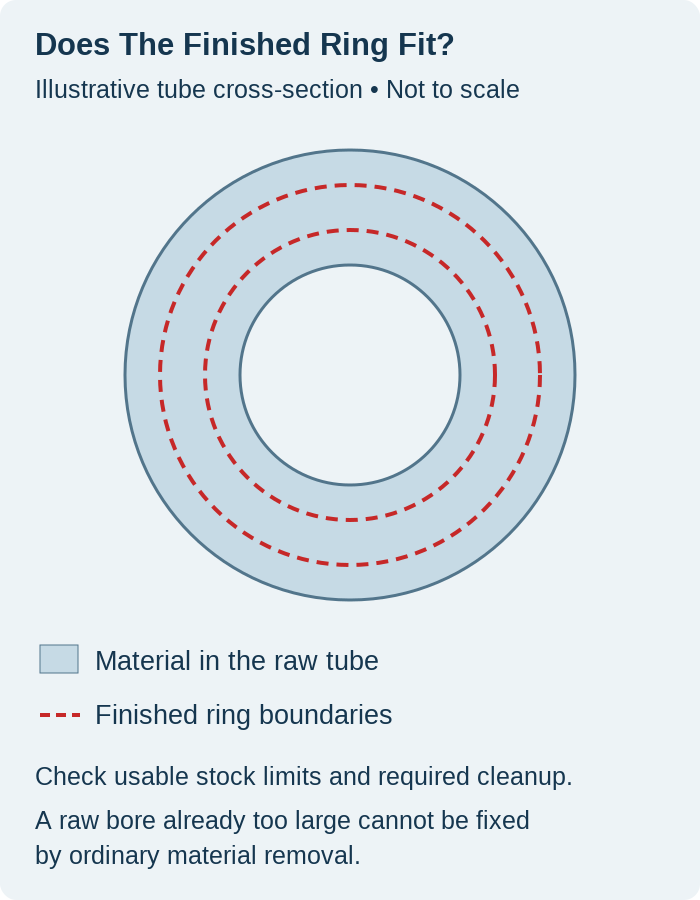
Compare the available outside diameter, inside diameter and length with their supplied tolerances. Then compare them with the finished drawing. Include wall variation, cleanup and any required relationship between the finished bore and outside surface.
An existing opening can reduce center removal, but it can also limit your options. A bore that is already too large cannot be corrected by ordinary material removal. Likewise, an offset feature may require more wall than the nominal tube section suggests.
Review clamping and support before choosing a thin-walled blank. A tube can respond differently to holding pressure than a solid rod. The proposed process should address the required final geometry without relying on excessive restraint.
Keep the distinction between a raw tube and a qualified finished sleeve. Supplied dimensions do not automatically satisfy finished roundness, wall, surface or alignment requirements. Agree which surfaces remain supplied and which receive machining.
Confirm Usable Dimensions Instead Of Buying By Nominal Size
You should compare the finished envelope with the minimum usable stock condition defined by the supplier's actual specification.
Nominal size is a purchasing description, not a complete machining plan. Obtain the applicable dimensions and tolerances for the exact product. Ask about straightness, flatness, cut condition and relevant surface limitations. Do not substitute assumptions from metal stock or a different polymer supplier.
Create an allowance review for each necessary direction. Include surface cleanup, cutting loss, gripping and any process steps that change the available envelope. The allowance should have a stated purpose. Excess material can add purchasing and machining work without resolving the original concern.
| Review Item | Information To Obtain | Purchasing Consequence |
|---|---|---|
| Supplied dimensions | Applicable minimum and maximum conditions | Determines whether the finished envelope fits |
| Cut blank | Length, width, cut condition and identification | Defines what arrives at machining |
| Workholding | Required grip or support arrangement | May change blank size or setup count |
| Surface cleanup | Surfaces requiring removal and acceptance | Prevents reliance on unsuitable supplied faces |
| Internal opening | Actual bore range and usable wall | Determines whether tube remains a viable candidate |
| Documentation | Grade, batch and approved product identity | Keeps the material route traceable |
For critical features, have the machinist review the proposed blank before material is ordered. An early drawing review can expose an unusable size combination.
Review Production History And Direction Where Relevant
You should consider how the stock was produced when that history could affect the finished component.
Ensinger's machining guidance explains that extrusion can introduce internal stress and orient reinforcement. It also discusses stress reduction and material-dependent processing. These points justify reviewing stock history; they do not prove that any specific blank will distort or fail.
Ask which production route and material condition apply to the quoted product. Do not assume two blanks are interchangeable because their polymer names and nominal dimensions match. Review any drawing restrictions before accepting a substitution.
Where direction matters, identify it on the stock and preserve that identification through cutting. Discuss the relationship between that direction and critical finished features. Avoid introducing an orientation requirement without a functional basis or relevant material information.
If stress treatment is proposed, obtain a material-specific process basis and define when dimensions will be finished. Our plastic annealing guide explains that separate review. This article does not prescribe a heating cycle or require additional annealing for every order.
Connect Stock Removal To The Machining Sequence
You should review the amount and distribution of material removal alongside the chosen blank.
Two stock routes can reach the same nominal finished outline through different sequences. Compare access to pockets, bores and opposite faces. Identify when the part becomes flexible and how it will remain supported. Keep the final measurement condition visible during that discussion.
Ensinger's guidance identifies one-sided removal and machining heat among dimensional-stability concerns. For your component, ask how the proposed roughing and finishing sequence addresses the relevant risks. A larger blank does not independently resolve an unsuitable process.
Review which operations establish the critical datums. Moving between turning and milling may require additional location features or setups. Include those needs when comparing a round blank with a rectangular alternative.
Our CNC turning versus milling guide explains the process-selection discussion. Keep the stock decision connected to the approved drawing. Do not change a functional feature merely to accommodate material already purchased.
Preserve Identity From Stock Receipt To Finished Inspection
You should retain the material identity and relevant stock information as blanks move through production.
Define the required records before ordering. Depending on the application, these may identify the product grade, supplier and material batch. Request the actual documentation your order needs. A generic catalogue sheet is not the same as an order-specific record.
Agree how identity will follow smaller cut pieces. A label on the original plate may no longer accompany every blank. Define an appropriate marking or traveler arrangement without damaging functional surfaces. Keep mixed grades and unidentified remnants out of the approved material stream.
At receipt, compare the delivered stock with the purchase specification. Verify the agreed dimensions, identification and supplied condition. Resolve discrepancies before machining removes evidence or adds value to unsuitable material.
Finished inspection remains a separate requirement. Passing a stock receipt check does not establish finished dimensions or application performance. Retain both records when the order requires traceability through the manufacturing route.
Compare Total Accepted-Part Cost Across Stock Routes
You should compare stock options by the complete cost and delivery scope of acceptable finished parts.
The lowest price per kilogram does not identify the lowest finished-part cost. Compare purchased blank quantity, usable yield and necessary machining operations. Include setups, inspection, documentation and the handling of leftover material. Ask whether quotation quantities represent stock pieces, finished parts or an entire supply lot.
For tube, compare any reduced center removal with purchase availability and required finishing. For plate, review realistic nesting rather than theoretical area utilization. For rod, include the complete length allocation and any additional milling.
Near-net shapes deserve consideration only when the complete commercial case supports them. Review minimum purchase quantities, preparation work, lead time and change control. A special blank may be less convenient when the design changes frequently.
Avoid promising savings before quotations exist. Compare equivalent material grades and finished acceptance requirements. Otherwise, an apparent stock saving may reflect a different product or incomplete manufacturing scope.
Agree The Stock Route Before Releasing Production
You should record the selected stock route and substitution rules with the approved manufacturing scope.
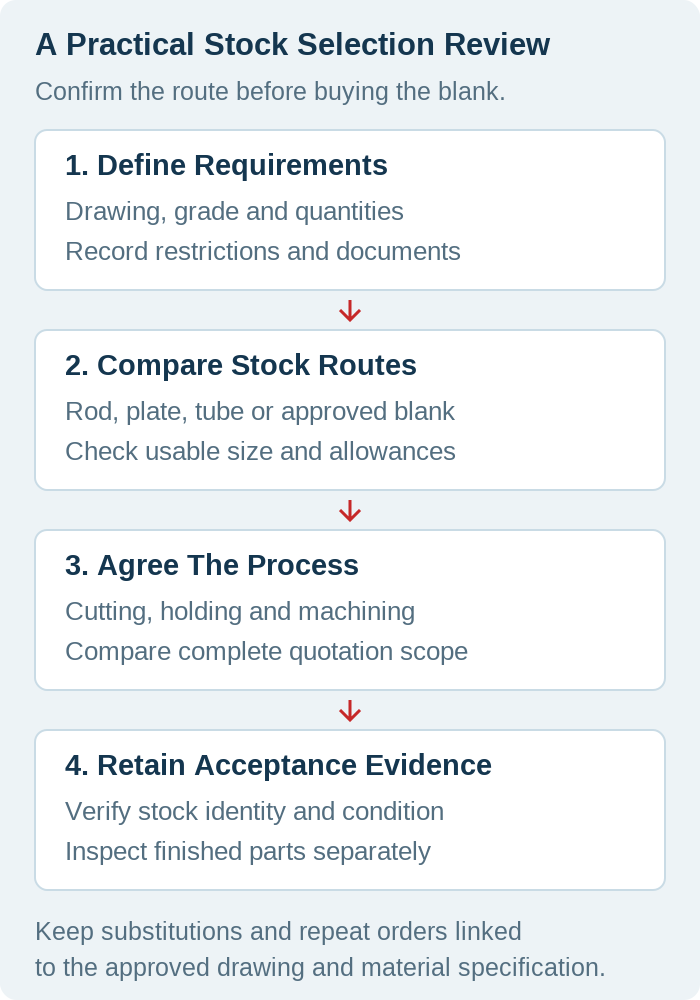
Use a short review sequence to connect engineering and purchasing decisions:
- Confirm the finished drawing, grade and documentation requirements.
- Compare rod, plate, tube and any qualified alternative.
- Check usable dimensions, allowances and material direction.
- Review cutting, workholding, machining and inspection.
- Compare equivalent quotations and delivery conditions.
- Approve the route and control subsequent substitutions.
Ask TOPS to confirm feasibility for your particular drawing and order quantities. The website offers custom plastic machining, but this article does not verify current stock inventory. It also does not establish a specific inspection capability, certification or guaranteed tolerance. Those requirements need order-specific confirmation.
State prototype quantity, repeat quantity and annual demand. Identify whether you will supply the material or purchase finished parts. For confidential designs, agree the sharing arrangements before sending restricted files. Keep the selected route linked to the drawing revision.
Plastic Stock Selection FAQ
You should resolve these purchasing questions before committing to a blank format or accepting a material substitution.
Is Rod Always The Best Starting Point For Round Parts?
No. A sleeve may justify tube, while other features may favor another blank. Compare the complete envelope and machining plan.
Does Tube Automatically Produce A Cheaper Sleeve?
No. Availability, usable wall, finishing and purchase quantity affect the comparison. Obtain equivalent quotations before claiming a saving.
Can Nominal Plate Thickness Equal Finished Thickness?
Possibly, if the supplied condition and drawing permit it. Confirm applicable tolerances and whether either face requires machining.
Can I Use The Same Allowance For Every Polymer?
Do not assume so. The allowance depends on supplied dimensions, finished geometry, workholding and the material-specific manufacturing plan.
Are Identically Named Grades Always Interchangeable?
No. Confirm the actual product specification, documentation and any production-route restrictions before approving a substitute.
Should Every Blank Receive Additional Annealing?
No universal requirement applies here. Review the supplied condition, material guidance and component needs with the responsible supplier.
Can I Rotate Blanks To Improve Plate Yield?
Only when the material and drawing allow it. Preserve any required direction and review the proposed nesting plan.
What Should A Stock-Selection RFQ Include?
Provide the drawing, approved grade, quantities and documentation requirements. Identify any mandatory stock route, direction and customer-supplied material.
Request A Drawing And Stock Review
You can choose a better starting blank by reviewing grade, usable envelope and machining sequence together. Compare complete quotations and preserve material identity. Confirm the route before purchasing stock, then control changes against the approved drawing.
Contact us with your drawing, material specification and quantities. Include annual demand, inspection requirements and any restrictions on stock shape or substitution.